



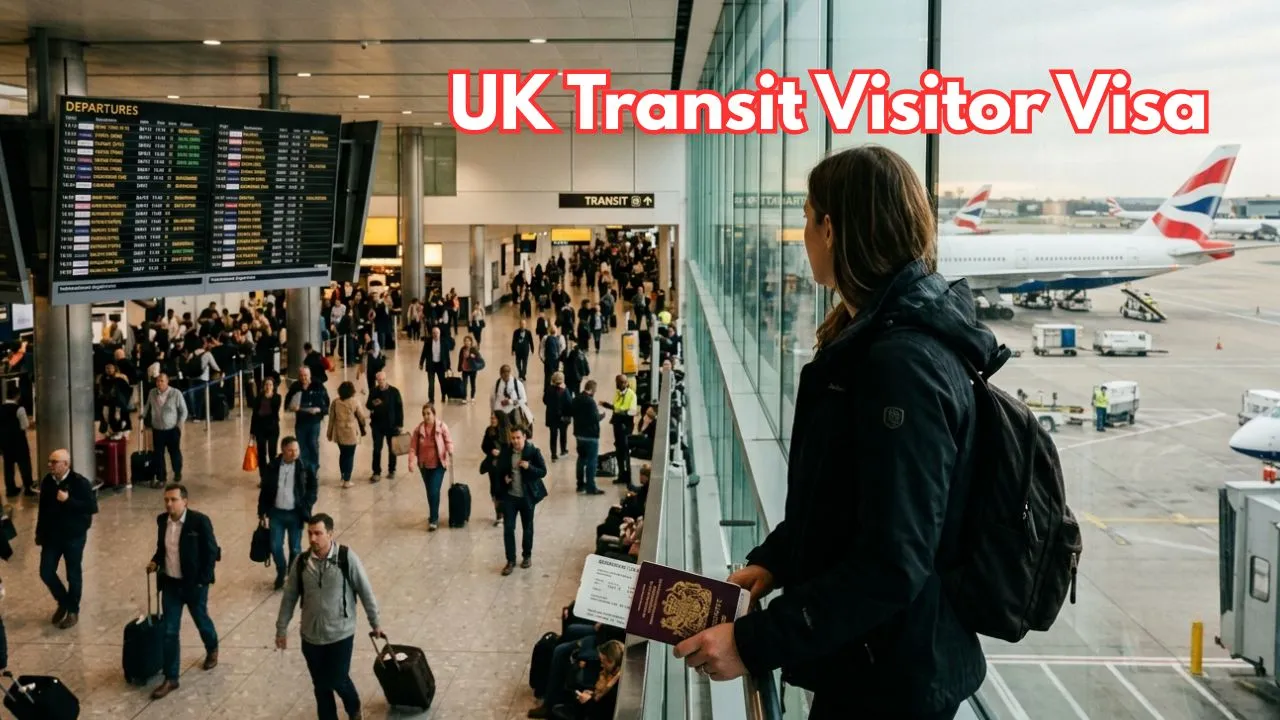

Real stories from the arrivals hall, and the rules behind them — who needs a UK transit visitor visa, who’s exempt, what it costs, and how not to get stuck at the border.
Terminal 5, just gone six in the morning. A man from Lagos stands at the transfer desk, boarding pass for Toronto in one hand, passport in the other, and no idea he needed anything else. His connection is four hours away. It will not be enough time. He is not entering the UK to see it — he barely wants to. He is just trying to get from one plane to another. But the UK border does not see it that way, and neither does the airline that will not let him board without the right paperwork. This scene, or some version of it, plays out most mornings at every major UK hub. It is, more than anything else, a story about a piece of paper nobody thought they’d need.
That piece of paper is the UK Visitor in Transit Visa — or, depending on the journey, its close cousin, the Direct Airside Transit Visa. Most travellers who need one don’t find out until they’re already at check-in, boarding pass in hand, being told by a gate agent that they can’t fly. That’s the sharp end of a system that, on paper, is fairly simple. In practice, it trips people up constantly.
This guide sets out exactly what a UK transit visitor visa is, who actually needs one, what it costs in 2026, how long it takes, and — because this is the part most guides skip — where people go wrong. Along the way there are a few real-world scenarios, the kind any experienced immigration adviser or airport officer would recognise instantly.
What Is a Visitor in Transit Visa UK?
A Visitor in Transit Visa is permission to pass through UK border control briefly, on your way somewhere else, for no longer than 48 hours. It is not a visit visa in the tourism sense — you’re not meant to see London, meet friends, or do business. You’re meant to land, get through immigration, and leave again on a confirmed onward flight.
It sits alongside a second, cheaper option: the Direct Airside Transit Visa, or DATV. The difference between the two comes down to one question — do you pass through UK border control, or not?
- Direct Airside Transit Visa (DATV). For travellers changing flights at the same airport without leaving the international transit zone. No entry to the UK, no border control. Valid up to 24 hours.
- Visitor in Transit Visa. For travellers who must pass through UK border control — to collect checked luggage, change airports, check in separately for an onward flight, or stay overnight. Valid up to 48 hours.
Neither of these is a substitute for a Standard Visitor visa. If your stopover is genuinely just a stopover, transit is the right category. If you’re stepping out to a hotel for two nights or popping into central London between flights, that’s a visit, not a transit — and it needs a different visa entirely.
DATV vs Visitor in Transit Visa: Quick Comparison
| Feature | Direct Airside Transit Visa | Visitor in Transit Visa |
| Passes UK border control? | No — stays airside | Yes — enters the UK briefly |
| Maximum stay | 24 hours | 48 hours |
| Cost (from 8 April 2026) | £41.50 | £74.50 |
| Used for | Same-airport connections, no luggage collection | Airport changes, luggage collection, overnight stops |
| Counts as entering the UK? | No | Yes, technically — but for a very short window |
Visitor in Transit Visa UK on Arrival: Can You Get One at the Airport?
A young couple from Bangladesh once turned up at Heathrow believing, quite genuinely, that the transit visa was something sorted “at the desk” — like a landing card, or a stamp. They’d read somewhere that transit was different, easier, informal. It isn’t. The airline had already flagged the booking before they’d even boarded in Dhaka. They never got on the first flight.
There is no such thing as a Visitor in Transit Visa UK on arrival for the vast majority of travellers. Both the Visitor in Transit Visa and the DATV must be applied for online, from outside the UK, before you travel. There is no walk-in service, no same-day counter application, and no way to sort it out once you’ve landed. The application has to be submitted through the official UKVI portal, followed by a biometric appointment at a visa application centre — which, depending on where you live, might itself be in a different city or country.
There is one narrow exception worth knowing about: the Transit Without Visa (TWOV) scheme. It allows certain passengers to pass through UK border control without a visa, provided they meet strict conditions — a specified onward booking, particular documents from countries like the US, Canada, Australia, or an EU member state, and continuing their journey on the same day. Even then, the decision is made by a Border Force officer at the point of arrival, not guaranteed in advance. Relying on TWOV for anything important is a gamble, not a plan.
Who Needs a UK Transit Visitor Visa — and Who’s Exempt?
Whether a transit visa applies to a given traveller depends on nationality first, and travel plans second.
Likely to need a DATV or Visitor in Transit Visa UK
Nationals of a long list of countries — including Afghanistan, Eritrea, Ethiopia, Ghana, Iran, Iraq, Nigeria, Pakistan, Somalia, and Sri Lanka, among others set out in the Immigration (Passenger Transit Visa) Order 2014 — are classed as visa nationals for transit purposes. Some of these countries appear on the DATV list specifically, meaning even a same-airport, airside-only change of planes requires a visa in advance.
Usually exempt
- Non-visa nationals such as citizens of the US, Canada, Australia, New Zealand, and most EU member states, are generally exempt from transit visas, though most now need a UK Electronic Travel Authorisation (ETA) for landside transit.
- Holders of a valid Standard Visitor visa can use it in place of a separate transit visa — no need to apply twice.
- Holders of certain US, Canadian, Australian, or New Zealand visas are often exempt from the DATV requirement specifically, provided the airline can verify the document electronically.
- Some seafarers travelling on duty with a valid seaman’s book are exempt from transit visa requirements altogether.
Compare two passengers on the same Lagos-to-Toronto route, both changing planes at Heathrow. One holds a valid ten-year US visitor visa; she walks through the transit lounge without a second glance from anyone. The other, travelling on the same Nigerian passport with no such document, needed a DATV weeks ago and didn’t get one. Same nationality, same airport, same four-hour gap between flights — entirely different outcome. That’s the part that catches people out: it’s rarely just about where you’re from. It’s about what you’re carrying, too.
Because rules shift — Home Office guidance notes that requirements for several nationalities changed within the last year alone — the only reliable source is the official checker at gov.uk/check-uk-visa, used fresh, every single time a trip is booked.
How to Apply for a UK Visitor in Transit Visa?
The process is broadly the same whether applying for a DATV or a Visitor in Transit Visa — the online system determines which applies based on the answers given.
- Check eligibility first. Use the gov.uk checker, select the correct nationality, choose “Transit,” and confirm whether border control will be crossed.
- Complete the online application. All answers must be in English, covering personal details, travel plans, and the onward journey.
- Pay the visa fee. Payment is taken online at the point of application and is non-refundable, whatever the outcome.
- Book a biometric appointment. Fingerprints and a photograph are taken at a visa application centre (VAC) — sometimes in a different city to where the applicant lives.
- Submit supporting documents. Passport, confirmed onward flight, and proof of permission to enter the final destination country, where relevant.
- Wait for a decision. Standard processing runs around 15 working days from the biometric appointment — roughly three weeks — though priority services can shorten this considerably.
- Receive the outcome. Approved applications get either a vignette sticker in the passport or a digital record accessible online, depending on the applicant’s location.
There is no version of this process that can be started from inside the UK. It has to be sorted before departure, in the country of residence or wherever the applicant happens to be travelling from.
Visitor in Transit Visa UK Cost (in 2026)
A family of four once budgeted carefully for their transit stop — flights, meals, the lot — and still got caught out, because nobody had told them the transit visa fee applied per person, not per booking. Four separate applications, four separate fees, four separate biometric appointments. It wasn’t the cost that stung so much as not seeing it coming.
Home Office fees rose on 8 April 2026, alongside most other UK visa categories. The current published rates are:
| Visa type | Cost (per person) | Notes |
| Direct Airside Transit Visa (DATV) | £41.50 | May vary slightly by country of application |
| Visitor in Transit Visa | £74.50 | May vary slightly by country of application |
| Priority service (where available) | +£500 | Decision typically within 5 working days |
| Super priority service (where available) | +£1,000 | Next-working-day decision, limited locations |
Fees are non-refundable if an application is refused or withdrawn — that applies to the standard fee and, generally, priority fees too, unless UKVI itself fails to meet the published timescale. Budget for the full amount before applying, not the amount hoped for.
Visitor in Transit Visa UK Processing Time
Most Visitor in Transit Visa and DATV applications are processed within about 15 UK working days — roughly three weeks — counted from the date of the biometric appointment, not the date the online form is submitted. That distinction matters. A rushed application submitted the week before travel, with a biometric appointment two weeks out, is already too late for standard processing.
An immigration officer at Manchester once described the same conversation happening on repeat: a traveller stood at the desk insisting their flight was “only next week,” as though urgency alone could speed up a government process. It can’t. The clock starts at the biometric appointment, not at the moment of panic.
- Standard processing: around 15 working days after biometrics.
- Priority service: around 5 working days, where available, for an extra £500.
- Super priority: next working day in limited locations, for an extra £1,000.
- Peak season delays: summer and the run-up to Christmas routinely push processing times beyond the standard window.
The safe rule of thumb, echoed by nearly every immigration adviser working this route: apply as soon as travel dates are confirmed, not as soon as convenient.
Documents Needed for a UK Transit Visitor Visa Application
Requirements vary slightly by visa type, but most applications need to show:
- A valid passport with at least one blank page.
- Confirmed onward flight booking or ticket, departing within 24 or 48 hours depending on visa type.
- Proof of permission to enter the final destination country — a visa, residence permit, or passport of that country, if the applicant isn’t a national or resident there.
- Evidence of genuine transit intent — a plausible route, consistent with how people actually travel between the two countries in question.
- Sufficient funds to cover the brief stay, where requested.
Travel or health insurance isn’t mandatory for transit, but experienced advisers still recommend it — a missed connection or medical issue during even a 48-hour window can get expensive fast without it.
Common Pitfalls at the Border — Real Scenarios
A Ghanaian engineer, connecting through Gatwick on his way to a conference in Brazil, held a valid DATV — but his booking required a change of terminal that meant crossing border control, however briefly. A DATV doesn’t cover that. He needed a Visitor in Transit Visa instead. Nobody had explained the difference to him when he applied, and by the time an officer caught the mismatch, his outbound flight to Brazil had already closed.
A few patterns come up again and again:
- Wrong visa type. Applying for a DATV when the journey actually requires passing through border control — often because the traveller assumed all transit stops work the same way.
- Overstaying the window. Treating 48 hours as roughly two days, rather than a hard 48-hour limit from arrival, and missing it by a matter of hours.
- No proof of onward permission. Arriving without evidence of the right to enter the final destination country, especially for third-country nationals travelling somewhere they don’t hold citizenship or residence.
- Leaving it too late. Applying days before travel and assuming standard processing will somehow be expedited without paying for priority.
- Assuming exemption. Believing a previous, uneventful transit through the UK means the same rules still apply — when in fact the requirement changed in the meantime.
None of these are exotic mistakes. They’re ordinary, understandable assumptions made by people who transit through dozens of countries a year and reasonably expect the rules to be similar everywhere. The UK’s transit system just isn’t built that way.
Transit Visitor Visa UK vs Standard Visitor Visa: Which Do You Need?
Sometimes the line between transit and a genuine visit blurs, and picking the wrong category causes more problems than paying slightly more would have.
| Situation | Correct visa |
| Changing planes at the same airport, staying airside, under 24 hours | Direct Airside Transit Visa |
| Passing through border control briefly, leaving within 48 hours | Visitor in Transit Visa |
| Layover longer than 48 hours, for any reason | Standard Visitor visa |
| Planning to leave the airport to sightsee, shop, or meet someone | Standard Visitor visa |
| Already holding a valid Standard Visitor visa for another purpose | No separate transit visa needed |
As a rule: if there’s any doubt about the timing or the plan, the Standard Visitor visa is the safer, more flexible option — it covers transit and considerably more, for a higher fee but with far less risk of falling foul of a technicality.
Frequently Asked Questions (FAQs)
Q. What is a Visitor in Transit Visa UK?
It’s permission to pass briefly through UK border control, for up to 48 hours, while travelling between two other countries. It doesn’t permit tourism, work, or an extended stay.
Q. Can I get a Visitor in Transit Visa UK on arrival?
No, not for most travellers. It must be applied for online and approved before departure. The narrow Transit Without Visa (TWOV) scheme is the only border-decided exception, and it isn’t guaranteed.
Q. How much does a Visitor in Transit Visa UK cost?
From 8 April 2026, it costs £74.50. The Direct Airside Transit Visa costs £41.50. Priority processing adds £500; super priority adds £1,000, where available.
Q. How do I apply for a Visitor in Transit Visa UK?
Check eligibility on gov.uk, complete the online application, pay the fee, attend a biometric appointment at a visa application centre, and wait for a decision — usually around 15 working days after biometrics.
Q. What is the processing time for a UK transit visitor visa?
Around 15 UK working days (roughly three weeks) from the biometric appointment under standard processing, with faster paid options available in many locations.
Q. Do I need a transit visa if I already have a UK Standard Visitor visa?
No. A valid Standard Visitor visa can be used instead of a separate transit visa for the same trip.
Final Thoughts
Every transit visa refusal starts the same way — someone assumed. Assumed the rules were the same as last time. Assumed a stopover this short couldn’t possibly need paperwork. Assumed the airline would sort it at the gate. Almost none of these assumptions hold up, and the UK border is not a place that extends the benefit of the doubt to a missed form.
The practical advice, from anyone who’s watched this play out at a check-in desk, is dull but reliable: check the requirement fresh for every trip, apply the moment travel dates are confirmed, and choose the visa type that actually matches the journey rather than the one that sounds simplest. A UK transit visitor visa is a small, unglamorous piece of paperwork — right up until the moment it’s the only thing standing between a traveller and their connecting flight.
Disclaimer:
UK Visa Consultant is affiliated with regulated immigration professionals with years of hands-on experience in successful UK visa applications. We closely monitor UKVI/Home Office updates and use only official guidance and sources. The information provided in this blog is subject to change depending on UK immigration laws and policies. It is recommended to stay updated regarding such changes and confirm the details through an official source before proceeding further. Our priority is unwavering accuracy and user trust. Here’s how you can maximize your success:
- Always rely on updates from the UK Government, the Home Office, and regulated immigration advisors.
- Keep up with the latest changes (e.g., digital eVisas, new sponsor requirements, post-Brexit rules).
- If in doubt, consult directly with an accredited UK immigration solicitor or OISC advisor.
- Ensure documentation, financials, and employment/education offers are fully compliant.
- Avoid scams and unregulated agents—your application’s credibility is paramount.
- Our consultants undergo regular professional development, maintain GDPR-compliant data handling, and provide transparent, ethical advice.





Leave a Reply
You must be logged in to post a comment.