



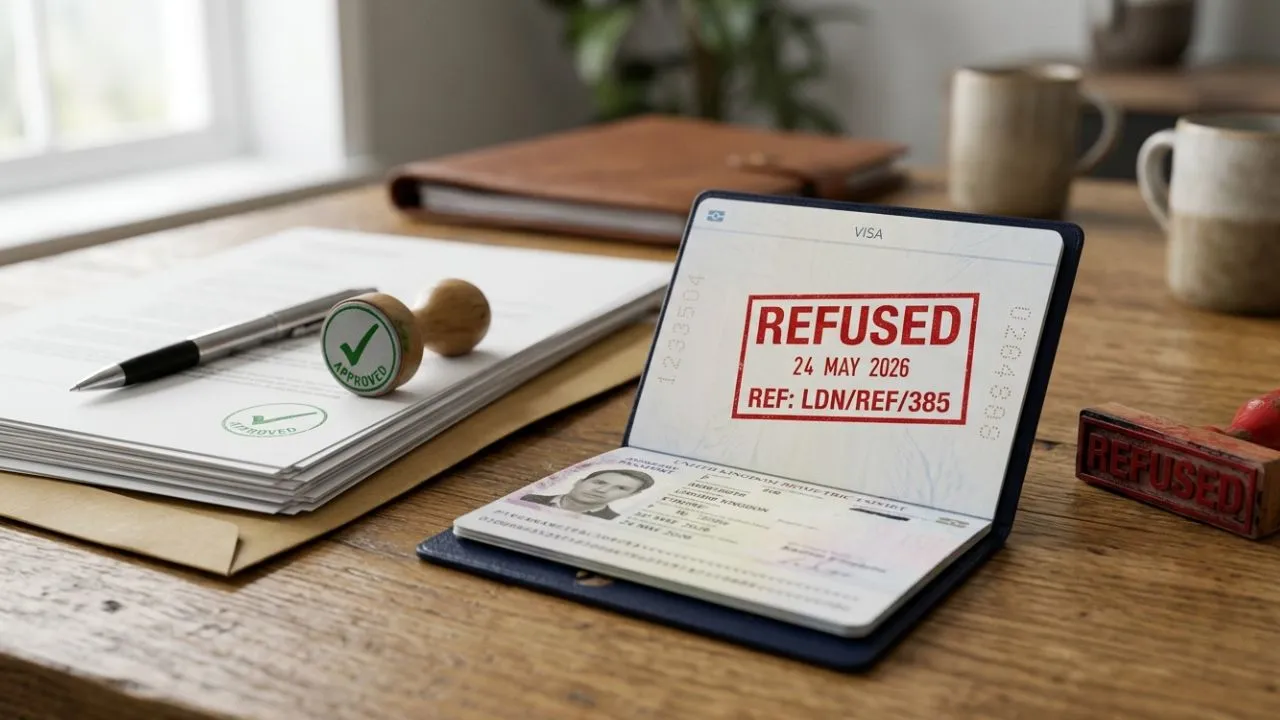

I want to say this first, before anything else: a UK visit visa refused isn’t a verdict on you as a person. I sat on the other side of that desk for years. Refusals are, more often than not, about paperwork, phrasing, and gaps in evidence — not about who you are. I know that’s cold comfort at 2am when you’re staring at a refusal letter and a non-refundable flight. But it matters, because the way forward starts with understanding that this can genuinely be fixed.
This guide walks through exactly what to do next after your UK visa gets refused — what your real options are, why ‘appeal’ doesn’t mean what you probably think it means for a visit visa, what happens if you’ve now been refused twice, and how to build a reapplication that actually stands a chance. Step by step. No jargon you don’t need.
What If Your UK Visit Visa Refused? First — Breathe. A Visit Visa Refusal Is Not the End of the Road
I know it feels final. It isn’t. Thousands of people are refused a UK visit visa every month, and thousands successfully travel to the UK a few months later on a stronger, better-evidenced application. What separates the two groups almost every time isn’t luck. It’s whether they actually read and responded to the refusal letter, rather than just resubmitting the same thing and hoping.
So the very first thing — before you panic, before you blame the airline, before you assume you’ll never get in — is to slow down and read.
Read Your Refusal Letter Like Your Future Depends On It
Because, in a real sense, it does. Every UK visit visa refusal comes with a written explanation from the Entry Clearance Officer, and that document is the single most valuable thing you now own. It tells you, in the ECO’s own words, exactly what didn’t convince them.
- Read it more than once. Refusal letters are often dense and formulaic, but every paragraph is doing a job.
- List out each individual reason separately — most refusals cite two or three distinct concerns, not just one.
- Check the final section for wording about appeal rights or administrative review rights. It will say clearly whether either applies to your case.
- Note the date on the letter, not the date you opened the email. Any deadlines run from there.
From experience: applicants who skim the letter and go straight to reapplying almost always repeat the same mistake. Applicants who go through it line by line, and answer every single line, are the ones who come back and succeed.
Can You Actually Appeal a UK Visit Visa Refusal?
Here’s the bit that surprises almost everyone, and it’s worth being straight with you about it: for the vast majority of Standard Visitor visa refusals, there is no right of appeal, and no administrative review either. That’s simply how the Immigration Rules were written. Visit visas are treated as short, temporary permissions, and the Home Office’s position is that a fresh, corrected application is the appropriate remedy — not a tribunal hearing.
There are narrow exceptions. You may have a right of appeal if your refusal genuinely engages human rights (for example, a case with a strong Article 8 family life element) or involves a discrimination claim. Administrative review is occasionally available for specific visitor sub-categories, such as certain S2 healthcare visitor decisions, but not for the ordinary tourism, business or family-visit refusal that most people are dealing with.
- Your refusal letter will state clearly whether you have appeal or AR rights — if it doesn’t mention either, you don’t have them.
- No mention of appeal rights = your realistic options are reapplication or, in rare cases, Judicial Review.
- Don’t let anyone charge you for an ‘appeal’ on a standard visit visa refusal without checking your letter first. It’s a route that, for most people, simply doesn’t exist.
UK Visit Visa Refused, Now What are Your Real Options — At a Glance
| Option | Available for Visit Visas? | Cost | What it actually does |
|---|---|---|---|
| Right of Appeal | Rare — human rights/discrimination cases only | £80 (paper) / £140 (oral) | Independent judge reviews the decision, new evidence allowed |
| Administrative Review | Rare — only specific sub-categories | £80, refunded if overturned | Home Office checks its own decision for a caseworker error |
| Fresh Application | Yes — the standard route for almost everyone | Full visa fee again | You address every refusal reason and reapply properly |
| Judicial Review | Technically yes, rarely worth it | £1,000s in legal costs | Court checks if the decision was lawful, not whether it was right |
What to Do If Your UK Visit Visa Is Refused — Step by Step
- Read the refusal letter fully and list every reason given, separately, in your own words.
- Check explicitly for appeal or administrative review rights — don’t assume either way.
- Gather the documents that directly answer each concern raised, not just ‘more of the same’ evidence you already submitted.
- Write a short cover letter for your reapplication that walks through each refusal reason and shows, point by point, how it’s now resolved.
- Recheck your dates, your itinerary, and your stated purpose of visit for consistency across every document — inconsistency is one of the biggest silent killers of a reapplication.
- Submit the fresh application with fresh, current bank statements and letters — dated close to the new submission, not recycled from the refused one.
- If a genuine legal error was made and no appeal or AR route exists, take advice on whether Judicial Review is realistically worth pursuing — for most visit visas, it isn’t.
The Most Common Reasons UK Visit Visas Get Refused
Having seen these refusal letters myself, I can tell you the same handful of issues come up again and again. Almost every refusal fell into one of these buckets.
- Weak ties to your home country — the ECO isn’t convinced you’ll leave the UK at the end of your visit. Thin evidence of a job, a lease, a business, or family responsibilities back home all feed this doubt.
- Unclear or unexplained finances — large, unexplained deposits, patchy statement history, or funds that appear from nowhere just before applying, all raise red flags.
- Vague or generic purpose of visit — no real itinerary, a copy-paste invitation letter, or a stated reason for travel that doesn’t match the length or timing of the trip.
- Inconsistencies across the application — dates that don’t line up, a job title on the form that doesn’t match the employer’s letter, a sponsor’s income that doesn’t add up.
- Previous immigration history concerns — a past overstay, a refusal from another country, or an unexplained gap in travel history.
- Insufficient sponsor or inviter evidence — for family and friend visits, a UK-based sponsor’s own finances and status often need to be evidenced just as carefully as the applicant’s.
None of these are unfixable. Every single one of them is a documentation and clarity problem, not a character judgment — which is exactly why a well-built reapplication so often succeeds where the first attempt didn’t.
UK Visit Visa Refused Twice? Here’s What Actually Changes
If this is your second refusal, I understand the frustration is a different level entirely. But let’s be honest and practical about what’s really going on, because pretending it’s ‘just bad luck twice’ won’t help you.
Two refusals on file means the next Entry Clearance Officer will read your case with a bit more scepticism, not less. It’s simply how credibility assessments work — a repeated pattern of unresolved concerns starts to look, to a caseworker, like something more entrenched than a one-off paperwork gap. That doesn’t mean you’re doomed. It means the bar for your third application is genuinely higher, and a half-hearted resubmission is far more likely to fail again.
- Get your first refusal letter and your second refusal letter out, side by side. Are the same reasons repeating? That’s your answer as to what genuinely still needs fixing.
- If the same concern has come up twice, do not submit a near-identical document set a third time. It will very likely be refused a third time, for the same reason.
- Consider whether the underlying story — your travel history, your finances, your ties — genuinely needs to change before you reapply, not just the paperwork describing it.
- If you believe both refusals were legally flawed and based on the same unlawful or unreasonable grounds, this is one of the few scenarios where Judicial Review starts to become a genuinely realistic conversation, rather than a theoretical one.
This is also, honestly, the moment I most often recommend people get a second pair of professional eyes on their case — not because you can’t do it yourself, but because after two refusals, you’re too close to your own paperwork to spot what’s still missing.
How to Build a Reapplication That Actually Works After UK Visit Visa Refusal?
A stronger reapplication isn’t about submitting more paper. It’s about submitting the right paper, aimed precisely at what was said in your refusal letter.
Address Every Single Refusal Reason, Not Just the Main One
If your letter lists three concerns and you only fix two, you will very likely be refused again — for the one you left standing. Go through it point by point.
Write a Short, Clear Cover Letter
A one-page cover letter that says ‘here is refusal reason one, and here is the document that resolves it’ does more for your case than almost anything else you can submit. It shows the ECO you understood the concern and answered it directly, rather than hoping the volume of paperwork speaks for itself.
Match Your Evidence to Your Story
| If your refusal cited… | Strengthen your reapplication with… |
|---|---|
| Unclear finances | 6 months of consistent bank statements, a covering letter explaining any large transactions, payslips, or an accountant’s letter if self-employed |
| Weak ties to home country | Employment confirmation letter, property or tenancy documents, evidence of ongoing study, or family responsibilities |
| Vague purpose of visit | A clear day-by-day itinerary, confirmed accommodation, return flight booking, and a specific (not generic) invitation letter |
| Sponsor/inviter concerns | The sponsor’s own bank statements, proof of their UK immigration status, and a signed letter confirming the relationship and support offered |
Keep Everything Current
Recycled documents from your refused application are one of the most common — and most avoidable — mistakes. Bank statements, employer letters, and invitation letters should all be dated close to your new submission, not simply reused.
When Judicial Review Is (and Isn’t) Worth It for a Visit Visa
I’ll be blunt here, because too many people are sold this option without being told the full picture. Judicial Review challenges whether a decision was made lawfully — not whether it was the right decision on the facts. It cannot introduce new evidence. It is expensive, slow, and for a short visit visa, the legal costs will very often exceed the value of the trip itself.
- Worth genuinely considering: repeated refusals on the same unlawful or clearly unreasonable grounds, or a decision that ignored evidence you can prove was submitted.
- Rarely worth it: a straightforward refusal over finances or ties, where the honest fix is simply better evidence, submitted through a fresh application.
- Always get a specialist immigration solicitor’s view before committing to Judicial Review — the pre-action protocol stage alone often resolves genuine errors without ever reaching court.
How Long Should You Wait Before Reapplying, After a UK Visit Visa Refusal?
There’s no mandatory waiting period, and no cap on the number of times you can apply. But ‘you can reapply tomorrow’ and ‘you should reapply tomorrow’ are two very different things.
- If your refusal was purely about missing or unclear documents, and you can gather stronger evidence quickly, there’s no real benefit in waiting.
- If your refusal was about weak ties or financial stability, it’s often worth giving it a few months — genuinely building up a stronger financial or employment picture, not just producing paperwork that describes an unchanged situation.
- If you’ve been refused twice, resist the urge to rush a third attempt. Take the time to fix what’s actually still weak, not just what’s quickest to paper over.
Frequently Asked Questions (FAQs)
Q. Can I appeal a UK visit visa refusal?
In most cases, no. Standard Visitor visa refusals do not carry a right of appeal or administrative review, except in rare cases involving human rights or discrimination grounds. For almost everyone, a fresh, stronger application is the realistic route forward.
Q. What should I do if my UK visit visa is refused?
Read the refusal letter carefully, identify every reason given, gather evidence that directly answers each one, and submit a fresh application with a short cover letter explaining how each concern has been resolved.
Q. What happens if my UK visit visa is refused twice?
A second refusal means future applications will be assessed more critically, since a repeated pattern of unresolved concerns affects credibility. It’s essential to identify whether the same reasons are repeating and to genuinely strengthen your case before reapplying a third time.
Q. Does a visit visa refusal affect future UK visa applications?
Yes, refusals are recorded on your immigration history and may be considered in future applications, including work or family visas. However, a past refusal does not make future success impossible if the underlying issues are properly addressed.
Q. How long should I wait before reapplying for a UK visit visa?
There is no mandatory waiting period, but reapplying immediately without addressing the refusal reasons rarely helps. Take the time needed to gather genuinely stronger evidence before submitting again.
Finally
I’ve written refusal letters, and I’ve since spent years helping people take those same letters apart, line by line, and come back stronger. Here’s what I know for certain: the applicants who succeed on their second or third try are not the ones with perfect circumstances. They’re the ones who stopped, read the letter properly, and built an honest, well-evidenced answer to exactly what was asked of them.
A visit visa refusal is disappointing, sometimes genuinely costly, and it’s fair to feel frustrated by it. But it is very rarely the final word — provided you treat your next application as a direct, careful answer to this one, rather than a repeat of it.
Disclaimer:
UK Visa Consultant is affiliated with regulated immigration professionals with years of hands-on experience in successful UK visa applications. We closely monitor UKVI/Home Office updates and use only official guidance and sources. The information provided in this blog is subject to change depending on UK immigration laws and policies. It is recommended to stay updated regarding such changes and confirm the details through an official source before proceeding further. Our priority is unwavering accuracy and user trust. Here’s how you can maximize your success:
- Always rely on updates from the UK Government, the Home Office, and regulated immigration advisors.
- Keep up with the latest changes (e.g., digital eVisas, new sponsor requirements, post-Brexit rules).
- If in doubt, consult directly with an accredited UK immigration solicitor or OISC advisor.
- Ensure documentation, financials, and employment/education offers are fully compliant.
- Avoid scams and unregulated agents—your application’s credibility is paramount.
- Our consultants undergo regular professional development, maintain GDPR-compliant data handling, and provide transparent, ethical advice.


Leave a Reply
You must be logged in to post a comment.