




Most people budgeting for a UK visa get the big numbers right — flights, deposit, tuition, the visa fee itself. Then health insurance for UK visa turns up as a line item nobody warned them about, and it’s usually bigger than expected. I look at this from the money side, not the legal side: what you’ll actually be asked to pay, when, and whether private cover is worth adding on top.
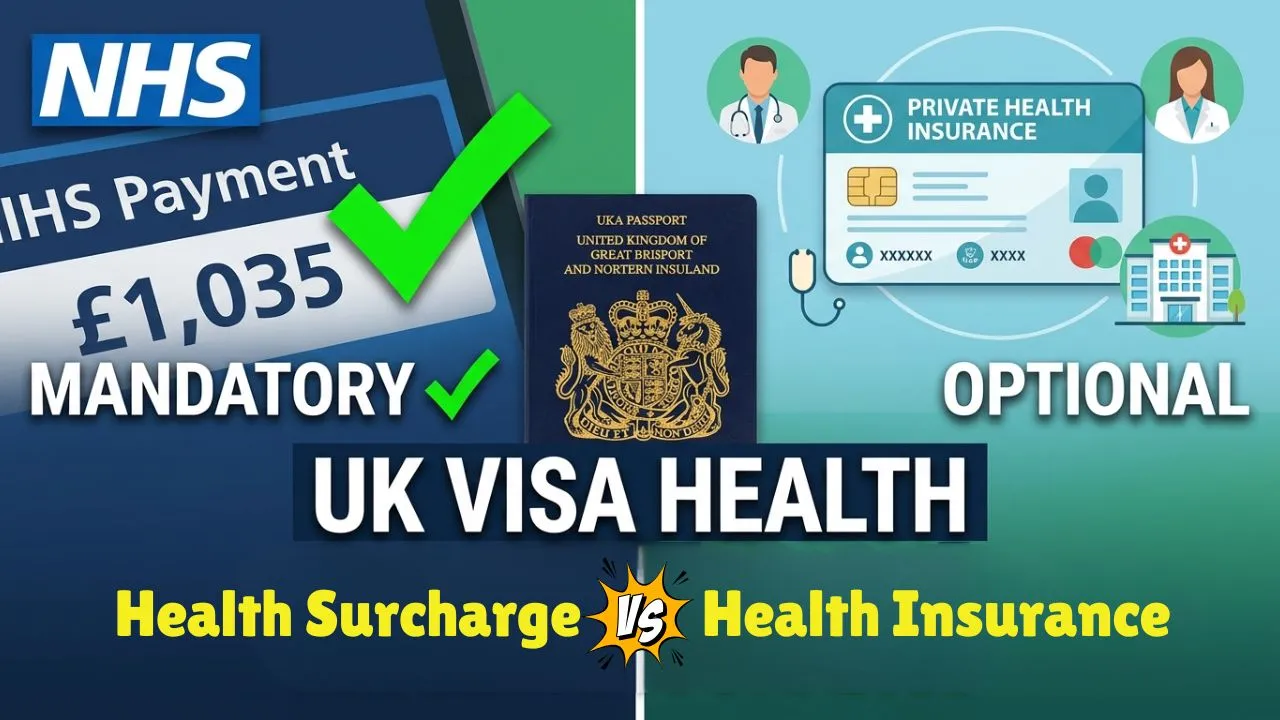
Short version, upfront: for almost every long-term UK visa, you don’t buy separate health insurance at all. You pay something called the Immigration Health Surcharge instead, and it’s compulsory, upfront, and non-refundable once your visa is granted. Private insurance sits on top of that, as an optional extra. Let’s break down exactly what that means for your budget.
Do You Need Health Insurance for a UK Visa? The Short Answer
For most visa categories lasting more than six months — Skilled Worker, Student, Spouse/Partner, Global Talent, and so on — the answer is: not in the way you might think. You don’t need a separate private health insurance policy to satisfy the Home Office. Instead, you pay the Immigration Health Surcharge (IHS) as part of your visa application, and that gives you NHS access on broadly the same footing as a UK resident.
Private medical insurance does not exempt you from the IHS, no matter how comprehensive the policy. There’s no opt-out. You pay the surcharge and, if you also want private cover, that’s a separate and entirely optional cost sitting alongside it. A lot of first-time applicants assume one cancels out the other. It doesn’t.
- Visa for more than 6 months: pay the IHS, no insurance required by the Home Office
- Visa for 6 months or less (most Standard Visitor visas): no IHS at all — and no automatic NHS access either, beyond emergency care
- Health and Care Worker visa: exempt from IHS entirely
This is the single most searched question on this topic, and it trips up more people than any other IHS point: private cover is additional, not a substitute.
IHS vs Private Health Insurance: What’s the Difference
These two things get confused constantly, so worth separating clearly, in plain financial terms.
| Immigration Health Surcharge (IHS) | Private Health Insurance | |
|---|---|---|
| Mandatory? | Yes, for most visas over 6 months | No, always optional |
| Paid to | UK Home Office, as part of visa application | A private insurer, in premiums |
| Payment structure | One lump sum, upfront, for the full visa length | Monthly or annual premium, ongoing |
| What it buys | NHS access, broadly equal to a UK resident | Faster access, choice of specialist, private hospitals |
| Refundable? | No, once the visa is granted and used | Depends on policy — usually pro-rata if cancelled |
| Typical cost | £776–£1,035 per year of visa length | £600–£6,000+ per year, depending on cover |
The IHS is really a healthcare tax bolted onto immigration. It isn’t insurance in any technical sense — there’s no policy document, no claims process, no underwriting. You pay, you’re in the system. Private insurance is a genuine commercial product, priced on your age, health, and how much cover you want.
How Much Is Health Insurance for a UK Visa? IHS Rates in 2026
Health insurance for uk visa purposes — meaning the IHS, since that’s what actually satisfies the visa requirement — currently costs:
- £1,035 per year for most adult applicants (Skilled Worker, Spouse/Partner, Global Talent, and similar routes)
- £776 per year for students, their dependants, Youth Mobility Scheme applicants, and anyone under 18 at the date of application
It’s charged for the full length of the visa, rounded up in six-month blocks. A three-year visa isn’t three separate annual payments — it’s one lump sum, paid before the visa is even issued. That’s the bit that catches people financially off guard.
How Much Is Health Insurance (referring to IHS) for a UK Student Visa? Worked Examples
- 1-year Master’s course, typically an 18-month visa: 1.5 × £776 rounds up to £1,164
- 3-year undergraduate degree: 3 × £776 = £2,328 (often slightly more once the visa’s extra pre/post-course months are added)
- 2-year visa for a dependant partner or child of a student: 2 × £776 = £1,552
Compare that with the adult standard rate on, say, a Skilled Worker visa: a 5-year visa comes to £5,175, paid as a single sum at application. For a family of three on that same visa — one adult dependant, one child — total IHS across the household can run past £14,000. That’s not a hypothetical; it’s a very ordinary outcome for a family relocating on a 5-year sponsored role.
The IHS Is Non-Refundable Once Your Visa Is Granted
This is the point I stress hardest with clients doing their budgeting, because it changes how you should plan cash flow. Once your visa is granted and you’ve entered the UK, the surcharge is spent. It doesn’t matter if you:
- Never see a GP the entire time you’re here
- Leave the UK a year early because a job or course ends sooner than planned
- Take out private health insurance on top and never touch the NHS
- Change your mind about coming, after the visa’s already been used to enter the country
None of that gets you a refund. Refunds exist, but only in narrow situations — your application is refused, withdrawn before a decision, you’re granted a shorter visa than you paid for, or you switch to an IHS-exempt route partway through. Financially, treat the IHS the same way you’d treat a non-refundable flight: pay it assuming you will not get it back, and budget accordingly, rather than hoping for a later refund that may never come.
From a pure cash-flow point of view: the IHS is a sunk cost the moment your visa is issued. Don’t build your household budget around the assumption you might claw some of it back.
Private Health Insurance for a UK Visa: When You Actually Need It
There are a handful of situations where private cover isn’t optional in any practical sense — it’s the only healthcare access you’ll have.
- Standard Visitor visa, 6 months or less — you don’t pay the IHS, but you also don’t get NHS access beyond emergency treatment. Genuine private travel/health insurance is strongly advisable here, even though the Home Office doesn’t formally require proof of it.
- Short-term study visas under 6 months — same position: no IHS, no automatic NHS entitlement, so private cover is the only safety net.
- Gaps between visas — if your leave has expired and you’re mid-application for an extension, your NHS entitlement can lapse temporarily. Travel or interim health insurance covers that window.
- Anyone wanting to skip NHS waiting lists — this is a lifestyle choice, not a visa requirement, but it’s the main reason long-term visa holders still buy private cover despite already paying the IHS.
Private Health Insurance Costs Compared: £600 to £6,000+
If you decide private cover is worth it — on top of the IHS, not instead of it — premiums vary hugely depending on what you actually want covered.
| Cover level | Typical annual premium | What you get |
|---|---|---|
| Basic / cash plan | £600 – £1,200 | Contribution towards routine costs (dental, optical, physio); limited hospital cover |
| Mid-range individual PMI | £1,200 – £2,500 | Private outpatient consultations, diagnostics, and inpatient treatment for most conditions |
| Comprehensive individual PMI | £2,500 – £4,000 | Wider specialist choice, private hospital rooms, mental health cover, cancer treatment |
| Family comprehensive plan | £3,000 – £6,000+ | Covers a partner and children, broader treatment scope, lower excess |
| Executive / international PMI | £4,000 – £6,000+ | Global cover, top-tier hospitals, minimal restrictions, often used by senior employees |
A healthy single adult in their 20s or 30s can often find reasonable mid-range cover for £1,200–£2,000 a year. Add a partner and a couple of kids, and you’re realistically into the £3,000-£4,000+ bracket. None of that touches the IHS — it’s stacked entirely on top.
Health Insurance & IHS Requirements by UK Visa Type
Here’s the full picture across the visa categories people search for most, in one table, so you can see exactly what applies to you.
| Visa type | IHS required? | Rate (per year) | Separate private insurance needed? |
|---|---|---|---|
| Skilled Worker visa | Yes | £1,035 | Optional only |
| Student visa | Yes | £776 | Optional only |
| Spouse / Partner visa | Yes | £1,035 | Optional only |
| Global Talent visa | Yes | £1,035 | Optional only |
| Youth Mobility Scheme visa | Yes | £776 | Optional only |
| Child / Parent / Dependant visas | Yes (age-dependent rate) | £776 or £1,035 | Optional only |
| Health and Care Worker visa | No — exempt | £0 | Optional only |
| EU Settlement Scheme (EUSS) | No — exempt | £0 | Optional only |
| Standard Visitor visa (up to 6 months) | No | £0 | Strongly recommended — no NHS access |
| Short-term Student visa (under 6 months) | No | £0 | Strongly recommended — no NHS access |
| Indefinite Leave to Remain / ILR | No — not time-limited leave | £0 | Optional only |
| Ancestry visa | Yes | £1,035 | Optional only |
| BN(O) visa | Yes | £1,035 | Optional only |
If a row says ‘exempt’ or ‘no’, that’s a saving worth confirming carefully before you apply — exemptions are set out in the Immigration Rules, not left to a caseworker’s discretion, so check gov.uk against your exact route before assuming you qualify.
Budgeting Tips: Fitting the Surcharge into Your Visa Costs
From a straightforward financial planning angle, here’s how to handle the IHS so it doesn’t blindside your budget.
- Calculate the full IHS cost before you calculate anything else. Multiply the annual rate by the full length of visa you’re requesting, rounded up per the 6-month rule, for every applicant including dependants.
- Treat it as a single upfront cash requirement, not a monthly expense. You need the whole amount available on the day you submit your application — there’s no instalment plan, ever.
- Build it into your total ‘cost of moving’ figure alongside the visa fee, priority service fees, flights, and initial accommodation deposit — not as a separate afterthought.
- If your employer is sponsoring you, ask directly whether they’ll reimburse the IHS. It’s increasingly common as part of relocation packages, particularly in tech and finance, but it’s rarely offered unless you ask.
- For families, price it per person, not per household. A partner and two children can easily double or triple the total surcharge bill versus a single applicant.
- Only budget for private insurance once the IHS figure is locked in. It’s the optional layer, and it should never squeeze out money you need for the compulsory one.
- If cash flow is genuinely tight, check whether your specific route qualifies for an IHS fee waiver (available on certain family and human rights routes) before assuming you have to pay in full.
Common Money Mistakes Migrants Make with the IHS
- Underestimating dependant costs — assuming a partner or child costs less than they actually do. Most dependants pay the full applicable rate, not a discounted family rate.
- Assuming private insurance offsets the fee — it doesn’t, ever, regardless of how comprehensive the policy is.
- Forgetting extensions cost the same again — every renewal or switch is a fresh IHS payment at whatever the current rate is then, not what you paid originally.
- Rounding down mentally — the system always rounds up in 6-month blocks, never in your favour, so a 2-year-1-month visa is billed as 2.5 years.
- Buying private insurance before locking in the visa budget — the compulsory cost should always be secured first; private cover is a nice-to-have, not the other way round.
Frequently Asked Questions (FAQS)
Q. Do I need health insurance for a UK visa?
For most visas over 6 months, you pay the Immigration Health Surcharge instead of buying separate insurance — this gives you NHS access. Private insurance is optional and additional, never a substitute.
Q. How much is health insurance for a UK visa?
Through the IHS: £1,035 per year for most adults, £776 per year for students, dependants and under-18s, paid upfront for the full visa length. Private insurance on top ranges from roughly £600 to £6,000+ a year depending on cover.
Q. How much is health insurance for a UK student visa?
Students pay £776 per year through the IHS — for example, £2,328 for a standard 3-year degree — rather than a separate private policy, unless they choose extra private cover voluntarily.
Q. Can private health insurance replace the IHS?
No. There is no exemption for holding private medical insurance. The IHS must be paid in full for any visa route where it applies, regardless of other cover you may have.
Conclusion
The Immigration Health Surcharge isn’t really optional, isn’t refundable once you’re through the door, and is very often the single largest line item in a family’s visa budget — bigger than the visa fee itself, in most cases. Private health insurance sits entirely separately, purely a lifestyle and speed-of-access choice once the compulsory cost is covered. Get the IHS number right first, build it into your cash-flow plan as a genuine upfront cost, and only then decide whether private cover is worth adding on top.
Disclaimer:
UK Visa Consultant is affiliated with regulated immigration professionals with years of hands-on experience in successful UK visa applications. We closely monitor UKVI/Home Office updates and use only official guidance and sources. The information provided in this blog is subject to change depending on UK immigration laws and policies. It is recommended to stay updated regarding such changes and confirm the details through an official source before proceeding further. Our priority is unwavering accuracy and user trust. Here’s how you can maximize your success:
- Always rely on updates from the UK Government, the Home Office, and regulated immigration advisors.
- Keep up with the latest changes (e.g., digital eVisas, new sponsor requirements, post-Brexit rules).
- If in doubt, consult directly with an accredited UK immigration solicitor or OISC advisor.
- Ensure documentation, financials, and employment/education offers are fully compliant.
- Avoid scams and unregulated agents—your application’s credibility is paramount.
- Our consultants undergo regular professional development, maintain GDPR-compliant data handling, and provide transparent, ethical advice.


Leave a Reply
You must be logged in to post a comment.