



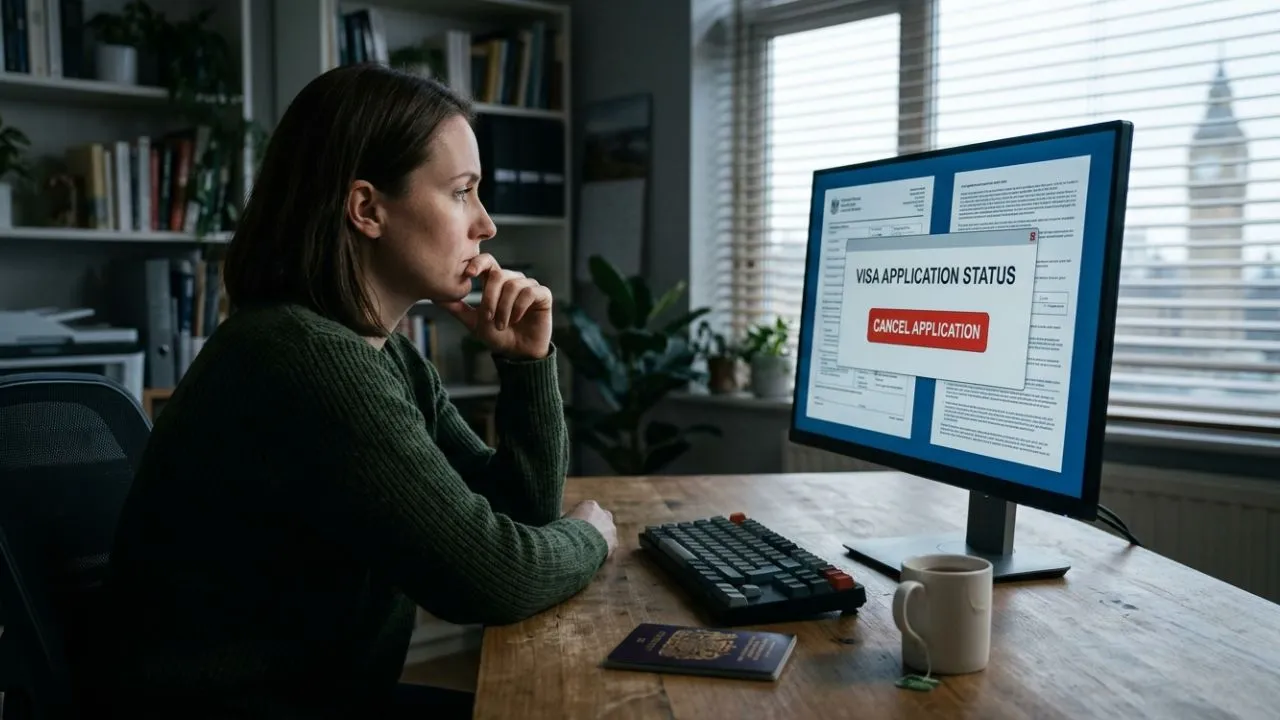

Somewhere in Lagos, a father is staring at his laptop at two in the morning, finger hovering over a button that says “withdraw this application.” He is unaware about the proper process to withdraw a UK visa application. His daughter’s university offer came through a week after he’d already applied for the wrong visa route. He doesn’t know if cancelling now will cost him the money he’s already paid, or worse, whether it will somehow mark him as a risk for next time.
That moment — the hovering finger, the doubt — happens more often than most people realise. Visa applications get withdrawn every single day, for reasons far more mundane than fraud or refusal. A job offer falls through. Someone spots a mistake the night after submitting. Circumstances change. And every one of those people needs the same three questions answered clearly: can I actually cancel this, will I get my money back, and what happens to me if I do.
This guide walks through all three, properly, based on how UK Visas and Immigration (UKVI) actually handles these requests today.
Understanding What “Withdrawing” a UK Visa Application Actually Means
The Home Office calls it “cancelling.” Most applicants, and most of the internet, call it “withdrawing.” They’re the same thing.
Withdrawing a UK visa application means telling UKVI, formally, to stop processing your case before a decision has been reached. It’s not a refusal. It’s not a black mark, in and of itself. It simply pulls the application back into your hands before anyone at the Home Office has made a judgement on it.
There’s one hard rule underneath all of this, and it doesn’t bend: withdrawal is only possible while a decision is still pending. The moment UKVI has decided — approved or refused — the window closes. No amount of asking nicely reopens it.
And once the withdrawal request lands with UKVI, that’s final too. There’s no undo button on the other side. Something worth sitting with for a moment before clicking anything.
Common Reasons People Cancel a UK Visa Application
Nobody withdraws an application for fun. The reasons tend to cluster around a handful of familiar situations:
- An error was spotted after submission — a wrong date, an incomplete section, a missing document
- The applicant chose the wrong visa category and needs to reapply under the correct one
- Personal circumstances changed — a job offer withdrawn, a relationship ending, a change of travel plans
- The applicant wants to add significant new evidence that wasn’t ready at the time of applying
- A university offer, sponsorship, or CAS changed after the original application went in
None of these are unusual. None of them suggest anything untoward. But how and when the withdrawal happens changes what comes back to the applicant financially — and that’s where most of the confusion sits.
Before You Cancel UK Visa: What to Check First
Here’s something worth knowing before touching that withdrawal button at all: cancelling the whole application isn’t always necessary.
If the only goal is getting a passport back — perhaps for urgent travel — there’s a separate route for that. Requesting the return of documents doesn’t require withdrawing the underlying application at all.
Similarly, anyone who applied from inside the UK and simply wants to switch to a different visa route may be able to vary the existing application rather than cancel it outright and start from zero. Varying keeps the original submission date and, in many cases, avoids paying the fee twice.
So the real first question isn’t “how do I cancel” — it’s “do I actually need to.”
Complete Process to Withdraw a UK Visa Application in the UK: Step by Step
Once withdrawal genuinely is the right move, the process itself is fairly mechanical. It depends entirely on how identity was verified at the point of applying — through an in-person biometric appointment, or through the smartphone app.
If You Applied From Inside the UK
Applicants who submitted their application from within the UK, and who were asked to attend a biometric appointment, cancel through the Home Office’s online cancellation service directly. The application reference number will be needed, along with the account used to submit the original application.
If You Applied From Outside the UK
For those who applied from overseas and were told to attend a visa application centre appointment, the process runs slightly differently. Sign in to the original application account using the link sent at the time of applying, then navigate to “Section 6: further actions.” That’s where the cancellation request sits.
One detail that trips people up constantly: cancelling the application itself does not automatically cancel any booked biometric appointment. That has to be done separately, through the visa application centre. Skipping this step can lead to confusion, missed slots, and in some cases, unnecessary charges from the visa centre itself.
If You Used the “UK Immigration: ID Check” Smartphone App
Applicants who verified their identity digitally through the ID Check app, rather than attending in person, follow a slightly simpler route. Sign in to the UKVI account using the original sign-up link, go to the dashboard, and select “Withdraw this application.”
Timing matters enormously for this group specifically — more on that in the refund section below.
How to Get a Refund After Canceling a UK Visa Application?
This is, understandably, the part everyone actually wants to know. And the honest answer is: it depends entirely on timing, not on the reason for withdrawing.
Application Fee Refunds
The application fee refund hinges on one single moment — whether biometrics have already been given.
- Biometric appointment route: the fee is refunded if fingerprints and a photo haven’t yet been provided. Once they have, the fee is not usually refundable.
- ID Check app route: the fee is refunded if “confirm and upload” hasn’t been selected in the app, or if the withdrawal happens before the deadline given for uploading evidence.
There’s nothing to apply for here — the refund lands automatically on the card or account originally used to pay.
Immigration Health Surcharge Refunds
This one is the most forgiving of the three. The Immigration Health Surcharge is refunded in full, no exceptions, so long as the withdrawal happens before a decision has been made. It doesn’t matter whether biometrics were given or not. It doesn’t matter which route was used to apply. If there’s no decision yet, the IHS comes back.
Again, this is automatic. Nothing needs to be requested.
Priority and Super Priority Service Fee Refunds
Anyone who paid extra for faster processing needs to actively request this refund — it isn’t automatic like the other two. A written request needs to be sent to UKVI, and eligibility depends on the same underlying rule: the priority fee is generally refundable if biometrics haven’t yet been attended.
How Long Refunds Take
Once a withdrawal is accepted:
- Application fee and priority service fee refunds arrive within 4 weeks
- Immigration health surcharge refunds arrive within 6 weeks
If either of those windows passes without payment landing, contacting UKVI directly is the next step. And a quiet but important warning here — if a bank account has changed since paying, UKVI needs to be told, but new bank details should never be sent unprompted. Verify any request for new payment information through UKVI’s official contact channels first. Refund scams targeting anxious applicants are, unfortunately, a real thing.
What Happens to a UK Visa Application “Drop” Mid-Process
Sometimes people describe this as “dropping” an application rather than withdrawing it — usually meaning they simply stop responding, stop uploading requested evidence, and let it lapse rather than formally cancelling.
This is worth being cautious about. Letting an application lapse instead of formally withdrawing it doesn’t necessarily protect the fee, and it can still result in a decision being made against the applicant based on the incomplete evidence available. If evidence was requested and a deadline given, missing that deadline without formally withdrawing can mean UKVI proceeds to decide the case anyway — often unfavourably, given the missing information.
If stopping the process is genuinely the intention, doing it formally, through the proper cancellation route, protects both the fee position and the applicant’s future record far better than simply going quiet.
The Risks of Withdrawing UK Visa While Inside the UK
Here’s where the story gets more serious, and where legal advice earns its cost.
Anyone applying from inside the UK to extend or switch their permission, particularly someone relying on what’s known as Section 3C leave — the automatic continuation of permission while a valid in-time application is pending — needs to tread carefully.
If existing leave is still valid at the point of withdrawal, that leave generally continues on its own terms, unaffected. But if the previous leave has already expired, and the applicant has only been remaining lawfully because of Section 3C protection tied to the pending application, withdrawing that application ends the protection immediately. There’s no soft landing. The permission to stay is deemed to end on the date of withdrawal.
This is precisely the kind of situation where a quick conversation with an immigration adviser before clicking “withdraw” is worth far more than the ten minutes it takes.
Withdrawing vs Varying Your UK Visa Application: Which Is Right?
These two get confused constantly, and the difference actually matters.
Withdrawing ends the current application entirely. A fresh one needs to be started from scratch, with its own new fee, own new reference number, own new timeline.
Varying an application — available to those applying from inside the UK — changes the existing application to a different visa category without cancelling it outright. The original submission date is often preserved, which can matter enormously for maintaining continuous lawful residence or protecting a Section 3C leave position.
As a rough rule: if the goal is simply to switch routes while staying inside the UK, varying is usually the gentler, lower-risk option. Withdrawing tends to make more sense for overseas applicants, or for anyone who needs to correct fundamental errors that can’t be fixed through variation.
Can You Reapply Immediately After Withdrawing UK Visa Application?
Yes, generally. There’s no statutory cooling-off period preventing a fresh application straight after a withdrawal. Most people who cancel do so specifically because they intend to reapply properly, whether that’s under a corrected category, with better evidence, or with an updated CAS or sponsorship document.
Two things are worth keeping in mind when reapplying, though. First, be transparent — if a previous application was withdrawn, and a new one asks about immigration history, answer honestly. Undeclared history causes far more damage than a withdrawal ever would on its own. Second, check whether anything time-sensitive was tied to the original application — a course start date, a job start date, sponsorship validity — because withdrawal doesn’t pause those external deadlines.
What Happens If Your Visa Is Approved But You Can No Longer Travel?
This is a different situation entirely, and it catches people out constantly, because everything written above about withdrawing only works while a decision is still pending. Once the visa has actually been granted — the vignette is in the passport, or the eVisa is sitting in the account — that window has already closed. There is nothing left to withdraw. The Home Office has made its decision, and cancellation, in the sense used throughout this guide, is simply no longer on the table.
So picture the situation properly. An applicant applies, waits, gets the approval email, feels the relief — and then the trip falls apart. Perhaps the event they were attending is cancelled. Perhaps the job offer behind a Skilled Worker visa is withdrawn before the start date. Perhaps a family emergency means travel just isn’t possible any more. The visa is sitting there, valid, unused, and the applicant is left wondering what, if anything, needs to be done about it.
Is There a Refund If an Approved Visa Goes Unused?
The honest answer, and it’s not the one most people hope for, is no — not usually. Once a visa application has been decided and granted, both the application fee and the Immigration Health Surcharge are treated as paid for a service that has already been delivered. The decision was made. The leave was granted. Whether it’s actually used afterwards doesn’t change that.
The Immigration Health Surcharge specifically is not refunded simply because someone chooses not to travel, changes their mind, or finds their plans have fallen through. This applies whether the visa is a six-month visit visa or a five-year Skilled Worker grant. The surcharge is treated as covering the period of leave granted, not the period actually spent using NHS services or physically present in the UK.
There are only a handful of genuine exceptions, and none of them relate to simply failing to travel:
- A partial IHS refund where the visa was granted for a shorter period than originally paid for
- A refund where a dependant’s application was refused while the main applicant’s was granted
- Health and care worker reimbursement routes, for those who qualify under that separate scheme
- Genuine duplicate payments or administrative errors on the Home Office’s part
Outside of those, an approved but unused visa is, financially, a closed chapter. It’s a hard thing to hear after paying what are often substantial fees, but it reflects how the whole system is built — the cost sits with the decision, not the journey.
How to Officially Let the Home Office Know You Can’t Travel?
Here’s the part that surprises most people: for the majority of visa categories, there is no formal notification required, and no dedicated form for saying “I’ve decided not to use this.” A Standard Visitor visa, for instance, simply sits unused and lapses quietly at the end of its validity. Nobody at UKVI is expecting a message explaining why a trip didn’t happen.
Longer routes carry a little more nuance, though. For Skilled Worker and Student visas specifically, the sponsor — the employer or the university — carries reporting duties of their own. If a job offer is withdrawn, or a course place is no longer available, the sponsor is generally required to report that change through their own sponsor management systems, which can in turn lead to the Home Office curtailing the visa on its own initiative. The applicant’s part in this is less about filling in a form and more about telling the sponsor promptly, in writing, so that their reporting obligations are triggered correctly and nobody’s compliance record suffers unnecessarily.
For anyone who simply wants to be careful and transparent — and this is generally sound practice rather than a legal requirement — keeping clear evidence of why travel didn’t happen is worth the effort. A cancelled event confirmation, a withdrawn job offer letter, a medical certificate. Not because the Home Office will come looking for it, but because future visa applications sometimes ask about previous visas held, and having a clean, honest explanation ready removes any awkwardness if the question ever comes up.
What If the Purpose of the Visit No Longer Exists at All?
This is the trickiest version of the scenario, and it deserves honesty rather than false comfort. If the entire basis for the visa — the conference that’s been cancelled, the wedding that’s been postponed indefinitely, the job that no longer exists — has genuinely disappeared, there is technically no legal obligation to inform UKVI before the visa’s expiry date, for most visit-visa scenarios. The visa was correctly granted based on the circumstances at the time; those circumstances changing afterwards doesn’t retroactively make the original decision wrong.
That said, using a visa for a purpose that no longer matches what was declared at the point of application is a different matter entirely, and worth flagging clearly: if someone still travels but for a materially different reason than what was assessed and approved, that can raise genuine concerns at the border, regardless of what the vignette says. The safest approach, always, is that if the purpose has changed entirely, the visa is simply left unused and allowed to lapse, and a fresh application is made later reflecting the actual, current purpose of travel, if and when one exists.
What Happens If the Visa Is Simply Left to Expire?
In the overwhelming majority of cases, this is exactly what happens, and it’s entirely fine. An unused visitor visa, work visa, or student visa quietly runs out at the end of its validity period, with no action needed and no consequence attached. There’s no black mark for holding a visa and not using it. The one thing worth remembering is that entry clearance vignettes historically carried a limited window — often 90 days — in which to make the first journey to the UK, after which a separate replacement vignette process, with its own fee, would be needed even if the underlying leave was still valid. Anyone holding an older-style vignette rather than a digital eVisa should check that window carefully before assuming there’s unlimited time to decide.
A Tale of Two Withdrawals
Picture two applicants, both cancelling their applications in the same week, for very different reasons.
The first is a graduate student who submitted her Student visa application, then realised two days later that her bank statement was missing its final page. She hadn’t yet attended her biometric appointment. She withdrew immediately, received her fee back within a fortnight, corrected the document, and reapplied with a complete file. A minor hiccup, resolved cleanly, because she acted before biometrics and understood exactly what she was doing.
The second is a Skilled Worker applicant already inside the UK on leave that had technically expired two weeks earlier, relying on Section 3C protection while his renewal was pending. He withdrew impulsively after a disagreement with his sponsor, intending to sort things out and reapply once the dust settled. What he hadn’t realised was that withdrawal ended his lawful stay immediately — there was no pending application left to protect it. He found himself, quite suddenly, without valid permission to remain in a country he’d lived in for six years.
Same action. Wildly different outcomes. The difference wasn’t luck — it was understanding exactly what stage each application was at, and what was quietly holding their status together underneath it.
Common Mistakes People Make When Cancelling a UK Visa Application
- Assuming withdrawal automatically means a refund. It doesn’t — timing decides everything.
- Forgetting to cancel a separate biometric appointment after cancelling the main application online.
- Letting an application lapse silently instead of formally withdrawing it, hoping it simply disappears.
- Withdrawing an in-country application without checking Section 3C status first.
- Sending new bank details to an unverified request, assuming it’s genuinely from UKVI.
- Not keeping evidence of the withdrawal — screenshots, confirmation emails, reference numbers — which become essential if a refund runs late.
Frequently Asked Questions (FAQs)
Q. How do I withdraw a visa application in the UK?
Sign in to the original application account and use the cancellation option relevant to how identity was verified — the online cancellation service for in-country biometric applications, “Section 6: further actions” for overseas applications, or “Withdraw this application” on the dashboard for ID Check app users.
Q. How do I cancel my UK visa application and get a refund?
Cancel before biometrics have been given (or before confirming evidence in the ID Check app) to secure the application fee refund. The immigration health surcharge refunds in full regardless, as long as no decision has been made yet.
Q. Can I cancel my UK visa application after biometrics?
Yes, cancellation is still possible up until a decision is made, but the application fee is usually no longer refundable once biometrics have been provided.
Q. What happens if I let my UK visa application drop instead of withdrawing it?
Letting it lapse rather than formally cancelling can still result in a decision being made against you based on incomplete evidence, and doesn’t protect your fee the way a formal withdrawal does.
Q. Can I reapply immediately after withdrawing my UK visa application?
Yes, in most cases there’s no waiting period. Just be transparent about the previous withdrawal in any future application, and check whether it affects your existing immigration status first.
Q. My UK visa was approved but I can’t travel any more — can I get a refund?
Generally, no. Once a visa is granted, the application fee and the Immigration Health Surcharge are treated as paid for a decision that has already been delivered, and neither is refunded simply because the holder doesn’t travel.
Q. Do I need to tell UKVI if I’m not going to use my approved visa?
Usually not, for standard visit visas — it simply lapses at expiry. For sponsored routes like Skilled Worker or Student visas, tell your sponsor promptly instead, since they carry the formal reporting duty if the underlying job or course falls through.
A Final Word
Withdrawing a visa application is rarely the crisis it feels like in the moment. Handled at the right stage, with the right understanding of what’s actually being protected — a fee, a status, a pending decision — it’s simply a tool. Handled without that understanding, particularly for anyone relying on Section 3C leave inside the UK, it can turn a minor hiccup into a genuine immigration problem.
The finger hovering over that button deserves thirty seconds of certainty first: what stage is this application at, what happens to the money, and what happens to me. Answer those three honestly, and the decision usually becomes a great deal clearer.
Disclaimer:
UK Visa Consultant is affiliated with regulated immigration professionals with years of hands-on experience in successful UK visa applications. We closely monitor UKVI/Home Office updates and use only official guidance and sources. The information provided in this blog is subject to change depending on UK immigration laws and policies. It is recommended to stay updated regarding such changes and confirm the details through an official source before proceeding further. Our priority is unwavering accuracy and user trust. Here’s how you can maximize your success:
- Always rely on updates from the UK Government, the Home Office, and regulated immigration advisors.
- Keep up with the latest changes (e.g., digital eVisas, new sponsor requirements, post-Brexit rules).
- If in doubt, consult directly with an accredited UK immigration solicitor or OISC advisor.
- Ensure documentation, financials, and employment/education offers are fully compliant.
- Avoid scams and unregulated agents—your application’s credibility is paramount.
- Our consultants undergo regular professional development, maintain GDPR-compliant data handling, and provide transparent, ethical advice.



Leave a Reply
You must be logged in to post a comment.