



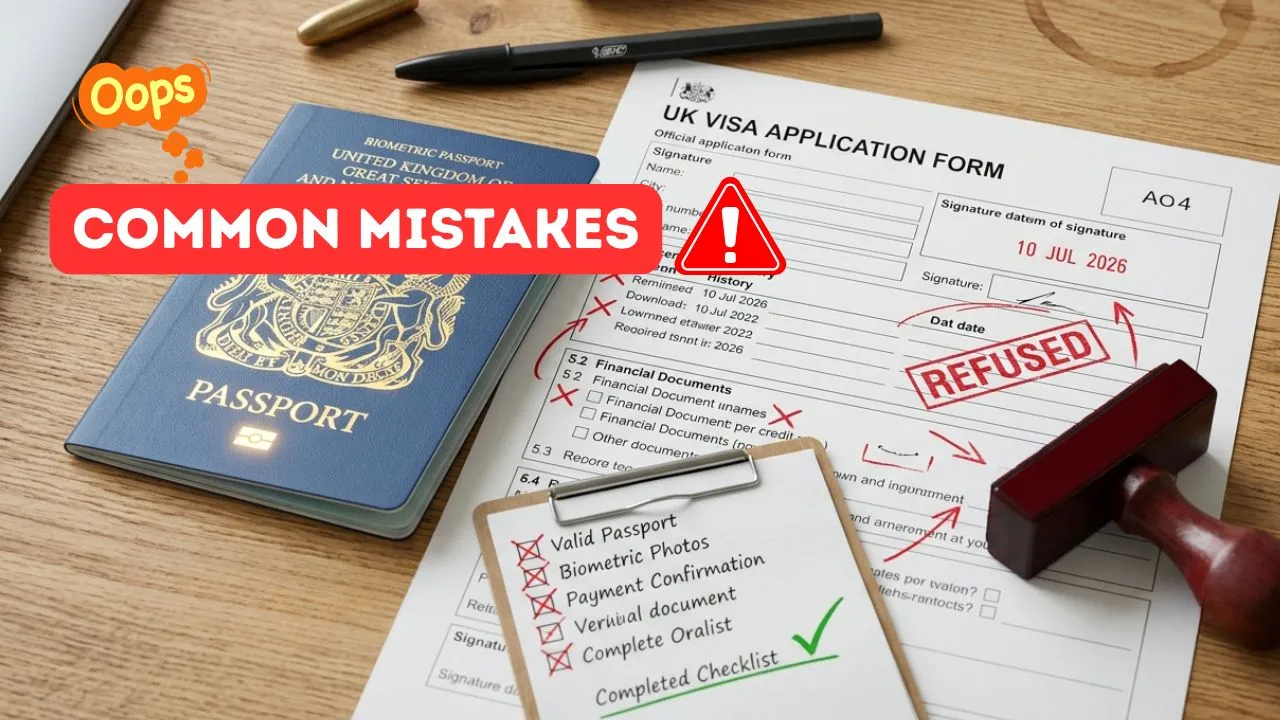

I have reviewed visa applications for eight years. Thousands of them. Some days I’d get through forty files before lunch, other days one complicated family visa would eat my entire afternoon. And if there’s one thing that stayed constant across all of it — the mistakes were rarely dramatic. Nobody was walking in with a forged passport taped together with sticky tape. It was smaller than that. Duller than that, honestly.
A bank statement missing a page. A name spelled differently on two documents. A cover letter that read like it was written for someone else’s trip. These are the things that actually sink applications, and they sink far more of them than fraud ever did.
With below outlined common mistakes in UK visa applications, I want to walk you through exactly what they were looking at, what made them pause, what made them reach for the refusal template, and — more usefully — what you can do to stop that happening to you. This isn’t theory. This is what actually happened on the other side of that desk.
Why Most UK Visa Refusals Are Avoidable
Here’s something people don’t want to hear: most visa refusals issued weren’t because someone was lying. They were because someone hadn’t told them enough.
That distinction matters enormously. Entry Clearance Officers don’t get to ring you up and ask “hey, can you clarify this deposit in your March statement?” We don’t have that luxury. We work from what’s in front of us, full stop. If the evidence doesn’t answer the question the Immigration Rules require it to answer, the application fails — even if your actual situation was completely fine.
I have seen them refused a woman once for a visit visa to see her daughter’s graduation. Genuine relationship, genuine occasion, genuine funds. But her bank statement showed a AED 60,000 deposit two weeks before applying, with zero explanation anywhere in the file. I had no way of knowing it was her end-of-service gratuity payout. She didn’t tell them. they couldn’t assume it in her favour — the burden of proof sits entirely with the applicant, not with me.
That’s the whole game, really. Prove it, don’t expect them to guess it.
How UKVI Caseworkers Actually Assess Your Application
People imagine some long, deliberative process. It isn’t, not for the vast majority of applications. Caseworkers are working through volume, and volume means pattern recognition kicks in fast.
They’re checking mistakes in UK visa applications, roughly in this order:
- Is the form complete and internally consistent?
- Does the applicant meet the requirements for the category they’ve applied under?
- Is there sufficient, credible evidence — not just documents, but documents that actually prove the point they’re meant to prove?
- Are there any suitability concerns — criminal history, past breaches, previous refusals not declared?
- Does the overall picture make sense as a coherent, believable story?
That last point is the one applicants underestimate the most. They’re not reading each document in isolation. They’re reading the whole file as one narrative. If the narrative doesn’t hang together, doubt creeps in, and doubt tends to resolve in favour of refusal, not against it.
The Most Common Mistakes in UK Visa Applications
Right then. Let’s get into it properly. These common mistakes in UK visa applications are ranked roughly by how often I saw them, not by severity — because honestly, some of the “minor” ones caused just as many refusals as the big ones.
1. Incomplete or Rushed Application Forms
An incomplete form is the single fastest route to refusal. UKVI will not chase you for missing information. There’s no follow-up call, no “just checking” email. If a mandatory field is blank, or your travel history section doesn’t match your passport stamps, that’s it — decision made on what’s there.
Fix it: Complete the form in one sitting where possible, with your documents open beside you, not from memory. Cross-check every date against your passport before submitting.
2. Choosing the Wrong Visa Category
I saw this constantly. Someone applies for a Standard Visitor visa when they actually intend to attend a paid work assignment, or a Student visa applicant who’s really coming to work part-time as their main purpose. Even if you’d otherwise qualify for a different route, applying under the wrong one is an automatic refusal.
Fix it: Read Appendix V (Visitor) or the relevant route’s rules properly before choosing. If you’re unsure which category fits your actual purpose, get advice before you pay the fee, not after.
3. Weak or Inconsistent Financial Evidence
Financial evidence is where I spent most of my time, and where most applicants trip themselves up. Not because they don’t have money — because they don’t present it clearly.
Common issues I saw again and again:
- Bank statements with pages missing (page 3 of 6, for instance — huge red flag, always)
- Statements that don’t show the account holder’s name
- Balances that don’t match the stated income
- Mismatched currency conversions that don’t add up
Fix it: Submit complete, continuous statements — no gaps — covering the full period required (usually 6 months). Every page should show your name, account number, and the bank’s letterhead or stamp.
4. Unexplained Bank Deposits and Irregular Transfers
This is the one that refused more genuine applicants than anything else I dealt with. A large, unexplained deposit shortly before applying looks exactly the same on paper whether it’s a bonus, an inheritance, or borrowed money used to inflate the appearance of savings. I couldn’t tell the difference just by looking at it, and I wasn’t allowed to assume the innocent explanation.
Fix it: Add a short, plain covering letter explaining any deposit over roughly 20–25% of your average balance. One sentence is often enough — “This deposit reflects my annual bonus, paid by [Employer] on [date], evidenced in the attached payslip.” Attach the supporting proof where you can.
5. Inconsistent Information Across Documents
Name spelled “Mohammed” on the passport and “Muhammad” on the bank letter. Date of birth transposed in one document. Address that doesn’t match between the tenancy contract and the application form. None of these are usually deception. All of them cause delay, and some cause refusal, because inconsistency is treated as unreliable evidence until proven otherwise.
Fix it: Before submitting, lay every document side by side and check names, dates, and addresses match exactly, including spelling variants. If there’s a genuine reason for a discrepancy (a legal name change, for instance), include the certificate that explains it.
6. Poor or Missing Translations
Any document not in English or Welsh needs a certified translation, and a badly done one — a family member’s rough translation on a scrap of paper — often gets treated as no translation at all.
Fix it: Use a professional translator who certifies the translation is accurate and includes their credentials and contact details. Attach both the original document and the translation.
7. Failure to Prove Ties to Home Country (Visitor Visas)
For visitor visas, the central question is simple: will you leave the UK at the end of your visit? Weak ties — no job, no property, no dependants, no clear reason to return — make that harder to believe, especially for first-time travellers with no prior international travel history.
Fix it: Include employment letters confirming your leave dates and your return to work, tenancy or property documents, and — if relevant — evidence of dependants who remain in your home country. A short cover letter tying it all together helps enormously.
8. Weak Relationship Evidence (Family and Partner Visas)
A marriage certificate on its own proves a legal marriage. It doesn’t prove an ongoing, genuine relationship, and that’s what Appendix FM actually requires. I refused applications where the only evidence was the certificate and a few holiday photos — no communication history, no joint finances, no cohabitation evidence.
Fix it: Build a timeline. Include messages spanning the relationship, joint bills or tenancy agreements, travel together, and photos across different occasions and time periods, not just one trip.
9. English Language Requirement Errors
Applicants regularly take the wrong test level — an A1 test where B1 is required, for instance — or use a test provider that isn’t on the approved list. Neither is fixable after submission.
Fix it: Check gov.uk’s current approved test list and the exact level required for your specific route before booking. Don’t rely on what a friend used two years ago; requirements and approved providers change.
10. Non-Disclosure of Previous Refusals or Criminal Records
This is the one that worries me most for applicants, because the consequences are disproportionate to how “small” it can feel. Ticking “no” to a previous refusal, or leaving out an old caution or conviction, is treated far more seriously than the underlying issue usually would have been on its own.
Fix it: Disclose everything asked for, even if you think it’s irrelevant or long resolved. An honestly declared old refusal is a manageable issue. An undeclared one discovered later is a suitability problem, and that can lead to a re-entry ban of up to 10 years under Paragraph 9.7.1 of the Immigration Rules.
11. Missing or Late Biometric Appointments
Even a technically flawless application collapses if you don’t attend your biometrics appointment at VFS Global or UKVCAS, or if you attend late without prior notice.
Fix it: Book early, arrive with time to spare, and if a genuine emergency prevents attendance, contact the visa application centre immediately — don’t just skip it and hope for the best.
12. Fee and IHS Payment Errors
Applications are automatically refused if the visa fee or Immigration Health Surcharge doesn’t go through — a declined card, an outdated fee table, an incorrect surcharge calculation for the visa length.
Fix it: Check the current fee table on gov.uk immediately before paying, not from a saved bookmark or an old blog post. Fees change, and they changed again as recently as April 2026.
13. Generic, Copy-Paste Cover Letters and Personal Statements
I read a lot of these. You can tell within two lines when a cover letter has been copied from a template forum post and had the names swapped. Vague language, no specific dates, no personal detail — it does nothing for your case and sometimes actively undermines it.
Fix it: Write your own, in your own voice, with specific dates, names, and reasons. It doesn’t need to be polished prose. It needs to be true and specific.
14. Overloading the File with Irrelevant Documents
More paper isn’t more persuasive. I’ve opened files with eighty pages when fifteen relevant ones would have made a cleaner, stronger case. Irrelevant documents dilute the ones that actually matter, and they slow down the officer reading them — which doesn’t help you.
Fix it: Include only what’s asked for, plus documents that directly support your specific circumstances. Quality over volume, every time.
15. Not Reading the Refusal Notice Properly Before Reapplying
If you’ve been refused before, the refusal notice tells you exactly what the officer wasn’t satisfied about. Reapplying with the same file, hoping for a different officer or a better mood, almost never works.
Fix it: Address every single point raised in the refusal notice directly in your new application, with new or clarified evidence for each one.
Minor Mistakes That Still Cause Refusals
Some errors feel too small to matter. They aren’t. Small mistakes compound, and enough of them together read as carelessness — which reads, unfairly perhaps, as unreliability.
- Reversing day and month in date fields (a very common one for anyone used to DD/MM in a country using MM/DD conventions, or vice versa)
- Providing an old address instead of your current one
- Forgetting a short transit stop or old trip in your travel history section
- Submitting photos that don’t meet the specification (background, size, recency)
- Using a nickname instead of the name exactly as it appears on your passport
- Signing a declaration without actually reading what it says
None of these alone will usually sink you. But an officer looking at a file with three or four of these together starts to wonder what else hasn’t been checked properly.
Innocent Error vs Misrepresentation vs Deception: Why the Difference Matters
This distinction genuinely changes your future, so it’s worth being precise about it.
An innocent error is unintentional — a typo, a transposed digit, a good-faith mistake. These can still cause a refusal if they can’t be verified, but they don’t usually carry long-term consequences once explained.
Misrepresentation is providing incorrect information without necessarily intending to deceive, but where the applicant should reasonably have known better or failed to take reasonable care.
Deception is deliberate — false documents, knowingly withheld convictions, or a “no” ticked on a question the applicant knew the true answer to. This is the one that triggers the serious consequences: a refusal under Part 9 of the Immigration Rules, and potentially a re-entry ban of up to 10 years.
I want to be clear on something because a lot of guidance online blurs this: an innocent mistake, properly explained, is not the same as deception, and it will not automatically trigger a 10-year ban. UKVI needs evidence of intent for that. But the burden is on you to make the innocent explanation clear and credible, because if the file simply looks inconsistent with no explanation attached, the officer has to work with what’s there.
How to Fix a Mistake After You’ve Submitted Your UK Visa Application
Once you’ve paid and submitted, you cannot directly edit the online form — there’s no formal amendment process under the Immigration Rules. That said, you’re not entirely stuck.
- Before your biometrics appointment: you may be able to submit clarification or additional documents through the visa application centre’s portal — VFS Global or UKVCAS, depending on your route.
- If the application is still in draft, unpaid: log back into your account and correct it before you submit — this is the only stage where a genuine edit is possible.
- If already refused because of the error: administrative review is available for certain categories, but it’s designed to correct Home Office errors, not to introduce new evidence for applicant mistakes. In most cases, withdrawing and reapplying properly is the more realistic route.
Whatever you do, don’t ignore a spotted mistake and hope it slides through unnoticed. A proactive, honest clarification reads far better to a caseworker than an unexplained inconsistency they discover themselves.
Insider Checklist: How I Assessed Every File Before Deciding
If I had to boil eight years of decisions down to one checklist, it would look like this. This is genuinely close to my own mental run-through on every file:
- Is the form complete, and does every date match the passport and supporting documents?
- Is the correct visa category being applied for, based on the actual purpose of travel?
- Is the financial evidence continuous, complete, and does it show the applicant’s own name clearly?
- Are large or unusual transactions explained, with supporting proof attached?
- Are all documents in English, or accompanied by certified translations?
- Does the applicant have credible ties to their home country, or credible grounds for the route they’re applying under?
- Have all previous refusals, convictions, or immigration breaches been disclosed?
- Is the biometric appointment booked and attended, and has the fee cleared?
- Does the whole file read as one coherent, believable story — or do parts of it contradict each other?
If an application clears all nine cleanly, it’s usually an easy approval. If two or three of these raise questions with no explanation attached, that’s when refusal becomes the likely outcome — not because the officer wants to refuse, but because the file simply hasn’t done the work of proving its own case.
Frequently Asked Questions (FAQs)
Q. What is the most common mistake in UK visa applications?
Incomplete forms and weak or inconsistent financial evidence remain the two most common causes of refusal across nearly every visa category.
Q. Can a small mistake cause a UK visa refusal?
Yes. Even minor inconsistencies — a mismatched name, an unexplained deposit, a missing statement page — can lead to refusal if they can’t be verified from the file alone.
Q. Does a mistake on a UK visa application lead to a 10-year ban?
Not automatically. A long-term re-entry ban applies where UKVI finds evidence of deliberate deception under Part 9 of the Immigration Rules, not for genuine, explainable errors.
Q. Can I correct a mistake after submitting my UK visa application?
There’s no formal amendment process once you’ve submitted and paid. You may be able to clarify through the visa application centre before your biometrics appointment, but in many cases, withdrawing and reapplying correctly is the safer route.
Q. What should I do if my UK visa was refused because of a mistake?
Read the refusal notice carefully, address every point raised directly, and reapply with new or clarified evidence rather than resubmitting the same file.
Final Thoughts
Every refusal I issued had a reason behind it, and in nearly all of the ordinary, non-malicious cases, that reason was something the applicant could have fixed before submitting. Not a lawyer’s trick, not a loophole — just clarity. Complete forms. Consistent details. Explained finances. A file that tells one honest, coherent story from start to finish.
That’s really the whole insider secret, if there is one. We’re not looking for reasons to catch you out. We’re looking for reasons to be confident in your case — and it’s entirely up to you to give us those reasons, clearly, the first time.
Disclaimer:
UK Visa Consultant is affiliated with regulated immigration professionals with years of hands-on experience in successful UK visa applications. We closely monitor UKVI/Home Office updates and use only official guidance and sources. The information provided in this blog is subject to change depending on UK immigration laws and policies. It is recommended to stay updated regarding such changes and confirm the details through an official source before proceeding further. Our priority is unwavering accuracy and user trust. Here’s how you can maximize your success:
- Always rely on updates from the UK Government, the Home Office, and regulated immigration advisors.
- Keep up with the latest changes (e.g., digital eVisas, new sponsor requirements, post-Brexit rules).
- If in doubt, consult directly with an accredited UK immigration solicitor or OISC advisor.
- Ensure documentation, financials, and employment/education offers are fully compliant.
- Avoid scams and unregulated agents—your application’s credibility is paramount.
- Our consultants undergo regular professional development, maintain GDPR-compliant data handling, and provide transparent, ethical advice.



Leave a Reply
You must be logged in to post a comment.