




If you’ve searched “UK humanitarian visa” hoping to find one single form to fill in, I’ll save you some time — it doesn’t exist. Not as a single named visa, anyway. What people usually mean when they say humanitarian visa UK is a cluster of different routes, all built for different crises, all with different rules. Confusing? Yes. Deliberately so, in parts. I’ve spent a fair bit of time going through Home Office data and the House of Commons Library’s research on this, and even the officials studying it admit the framework is, in their words, uncoordinated.
This guide pulls it all together in one place: what counts as a humanitarian visa in the UK, what a humanitarian parole visa is (and why the UK doesn’t really have one), what a permanent humanitarian visa looks like, and how to actually apply. Along the way I’ll bring in the current figures, because numbers tend to say more than policy language ever does.
What Is a Humanitarian Visa in the UK?
A humanitarian visa, broadly, is any authorised immigration route that lets someone come to or remain in the UK because returning home — or staying where they are — would put them at serious risk. That’s the working definition used by UNHCR too, and it covers a wide range of legal mechanisms rather than one product.
In UK terms, this umbrella includes:
- Asylum and refugee status, granted once someone is already in the UK and their protection claim succeeds.
- Humanitarian protection, a related but separate status for people who don’t meet the strict 1951 Refugee Convention definition but still face a real risk of serious harm — think armed conflict, torture, or inhuman treatment.
- Named country schemes, such as the Ukraine visa schemes, the Hong Kong BN(O) route, and the Afghan resettlement and relocation schemes.
- Refugee resettlement programmes, run with UNHCR, for people referred from outside the UK who are already recognised as refugees.
- Refugee family reunion, which allows close family of someone with protection status to join them.
So when someone types “what is humanitarian visa” into Google, the honest answer is: it depends which route they mean. That’s not a cop-out, it’s just how the system was built — piece by piece, crisis by crisis, rather than as one coherent policy.
Humanitarian Visa vs Humanitarian Protection vs Refugee Status
People use these terms interchangeably, and that causes a lot of confusion. Here’s the actual difference.
| Term | What it means | Who grants it | Typical length |
| Humanitarian visa (general term) | Any route allowing entry/stay on humanitarian grounds | Varies by scheme | Varies |
| Refugee status | Granted after a successful asylum claim under the Refugee Convention | Home Office | 5 years, or 30 months for claims from 2 March 2026 |
| Humanitarian protection | For those not meeting Refugee Convention criteria but facing real risk of serious harm | Home Office | 5 years, or 30 months for claims from 2 March 2026 |
| Named scheme visa | e.g. Ukraine Permission Extension, BN(O), ACRS | UK Visas and Immigration | 18 months to 5 years, scheme-dependent |
Refugee status and humanitarian protection sit close together and give most of the same rights — work, study, NHS access, benefits eligibility. The practical differences show up mostly around travel documents and family reunion rights, where refugee status tends to be the stronger of the two.
What Is a Humanitarian Parole Visa? (And Does the UK Have One?)
This one trips a lot of people up, understandably. Humanitarian parole is a US immigration mechanism, not a UK one. It lets the US Department of Homeland Security allow someone into the country temporarily for an urgent humanitarian reason or significant public benefit — a medical emergency, a family crisis, that sort of thing — without going through the normal visa process. It’s discretionary, it’s temporary, and it doesn’t lead directly to a green card or citizenship.
The UK has no direct equivalent called “parole.” What the UK offers instead, for genuinely urgent cases, tends to fall under:
- Emergency or expedited processing within existing schemes, such as fast-tracked decisions under the Afghan schemes during the 2021 evacuation.
- Discretionary leave, granted outside the Immigration Rules in exceptional individual circumstances.
- Human rights-based leave, where removal would breach Article 3 (protection from inhuman or degrading treatment) or Article 8 (right to family life) of the European Convention on Human Rights.
So if someone’s searching “what is humanitarian parole visa” hoping to apply for it in the UK — you can’t, not under that name. The nearest practical options are humanitarian protection, discretionary leave, or one of the named country schemes, depending on your circumstances. Worth getting proper legal advice here, because the route you pick changes your rights quite significantly down the line.
What Is a Permanent Humanitarian Visa?
A permanent humanitarian visa isn’t a formal Home Office term either, but it’s what most people mean by Indefinite Leave to Remain (ILR) — sometimes called settlement — reached via a humanitarian route. It’s permanent in the sense that there’s no expiry date and no further application needed to stay. You can work, study, claim benefits if eligible, and it’s the step before applying for British citizenship.
Here’s the general path, and it’s changed recently so it’s worth being precise:
- Initial grant. Refugee status or humanitarian protection used to come with 5 years’ leave. For asylum claims made on or after 2 March 2026, adults and accompanied children instead get 30 months, renewable. Unaccompanied children still get 5 years.
- Renewal or extension. If you’re on the 30-month track, you’ll need to extend before it expires rather than going straight to settlement.
- Eligibility for ILR. Broadly after 5 years of continuous protection-based leave, subject to conduct and, now, a safe return review.
- Safe return review. From 8 April 2026, the Home Office checks whether conditions in your home country have changed enough that protection is no longer needed, before granting ILR.
- Settlement granted. ILR gives permanent status. From there, naturalisation as a British citizen is usually possible after a further qualifying period.
Hong Kong BN(O) visa holders follow a different, separate track — five years on the route followed by a further twelve months on BN(O) status before ILR, so nearer six years altogether. Ukraine scheme visa holders, by contrast, still only have temporary permission; the government has said it intends to set out long-term plans for Ukrainians in the UK, but nothing permanent has been confirmed yet at the time of writing.
Types of UK Humanitarian Visas and Routes
Important Routes for UK Humanitarian Visa
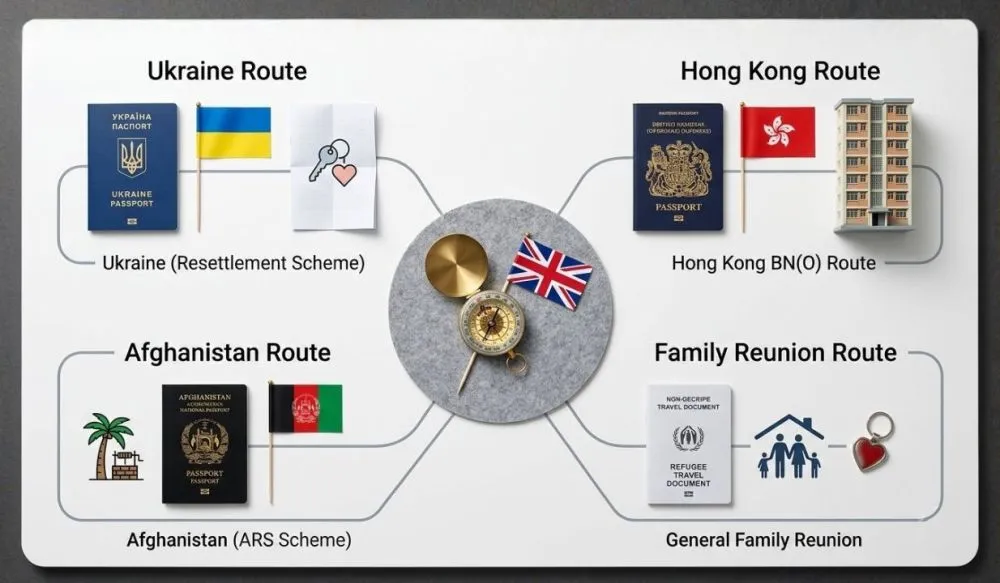
This is really the core of it. The UK’s humanitarian offer isn’t one visa, it’s a patchwork of six or seven routes, each shaped by a specific event. Here’s how they stack up.
| Route | Who it’s for | Status length | Cost | Scale (recent) |
| Ukraine schemes (Family, Sponsorship, Permission Extension) | Ukrainian nationals and immediate family | Temporary, up to 3 years initially | Free | Over 282,000 visas granted since 2022 |
| Hong Kong BN(O) route | BN(O) status holders and eligible family | 5 years to ILR, +1 year on BN(O) status | Paid (fees apply) | Over 185,000 grants |
| Afghan schemes (ARAP / ACRS) | Afghans who worked with UK forces, or at particular risk | 5 years, route to ILR | Free for main applicants | Around 38,000 arrivals |
| Refugee resettlement (UKRS, Community Sponsorship, Mandate) | UNHCR-referred refugees abroad | 5 years, route to ILR | Free | Smaller, steady annual numbers |
| Refugee family reunion | Partners/children of someone with protection status | Matches sponsor’s status | Free for most eligible applicants | Around 62,000 since scheme tracking began |
| Asylum route (in-country) | Anyone claiming protection after arrival | 30 months or 5 years, depending on claim date | Free to claim | Largest single category by volume |
Two things jump out when you sit with this table for a while. First, the Ukraine and Hong Kong BN(O) routes are, by a distance, the biggest and least restricted — uncapped, application-based, and giving broadly unrestricted rights to live, work and study. Second, almost every other route is either capped, referral-based, or dependent on already being inside the UK. That gap is exactly what advocates keep pointing at.
How to Apply for a Humanitarian Visa in the UK?
The exact process depends entirely on which route applies to you, but the shape of it is fairly consistent across schemes. Broadly:
- Work out which route fits your circumstances — nationality-specific scheme, resettlement referral, family reunion, or an in-country asylum claim. This decision shapes everything else, so it’s worth getting right first.
- Check eligibility against the specific criteria for that route (see below).
- Gather documentation — identity documents, evidence of the risk you face, relationship evidence for family routes, and any scheme-specific proof (e.g. BN(O) status, or evidence of Afghan government or UK forces employment).
- Submit the application online via GOV.UK, or through UNHCR/a resettlement partner for referral-based routes.
- Attend a biometric appointment, usually at a UK Visa and Citizenship Application Services (UKVCAS) point or, for out-of-country applicants, a Visa Application Centre.
- Wait for a decision. Timelines vary hugely by route — some Ukraine applications are decided within weeks, asylum claims can take considerably longer.
- If granted, register for an eVisa and keep it updated for travel and right-to-work checks.
If you’re claiming asylum specifically, note that you generally need to be in the UK (or at the border) to claim — there’s no standard visa route to travel to the UK purely to seek asylum. That’s a structural quirk of the system that catches a lot of people out, and it’s part of why unauthorised journeys still happen even where legal routes exist.
Eligibility Requirements for UK Humanitarian Visas
Eligibility differs by scheme, but most routes share a common backbone. You’ll typically need to show:
- Genuine risk. Evidence of persecution, armed conflict, torture, or serious harm if you returned home, or — for named schemes — proof of belonging to the relevant group (Ukrainian national, BN(O) status holder, eligible Afghan).
- No refugee status already granted elsewhere. Humanitarian protection specifically requires that you don’t qualify for full refugee status.
- Not a security risk. You shouldn’t pose a threat to UK national security or have a serious criminal record.
- Family relationship evidence. For reunion routes, proof of the relationship — marriage certificates, birth certificates, or equivalent.
- Sponsorship, where required. Ukraine Sponsorship Scheme applicants need a named UK-based sponsor; Community Sponsorship for refugees works similarly through local groups.
A quick note on discretionary leave, because it comes up a lot: it’s not really a route you apply for directly. It’s something the Home Office grants when your case doesn’t fit any category cleanly but there’s still a compelling reason you can’t be removed. It tends to come with a longer path to settlement — around ten years rather than five.
The Numbers: How Many People Actually Use These Routes
This is where the data gets genuinely interesting, and it’s the bit most guides skip over. According to the House of Commons Library’s most recent analysis of safe and legal routes:
- Around 282,000 visas have been granted under the Ukraine schemes since 2022 — still the single largest humanitarian route by volume.
- Over 185,000 grants have been made under the Hong Kong BN(O) route.
- Roughly 38,000 people have arrived through the various Afghan schemes.
- Around 62,000 people have come through refugee family reunion.
- In 2025, about 50,000 people were granted permission through a safe and legal route in total — 23% fewer than in 2024, driven mainly by falling Ukraine and Hong Kong applications as those populations mature.
- Separately, almost 141,000 people already in the UK — mostly Ukrainians — were granted extensions in 2025, largely through the Ukraine Permission Extension scheme.
📊 UK Humanitarian Visa: Safe & legal routes
UK Humanitarian Visa: Government Position vs Calls for More Routes
There’s a genuine, ongoing debate here, and I’ll lay out both sides as fairly as I can rather than pick one.
The government’s position
Ministers have generally framed the existing scheme structure — Ukraine, Hong Kong, Afghanistan — as targeted, proportionate responses to specific crises, rather than a template to be endlessly expanded. The current review of refugee resettlement routes suggests policymakers are looking at consolidating or reforming what exists, rather than necessarily adding new named schemes. Cost, capacity, and integration support are recurring concerns raised in government commentary — each new scheme adds administrative load and long-term public service demand.
The case advocates make
Refugee and migration charities argue the current framework is too narrow and too inconsistent — some nationalities get generous, uncapped routes; others, depending on where the crisis happens to be, get nothing comparable. They point to the low number of Ukrainians attempting unauthorised crossings as evidence that legal routes reduce dangerous journeys, at least for some groups. Critics of that argument counter that the evidence base linking legal routes to reduced unauthorised migration overall is genuinely limited — it’s not settled science, whatever either side implies.
Both things can be true at once, really: safe routes clearly help the specific people who get access to them, and expanding them doesn’t automatically solve unauthorised migration as a whole. It’s a trade-off between reach, scale, and what the system can realistically absorb — not a simple yes-or-no policy question, even if it often gets treated like one.
Frequently Asked Questions (FAQS)
Q. What is a UK humanitarian visa in simple terms?
It’s a general term for any UK immigration route that lets someone stay because they’d face serious harm at home. There isn’t one single “humanitarian visa” form — it’s a mix of asylum, humanitarian protection, and named country schemes.
Q. How do I apply for a humanitarian visa in the UK?
Identify which route matches your situation, then apply through GOV.UK or via UNHCR/a resettlement partner for referral-based schemes. Most require biometrics and supporting evidence of risk or eligibility.
Q. What is a humanitarian parole visa, and can I get one in the UK?
Humanitarian parole is a US mechanism, not a UK one. The closest UK options are humanitarian protection, discretionary leave, or human rights-based leave.
Q. What is a permanent humanitarian visa?
It refers to Indefinite Leave to Remain reached via a humanitarian route, usually after five years of protection-based leave, a safe return review, and no disqualifying conduct issues.
Q. Is humanitarian protection the same as refugee status?
Similar, not identical. Both offer broadly the same rights to work, study and access benefits, but refugee status comes with stronger travel document and family reunion rights.
Q. Can I claim asylum from outside the UK?
No. Asylum has to be claimed in the UK or at the border. There’s no standard visa to travel to the UK specifically to seek asylum, which is why named schemes and resettlement programmes matter so much for people still abroad.
Final Thoughts
The phrase “UK humanitarian visa” promises something simpler than what actually exists. In reality it’s six or seven overlapping routes, each shaped by a different crisis, each with its own rules on cost, length, and pathway to settlement. That’s not necessarily a criticism — crises are different, and a one-size scheme would probably serve nobody well — but it does mean the burden of figuring out which door to knock on falls heavily on the applicant.
If you’re trying to work out which route applies to you, start with your nationality and circumstances rather than the word “humanitarian” itself — that’s what actually determines which scheme, if any, you fit into. And given how often the rules shift (the March and April 2026 changes are a good example), it’s worth checking GOV.UK directly or speaking to an immigration adviser before relying on anything that isn’t dated.
No. Asylum has to be claimed in the UK or at the border. There’s no standard visa to travel to the UK specifically to seek asylum, which is why named schemes and resettlement programmes matter so much for people still abroad.
Disclaimer:
UK Visa Consultant is affiliated with regulated immigration professionals with years of hands-on experience in successful UK visa applications. We closely monitor UKVI/Home Office updates and use only official guidance and sources. The information provided in this blog is subject to change depending on UK immigration laws and policies. It is recommended to stay updated regarding such changes and confirm the details through an official source before proceeding further. Our priority is unwavering accuracy and user trust. Here’s how you can maximize your success:
- Always rely on updates from the UK Government, the Home Office, and regulated immigration advisors.
- Keep up with the latest changes (e.g., digital eVisas, new sponsor requirements, post-Brexit rules).
- If in doubt, consult directly with an accredited UK immigration solicitor or OISC advisor.
- Ensure documentation, financials, and employment/education offers are fully compliant.
- Avoid scams and unregulated agents—your application’s credibility is paramount.
- Our consultants undergo regular professional development, maintain GDPR-compliant data handling, and provide transparent, ethical advice.


Leave a Reply
You must be logged in to post a comment.