




I’ve stood on the beach at Dover watching a dinghy come in. I’ve sat in a Glasgow tenement flat with a family who’d been waiting three years for a decision. I’ve interviewed Home Office officials who genuinely believe the system is under control, and caseworkers who think it’s close to breaking. Ten years observing this, and the one thing I’ve learned is that almost everyone arguing about asylum in the UK is working from a different set of facts. So let’s start with the facts, all of them, and let you draw your own conclusions from there.
This article covers everything about Asylum Seekers in the UK, who’s arriving and how, what happens to a claim once it’s lodged, what an asylum seeker is actually entitled to while they wait, and why the numbers are what they are. No campaigning, in either direction — just what the data and the people living it actually say.
Asylum Seekers in the UK: The Numbers Right Now
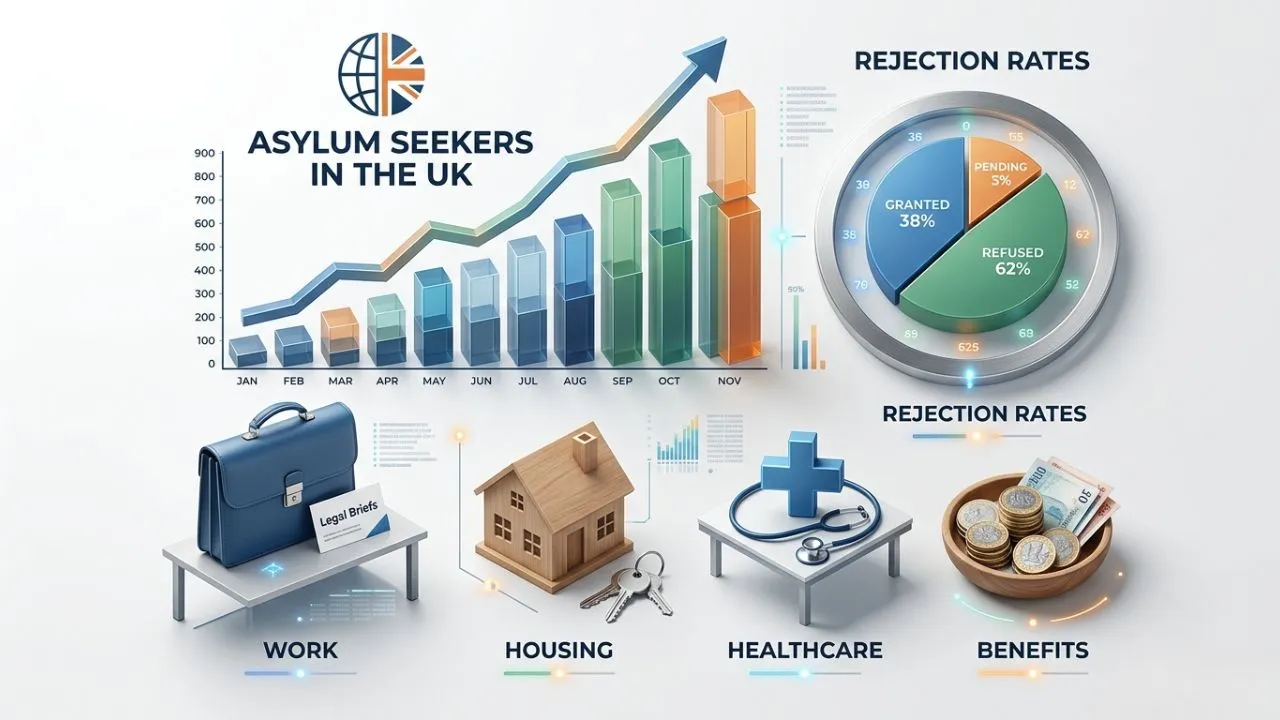
In the year to March 2026, there were 76,714 asylum applications (Asylum Seekers in the UK), covering 93,525 people — a 9% fall on the year before. Pakistan, Eritrea, Iran, Afghanistan, Bangladesh and Sudan topped the list of origin countries. Measured per head of population, the UK actually sits mid-table across Europe, ranking around 12th to 15th depending on which year’s comparison you use — not the outlier the loudest headlines sometimes suggest, but not negligible either.
The backlog tells its own story. The number of asylum cases waiting for an initial decision peaked at roughly 134,000 in June 2023, and has since fallen by around 73% to about 35,700 by March 2026. That’s genuine progress on paper. But the wider ‘work in progress’ caseload — including appeals and people awaiting removal after a refusal — still ran to over 224,000 cases as of mid-2024, and that backlog quadrupled in size across the previous decade. Clearing the front door hasn’t emptied the building.
Statistics: Key Figures for Asylum Seekers in the UK
| Metric | Figure | Period |
|---|---|---|
| Asylum applications | 76,714 | Year to March 2026 |
| People covered by those applications | 93,525 | Year to March 2026 |
| Change vs previous year | down 9% | Year on year |
| Top origin countries | Pakistan, Eritrea, Iran, Afghanistan, Bangladesh, Sudan | Year to March 2026 |
| UK rank per head of population (Europe) | ~12th-15th highest | 2025/2026 comparisons |
| Initial-decision backlog (peak) | ~134,000 cases | June 2023 |
| Initial-decision backlog (current) | ~35,700 cases | March 2026 |
| Fall from peak | down 73% | 2023 to 2026 |
| Total work-in-progress caseload (incl. appeals/removals) | ~224,700 cases | June 2024 |
| – of which awaiting initial decision | 39% | June 2024 |
| – of which post-refusal (appeal/removal stage) | 61% | June 2024 |
| Caseload growth | Quadrupled | 2014 to 2024 |
Note: “Year to March 2026” = the 12 months from April 2025 to March 2026 (a rolling annual period, not a calendar year).
How Do Asylum Seekers Arrive in the UK?
There’s no single route in, and this is where a lot of public debate gets muddled. The main pathways are:
- Small boat crossings — around 39,000 people were detected crossing the Channel in the year to March 2026, roughly 90% of all detected unauthorised arrivals. Over half came from just five countries: Eritrea, Afghanistan, Iran, Sudan and Somalia. Numbers were almost non-existent before 2018, peaked around 46,000 in 2022, and have fluctuated since — down sharply in early 2026 compared with the same point in 2025.
- Arriving on a visa, then claiming asylum in-country — a significant share of claims come from people already lawfully in the UK on a study, work or visit visa, who then apply for protection before that leave expires.
- Clandestine entry — lorries, containers, and other undetected methods. By definition, nobody knows the true scale of this route, since it isn’t captured until someone is caught or comes forward.
- Resettlement schemes — legal, pre-arranged routes such as the UK Resettlement Scheme and the now-closed Vulnerable Persons Resettlement Scheme for Syrian nationals, which brought over 20,000 people to the UK through a managed, off-shore process rather than a spontaneous claim.
A striking fact from the Home Office’s own data: around 90% of small boat arrivals in 2025 went on to formally claim asylum, and the Home Office has confirmed enforced returns to Afghanistan and Sudan — two of the top nationalities on this route — are currently on hold, along with Iran and Syria not accepting enforced returns at all. That single administrative reality shapes a great deal of what happens next in the system.
Why Are There So Many Asylum Seekers in the UK? Untangling a Contested Question
This is the question that generates the most heat and, honestly, the least consensus. A few things are reasonably well evidenced, though, whichever side of the debate you sit on.
- Global displacement is at record levels — wars in Sudan, ongoing repression in Eritrea, instability in Afghanistan and Iran all feed the pool of people seeking protection somewhere, not just in the UK specifically.
- Academic research, including work cited by the Migration Observatory, generally finds that small variations in asylum policy between European countries are not the dominant factor in where someone chooses to claim — existing family and diaspora ties, language, and perceptions of safety tend to matter more.
- Smuggling networks have professionalised. Reported per-person Channel crossing prices fell from roughly €14,000 in 2018 to under €4,000 by 2024, and were reported around €1,500 in early 2026 — a lower price point that, economically, makes the route accessible to more people.
- Government critics point to pull factors: the UK’s existing diaspora communities, English language, and (until recent reforms) a relatively clear route to settlement as reasons the UK specifically is chosen over other safe European countries.
Both of those last two bullet points are genuinely contested in the literature, and reasonable, well-informed people land in different places on which matters more. I’d be doing you a disservice pretending otherwise.
How Many Asylum Seekers Are Rejected in the UK?
At initial decision stage, roughly 42% of asylum applications in the UK were refused in 2025 (meaning around 58% led to some form of grant, though that figure moves year to year — it was as low as 12% granted in 2004 and as high as 73% granted in 2022). Looking at it the other way for the most recent full year of data: about 39% of initial decisions in the year to March 2026 were grants of refugee status or humanitarian protection, with the remainder refused.
- Refusal doesn’t always end the process. Historically, around three-quarters of refused main applicants have lodged an appeal.
- Roughly a third of determined appeals are allowed, overturning the original refusal — a rate that’s stayed fairly stable, sitting at 39% of 2025 appeals allowed.
- Grant rates vary sharply by nationality. Eritrean applicants, for instance, have had initial grant rates as high as 96–99% in some recent years, dropping to around 87% more recently — reflecting how heavily individual case outcomes depend on conditions in the country of origin.
- Unaccompanied children fare somewhat better than the overall average: 52% of decided child claims in the year to March 2026 resulted in a grant of asylum.
Asylum Applications in UK: Rejections Percentage
Initial decisions • year to March 2026
Where Do Asylum Seekers Live in the UK?
Accommodation has become one of the most politically charged parts of the whole system, and for understandable reasons — it’s the most visible, locally, of anything the asylum process does.
| Support type | Who it’s for | Typical setting |
|---|---|---|
| Section 98 support | Temporary, while a Section 95 application is assessed | Initial accommodation, often hotels, short-term |
| Section 95 support | Asylum seekers with a pending claim, assessed as destitute | Dispersal accommodation — ordinary housing outside London/the South East, or full-board sites |
| Section 4 support | Some refused asylum seekers who cannot yet leave the UK | Similar accommodation, support paid in non-cash form |
Full-board accommodation — hotels and large sites, including some former Ministry of Defence facilities — has drawn the most sustained criticism, both over cost and over local community strain. Reported daily hotel costs have run into the millions of pounds nationally at various points since 2022, and the National Audit Office has estimated the asylum system could cost in excess of £15bn over ten years if current patterns continue. The government has repeatedly stated an intention to reduce reliance on hotels in favour of dispersal housing, with mixed success depending on local authority capacity.
What Benefits Do Asylum Seekers Get in the UK?
Asylum seekers in the UK cannot claim mainstream welfare benefits like Universal Credit. Instead, those assessed as destitute receive Section 95 support, set at a flat weekly rate.
- £49.18 per person per week (about £7 a day) for those in self-catered accommodation or on subsistence-only support
- £9.95 per person per week for those in full-board accommodation where meals are already provided
- An extra £5.25 a week for pregnant women, £9.50 a week for babies under one, and £5.25 a week for children aged one to three
Support is paid onto a pre-loaded ASPEN card, usable in shops or for cash withdrawal. It’s worth being blunt about the scale of that figure: £49.18 a week works out to roughly £7 a day to cover food, clothing, transport and communication — well below the poverty line by any conventional UK measure, a point campaign groups like the Refugee Council and Asylum Matters raise consistently.
A regulatory change that took effect on 2 June 2026 shifted the legal basis of this support from a statutory duty to a discretionary power. In practice, support is still generally provided, but the Home Office now has wider scope to refuse, suspend or withdraw it — including, newly, in cases involving suspected illegal working.
Benefits Asylum Seekers Are Entitled To: Healthcare, Education and Legal Aid
- Healthcare — free access to the NHS, including free prescriptions, dental care, eyesight tests and glasses vouchers.
- Education — children have the same entitlement to state education as any other child of compulsory school age, including free school meals eligibility and 15 hours of free early years childcare for two-to-five-year-olds.
- Legal advice — asylum claims and related appeals are within scope for legal aid, though the availability of a solicitor with capacity to take a case varies significantly by region.
- Accommodation — as set out above, for those who pass the destitution test.
Can Asylum Seekers Work in the UK?
This is one of the most searched, and most misunderstood, parts of the whole system. The honest answer: only in narrow, specific circumstances.
- Asylum seekers cannot work while their initial claim is being decided, in almost all cases.
- If a decision has been outstanding for more than 12 months, through no fault of the applicant, they can apply for permission to work.
- Even if granted, that permission is tightly restricted to roles on a specific Home Office list — until March 2026, the Immigration Salary List; for applications from 26 March 2026 onwards, the narrower Appendix Skilled Occupations list, requiring graduate-level (RQF6+) roles.
- In practice, this restriction has made the right to work largely theoretical for most asylum seekers — the eligible roles are specialist, graduate-entry positions that few people arriving via the asylum route are realistically positioned to take up, language barriers and recognition of overseas qualifications aside.
- Children under 18 cannot be granted permission to work under any circumstances.
- Anyone caught working illegally risks their asylum support being suspended or withdrawn entirely.
Once someone is granted refugee status or humanitarian protection, this changes completely — they get unrestricted access to the labour market, the same as any other UK resident with leave to remain.
Can Asylum Seekers Volunteer in the UK?
Yes, and this is actively encouraged by the Home Office itself. Volunteering is legally distinct from work — it’s unpaid, involves no contractual obligation, and benefits a charity, public body, or community rather than functioning as a substitute for paid employment.
- Permitted: unpaid roles with charities or public sector organisations, alongside reasonable expense reimbursement (travel, meals)
- Not permitted: anything that functions as a salaried role in substance, regardless of what it’s called
- Volunteering must not interfere with asylum process obligations — interviews, reporting requirements, and so on
- The Home Office’s own guidance frames volunteering as good for integration prospects if the claim eventually succeeds — a rare point of genuine, non-controversial common ground in this whole debate
How Long Can Asylum Seekers Stay in the UK?
This depends entirely on where someone is in the process, and the rules here changed significantly in 2026.
- While a claim is pending: indefinitely, in principle, for as long as the decision and any appeal take — which, given the backlog described earlier, can run to years in complex cases.
- If refused with no further appeal rights: support and accommodation are expected to stop (typically 21 days after the decision, or a little longer if notice arrives by post), and the person is expected to leave the UK, though enforcement varies hugely depending on whether their country of origin accepts returns.
- If granted protection: under reforms applying to claims made on or after 2 March 2026, recognised refugees now receive temporary status renewable every 30 months, rather than a more direct path to settlement — and those who arrived without authorisation may wait up to 30 years before qualifying for permanent settlement, a substantial change from the previous system.
That 30-year figure is genuinely one of the most consequential policy shifts of 2026, and it’s worth flagging as still relatively new and politically contested — expect further legal challenges and possible amendment as it beds in.
What Rights Do Asylum Seekers Have in the UK?
Beyond support and accommodation, asylum seekers in the UK retain a defined set of legal rights, rooted in the 1951 Refugee Convention (which the UK signed in 1954) and domestic law.
- The right to have a claim heard and individually assessed, rather than refused on nationality or route of arrival alone
- Protection from return to a country where they face persecution (the principle of non-refoulement)
- Access to a lawyer and, where eligible, legal aid, for the asylum process and related appeals
- The right to appeal a refused claim to the First-tier Tribunal in most cases
- Access to healthcare, education for children, and destitution support, as detailed above
One right that consistently draws criticism from refugee organisations: there’s no maximum time limit on immigration detention in the UK, meaning someone can, in principle, be held indefinitely. In the year to March 2026, 22,586 people passed through immigration removal centres, of whom 13,354 were asylum seekers — a 10% rise on the previous year. This remains one of the sharpest points of disagreement between the Home Office and groups like the Refugee Council and Amnesty International.
The Political Debate: Two Views of the Same System
However you feel personally about any of this, it’s worth setting out honestly what each side of the argument actually says, because both draw on real evidence.
The case for tighter controls
- The asylum and small boats system has cost the public purse an estimated £15bn-plus over a decade, according to the National Audit Office, with hotel accommodation alone running into the millions of pounds daily at peak points
- A functioning border requires credible removal of those refused protection, which enforcement data suggests has struggled to keep pace with claim volumes
- Deterrence-focused reforms, including the 2026 changes to settlement timelines, are intended to reduce the incentive for unauthorised Channel crossings specifically
The case for a more humanitarian approach
- Current support rates — £49.18 a week — sit well below any recognised UK poverty line, and campaigners argue this causes real, measurable hardship, particularly for families with children
- Indefinite detention, with no maximum time limit, is flagged repeatedly by the UN and domestic refugee organisations as out of step with comparable countries
- Academic evidence suggests policy deterrence has limited effect on crossing numbers compared with global displacement drivers, meaning tougher domestic rules may not meaningfully reduce arrivals while increasing hardship for those already here
Both positions are held by serious, informed people. This is precisely the kind of question where I’d rather hand you the numbers than the verdict.
Quick Reference: Asylum Seeker Status at a Glance
| Question | Short answer (2026) |
|---|---|
| Can they work? | Only after 12+ months waiting, and only in graduate-level shortage roles — rare in practice |
| Can they volunteer? | Yes, for charities and public bodies, unpaid |
| What financial support do they get? | £49.18/week (self-catered) or £9.95/week (full board) |
| Where do they live? | Dispersal housing, hotels, or MoD/large sites, depending on availability |
| How long can a claim take? | Indefinite while pending; backlog has fallen but remains substantial |
| What happens if refused? | Appeal possible in most cases; support ends ~21 days after appeal rights are exhausted |
| Path to settlement if granted? | 30-month renewable status; up to 30 years to settlement for unauthorised arrivals (2026 rules) |
Frequently Asked Questions (FAQs)
Q. How many asylum seekers are rejected in the UK?
Around 42% of asylum applications were refused at initial decision in 2025, though refusal rates vary significantly year to year and by nationality. Around a third of appealed refusals are subsequently overturned.
Q. Can asylum seekers work in the UK?
Only if a decision has been outstanding for over 12 months through no fault of their own, and even then only in specific graduate-level roles on a restricted Home Office list — in practice, very few qualify for suitable positions.
Q. How long can asylum seekers stay in the UK?
For as long as their claim and any appeal are pending. If granted protection under 2026 rules, status is temporary and renewable every 30 months, with up to 30 years before settlement for those who arrived without authorisation.
Q. What benefits do asylum seekers get in the UK?
Weekly support of £49.18 (self-catered) or £9.95 (full board), plus free NHS healthcare, free education for children, and asylum accommodation if assessed as destitute.
Q. Can asylum seekers volunteer in the UK?
Yes. Unpaid volunteering for charities and public bodies is permitted and actively encouraged, provided it doesn’t function as paid employment in substance.
Conclusion
Ten years in, the thing that’s changed least about this beat isn’t the politics — that shifts with every government. It’s the gap between how the system is described in headlines and how it actually functions, day to day, for the people inside it and the officials running it. The numbers above are real, sourced from the Home Office, the House of Commons Library, and the UNHCR. What you make of them — whether the balance between control and compassion is currently right — is, genuinely, for you to decide.
Disclaimer:
UK Visa Consultant is affiliated with regulated immigration professionals with years of hands-on experience in successful UK visa applications. We closely monitor UKVI/Home Office updates and use only official guidance and sources. The information provided in this blog is subject to change depending on UK immigration laws and policies. It is recommended to stay updated regarding such changes and confirm the details through an official source before proceeding further. Our priority is unwavering accuracy and user trust. Here’s how you can maximize your success:
- Always rely on updates from the UK Government, the Home Office, and regulated immigration advisors.
- Keep up with the latest changes (e.g., digital eVisas, new sponsor requirements, post-Brexit rules).
- If in doubt, consult directly with an accredited UK immigration solicitor or OISC advisor.
- Ensure documentation, financials, and employment/education offers are fully compliant.
- Avoid scams and unregulated agents—your application’s credibility is paramount.
- Our consultants undergo regular professional development, maintain GDPR-compliant data handling, and provide transparent, ethical advice.


Leave a Reply
You must be logged in to post a comment.