



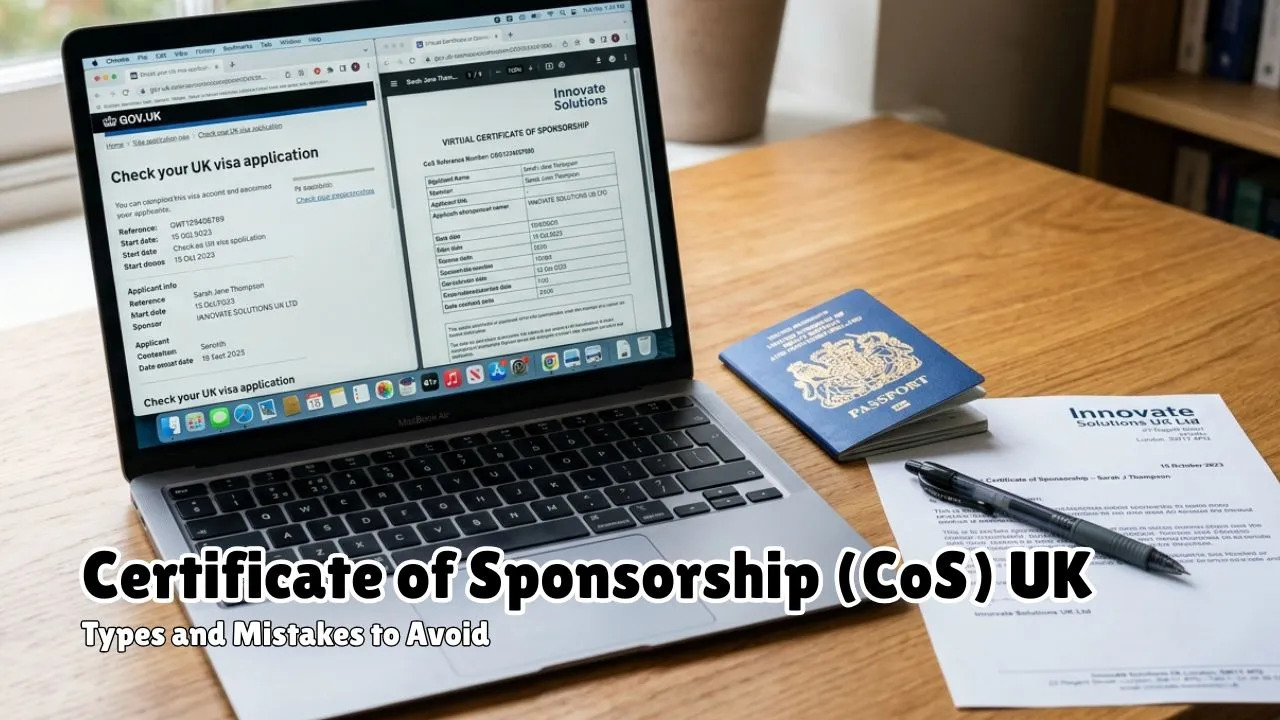

What a CoS actually is, how Defined and Undefined certificates work, what the 2026 fee structure looks like, and the errors that still derail experienced sponsors — as witnessed from the desk of the decision-making officer.
There was a large NHS trust — experienced sponsor, years of international recruitment — that lost a consultant surgeon’s visa application on what looked, from the outside, like a clerical error. The HR team had issued an Undefined Certificate of Sponsorship. The surgeon was applying from Mumbai, outside the UK. Wrong type. Automatic refusal. No correction, no appeal on that ground, no grace period. The Certificate of Sponsorship fee was gone, the visa application fee was gone, and the surgeon — who had already resigned his position in India on the assumption the visa was a formality — had to wait months while the process restarted. The trust’s compliance officer described the moment she realised the mistake as the kind of quiet that follows something irreversible. Nobody had checked the one rule that mattered most.
That case — real in its shape, if not its precise detail — is why the Certificate of Sponsorship (CoS) sits at the centre of so much UK immigration risk. It is, on the surface, a simple document. A reference number. A digital record linking an employer to a specific worker for a specific role. In practice, it is the mechanism by which everything else is tested: salary, job description, skill level, location, and the employer’s own standing with the Home Office. Get it wrong and there is no fixing it mid-application.
This guide covers what a Certificate of Sponsorship (CoS) is, the Defined and Undefined distinction that trips up even experienced sponsors, what the 2026 fees look like, how long the process takes, and what a completed certificate actually contains. No filler — just the detail that matters.
What Is a Certificate of Sponsorship (CoS)?
A Certificate of Sponsorship (CoS) is a digital record — not a physical document, despite the name — created by a licensed UK employer through the Home Office’s Sponsor Management System (SMS). It is assigned to a specific overseas or in-UK worker for a specific role, and it contains the information that UKVI uses to assess whether a Skilled Worker visa application can be approved.
The CoS itself is not the visa. It is the prerequisite for one. Once an employer assigns a CoS, the worker receives a reference number — a long alphanumeric code — which they use in their visa application to link themselves to the sponsoring employer. UKVI then checks whether the CoS details match the application, whether the role genuinely qualifies, and whether the salary meets current thresholds.
A sponsor licence is the employer-level permission. The Certificate of Sponsorship (CoS) is the per-worker permission that sits underneath it. An employer cannot issue a CoS without a valid sponsor licence. A worker cannot apply for a Skilled Worker visa without a valid CoS. The two are separate but sequential — and both have to be right.
Defined vs Undefined Certificate of Sponsorship (CoS): The Distinction That Cannot Be Got Wrong
An immigration consultant once described the Defined vs Undefined choice as the moment where sponsors most often demonstrate how little they understood about the route they’d been using for years. It wasn’t arrogance. It was just that nobody had ever sat them down and explained that this single decision — which type of CoS to assign — was the one that carried the most immediate consequences for getting it wrong. Most companies find out the hard way, which is to say, after a refusal.
There are two types of Certificate of Sponsorship (CoS) in the UK system. They serve different purposes. They are not interchangeable. Using the wrong one is not a recoverable error.
Defined Certificate of Sponsorship (CoS)
A Defined CoS is used when the worker is applying for a Skilled Worker visa from outside the UK — entry clearance, in the official terminology. The employer must first request a Defined CoS from the Home Office. UKVI assesses that request, checks the vacancy is genuine, and typically processes it within one working day. It can take up to five if the Home Office refers the request for further checks — which happens more than sponsors expect, particularly when salary figures sit close to the threshold or the job description is vague.
Defined CoS sit within an allocation system. Sponsors must request an allocation from the Home Office quarterly, based on anticipated recruitment needs. If a sponsor has used up their allocation, they must apply for more before they can issue further Defined certificates. That process — the allocation request itself — can take considerably longer than the single-CoS request, sometimes running to weeks during periods of high demand.
Undefined Certificate of Sponsorship (CoS)
An Undefined CoS is used when the worker is already in the UK and is either extending their stay, switching from another visa type, or changing employer. The sponsor does not request it from the Home Office in advance — it is drawn from the employer’s annual allocation and assigned directly through the SMS, taking effect immediately. UKVI checks the Undefined CoS at the visa decision stage rather than at the point of assignment.
The practical difference in speed is considerable. An Undefined CoS can be assigned to a worker within minutes of a decision being made. A Defined CoS requires the Home Office to assess it first. For in-country recruitment — a team member whose Student visa is expiring, a healthcare worker switching from one route to another — Undefined is the right instrument.
| Feature | Defined CoS | Undefined CoS |
| When it’s used | Worker applying from outside the UK (entry clearance) | Worker already in UK — extension, switch or employer change |
| Home Office pre-approval required? | Yes — request submitted through SMS, assessed before assignment | No — assigned immediately from annual allocation |
| Processing time | Typically 1 working day; up to 5 if referred | Instant — drawn from existing allocation |
| Allocation system | Quarterly request to Home Office | Annual allocation, renewed automatically |
| Risk if wrong type used | Automatic visa refusal, fees lost, no correction path | Automatic visa refusal, fees lost, no correction path |
Certificate of Sponsorship UK Cost in 2026
A finance director at a mid-sized technology company once looked at the true cost of sponsoring three senior hires from the United States and very nearly cancelled the recruitment. Not because of salary. Because of the sponsorship cost stack — CoS fee, Immigration Skills Charge, the sponsor licence renewal they hadn’t budgeted for — which she hadn’t known about when the HR team put together the initial business case. The CoS fee was only one layer. The Immigration Skills Charge was the number that actually changed the conversation.
The Certificate of Sponsorship cost changed significantly in April 2025, when the Home Office increased the CoS assignment fee by 120%. As of the April 2026 fee schedule, the picture looks like this:
| Cost component | Amount | Who pays | Notes |
| CoS assignment fee | £525 | Employer | Per certificate. Non-refundable. Increased from £239 in April 2025. |
| Immigration Skills Charge (ISC) — Small sponsor | £364 per year | Employer (cannot be passed to worker) | Applies per sponsored worker for the visa duration. |
| Immigration Skills Charge (ISC) — Large sponsor | £1,000 per year | Employer (cannot be passed to worker) | For a 3-year visa, ISC alone reaches £3,000 per hire. |
| Sponsor licence fee — Small sponsor | £611 | Employer | Licence required before any CoS can be issued. Lasts 4 years. |
| Sponsor licence fee — Large sponsor | £1,682 | Employer | One-off at application; renewal fee applies after 4 years. |
| Skilled Worker visa application fee | Varies by length and location | Usually worker | Overseas applications from approximately £719; in-UK from £827. |
| Immigration Health Surcharge (IHS) | £1,035 per year (2026) | Usually worker | Payable upfront for the full visa duration. |
The ISC cannot, under any circumstances, be passed to the worker. Neither can the CoS fee. These are employer-side obligations, and attempting to recover them from the sponsored employee — formally or informally — is a breach of sponsor duties that the Home Office takes seriously. A sponsor doing this risks their licence.
Total employer-side costs for a single Skilled Worker hire, including ISC for a three-year visa, typically run between £1,500 and £3,000 or more, before any legal advisory or recruitment costs. That figure surprised many employers when the April 2025 fee increase came through, and it continues to shape how HR teams present international recruitment business cases internally.
What Does a UK Certificate of Sponsorship Contain?
Because the Certificate of Sponsorship (CoS) is a digital record rather than a physical certificate, there is no single-page document to show. The worker receives a reference number; UKVI accesses the underlying record directly. But the information the CoS must contain is precisely defined, and any discrepancy between the CoS and the visa application — even a minor one in a job title or salary figure — creates a compliance problem at the decision stage.
A Certificate of Sponsorship (CoS) must include:
- The worker’s full name, date of birth, and nationality.
- The job title and Standard Occupational Classification (SOC 2020) code.
- The salary — annual and hourly rate, both gross figures.
- The employment start date and end date (or confirmation it is permanent).
- The main workplace address.
- Whether the role is full-time or part-time, and contracted hours per week.
- The sponsor’s licence number and details.
- Any allowances being paid, broken down separately from basic salary.
Salary is the field that causes most downstream problems. Since April 2024, the general Skilled Worker salary threshold sits at £38,700. From changes introduced in April 2026, the threshold for most roles is £41,700, or the relevant SOC going rate if that is higher. Both tests apply. A CoS that meets one but not the other will not secure the visa.
Allowances — things like accommodation supplements, training payments, or London weighting — are not all treated equally by UKVI. Some can be counted towards the salary threshold; others cannot. Getting this wrong on the CoS is a very common source of last-minute complications that an experienced immigration adviser would have caught at draft stage.
Certificate of Sponsorship (CoS) UK Sample: What One Actually Looks Like
There is no official published sample of a Certificate of Sponsorship (CoS) because the record exists within the SMS rather than as a downloadable template. What does exist — and what employers and workers can both access — is the CoS confirmation page generated when the certificate is assigned.
This confirmation shows the CoS reference number (a 10-digit alphanumeric code, used in the visa application), the worker’s details, the job, the salary, and a validity timestamp. The worker uses this reference to complete their online visa application, and it is the reference UKVI uses to pull the underlying data for assessment.
Certificate of Sponsorship (CoS) Processing Time in the UK
A specialist engineering firm trying to bring in a structural engineer from India ahead of a major project start date learned an expensive lesson about the difference between CoS processing time and visa processing time. The Defined CoS came back from the Home Office in two days — efficient, no queries. The visa application itself, made in standard processing from New Delhi, then took another four weeks. The project start date was missed anyway. The total timeline — CoS request, visa application, travel, onboarding — had never been mapped out end-to-end before the offer was made. That mapping exercise is where experienced sponsors spend the time that inexperienced ones skip.
Certificate of Sponsorship (CoS) processing time in the UK differs sharply between the two types:
- Defined CoS: typically 1 working day. The Home Office can take up to 5 working days if the request is referred for additional checks — which may happen when job descriptions are imprecise, salary figures are borderline, or the employer is relatively new to sponsorship. Some specialists now advise submitting extensive supporting evidence with the initial Defined CoS request specifically to reduce the chances of a referral.
- Undefined CoS: instant — assigned directly through the SMS from the sponsor’s existing allocation, with no Home Office pre-assessment. UKVI scrutinises Undefined CoS at the visa decision stage instead.
Once a CoS is assigned — of either type — it is valid for 3 months. The worker must apply for their visa within that 3-month window. Missing it means the CoS expires and a new one must be assigned, with a new fee. This is a more frequent problem than it might seem, particularly when workers are slow to gather their visa application documents or when there are delays at the visa application centre stage.
The CoS processing time is only one part of the overall timeline. The end-to-end process — from deciding to make an overseas hire to the worker’s first day in the UK — typically runs to several months once sponsor licence acquisition, CoS request, visa application, and travel are all factored in. For in-UK switches, the timeline is considerably shorter, but the compliance obligations are the same.
| Stage | Typical time | Notes |
| Sponsor licence (if not already held) | Up to 8 weeks | Priority service available for £500, reducing to approximately 10 working days |
| Defined CoS request | 1 working day (up to 5 if referred) | Additional evidence at submission reduces referral risk |
| Undefined CoS assignment | Immediate | Requires available allocation; allocation request if exhausted can take weeks |
| Skilled Worker visa — overseas (standard) | Approximately 3 weeks | From biometric appointment; priority service available |
| Skilled Worker visa — in-UK (standard) | Approximately 8 weeks | From submission; priority service reduces this |
| Total end-to-end (overseas hire, no licence) | 3–5 months minimum | Varies significantly by country and individual complexity |
Why CoS Applications Go Wrong: The Recurring Mistakes
A compliance audit at a care home group revealed something that made the immigration consultant conducting it pause. Three of the Certificates of Sponsorship issued in the previous eighteen months had incorrect SOC codes. The workers were employed as senior carers — SOC 6145 — but the CoS records showed a different code, one that had been used in the original sponsor licence application years earlier and never updated.
None of the three visa applications had been refused, because the salary thresholds for both codes were similar and the discrepancy hadn’t triggered a flag. But in a compliance visit, those CoS records would raise a direct question about whether the employer genuinely understood what they were sponsoring. The answer, in that case, was that they didn’t. They’d been copying and pasting from a template since 2021.
- Wrong CoS type. The most consequential error: Defined for an in-UK worker, or Undefined for someone applying from abroad. Automatic refusal, no correction, full fee loss.
- Incorrect SOC code. The Standard Occupational Classification code determines the going rate and in some cases the visa eligibility itself. A wrong code means the salary threshold being applied may be wrong — either too low, creating a compliance risk, or too high, causing an unnecessary refusal.
- Salary errors. The dual-test framework — general threshold and occupation going rate — both apply from 2026. A salary that passes one but not the other fails. Pro-rating for part-time roles must be calculated accurately. Allowances must be correctly characterised as qualifying or non-qualifying.
- Expired CoS. Failing to apply for the visa within 3 months of the CoS assignment date. Particularly common in overseas recruitment where document gathering takes longer than expected.
- Mismatched details. Any discrepancy between the CoS and the visa application — salary figures, job title, employer address — creates a compliance problem that UKVI will query and may refuse on.
- CoS issued before offer letter signed. Some sponsors assign CoS records before employment contracts are finalised, which creates a compliance record showing a start date that doesn’t match eventual onboarding. A small detail that becomes significant under audit.
- Allocation exhausted. Particularly for Defined CoS, if the annual allocation runs out at a critical hiring point, the recruitment is stalled until a new allocation is approved — a process that can take weeks.
Frequently Asked Questions (FAQs)
Q. What is the difference between a Defined and Undefined CoS?
A Defined CoS is used for workers applying from outside the UK. It requires Home Office pre-approval and typically takes one working day to process. An Undefined CoS is for workers already in the UK, can be assigned immediately from the sponsor’s allocation, and is assessed by UKVI at the visa decision stage. Using the wrong type causes automatic refusal.
Q. How much does a Certificate of Sponsorship (CoS) cost in the UK?
The CoS assignment fee is £525 per certificate as of 2026, payable by the employer. Additional costs include the Immigration Skills Charge (£364–£1,000 per year, per worker, depending on sponsor size), the sponsor licence fee, and the worker’s visa application fee and Immigration Health Surcharge.
Q. How long does Certificate of Sponsorship processing take?
A Defined CoS takes approximately 1 working day (up to 5 if referred). An Undefined CoS is assigned immediately. Once assigned, the CoS is valid for 3 months, during which the worker must submit their visa application.
Q. Is a Certificate of Sponsorship the same as a Tier 2 sponsorship?
The Tier 2 route was replaced by the Skilled Worker route in December 2020. A Tier 2 Certificate of Sponsorship is the legacy term for what is now simply a Certificate of Sponsorship under the Skilled Worker route. The underlying system and most compliance obligations carried over from Tier 2.
Q. Can I see a sample Certificate of Sponsorship (CoS)?
There is no official published sample because the CoS is a digital record held within the Sponsor Management System. The worker receives a reference number; UKVI accesses the underlying data directly. Any sample circulating online is either a screenshot of a confirmation page or a fabricated reproduction — neither should be relied upon as authoritative.
Q. Can an employer pass the Certificate of Sponsorship cost to the worker?
No. The CoS fee and the Immigration Skills Charge are employer obligations that cannot, under any circumstances, be recovered from the sponsored worker. Doing so is a breach of sponsor duties and risks the sponsor licence.
Final Thoughts: The CoS Is the Entire Process in One Record
The Certificate of Sponsorship is small in terms of what it looks like — a reference number, a digital form — and enormous in terms of what it carries. Every fact in that record is a statement to the Home Office about the role, the employer, and the worker. Every discrepancy is a compliance question. Every error of type or timing has consequences that play out weeks later, when the visa decision comes back and the money is already gone.
Experienced sponsors treat the CoS not as an administrative formality but as the document that locks in every decision made during the recruitment process. The job title has to be the right one. The SOC code has to match. The salary has to clear both thresholds. The type — Defined or Undefined — has to correspond to where in the world the worker currently is.
The employers who do this well are the ones who built a process around it, rather than handling it case by case. The ones who have problems are, almost without exception, the ones who assumed it was simpler than it is.
Disclaimer:
UK Visa Consultant is affiliated with regulated immigration professionals with years of hands-on experience in successful UK visa applications. We closely monitor UKVI/Home Office updates and use only official guidance and sources. The information provided in this blog is subject to change depending on UK immigration laws and policies. It is recommended to stay updated regarding such changes and confirm the details through an official source before proceeding further. Our priority is unwavering accuracy and user trust. Here’s how you can maximize your success:
- Always rely on updates from the UK Government, the Home Office, and regulated immigration advisors.
- Keep up with the latest changes (e.g., digital eVisas, new sponsor requirements, post-Brexit rules).
- If in doubt, consult directly with an accredited UK immigration solicitor or OISC advisor.
- Ensure documentation, financials, and employment/education offers are fully compliant.
- Avoid scams and unregulated agents—your application’s credibility is paramount.
- Our consultants undergo regular professional development, maintain GDPR-compliant data handling, and provide transparent, ethical advice.





Leave a Reply
You must be logged in to post a comment.