



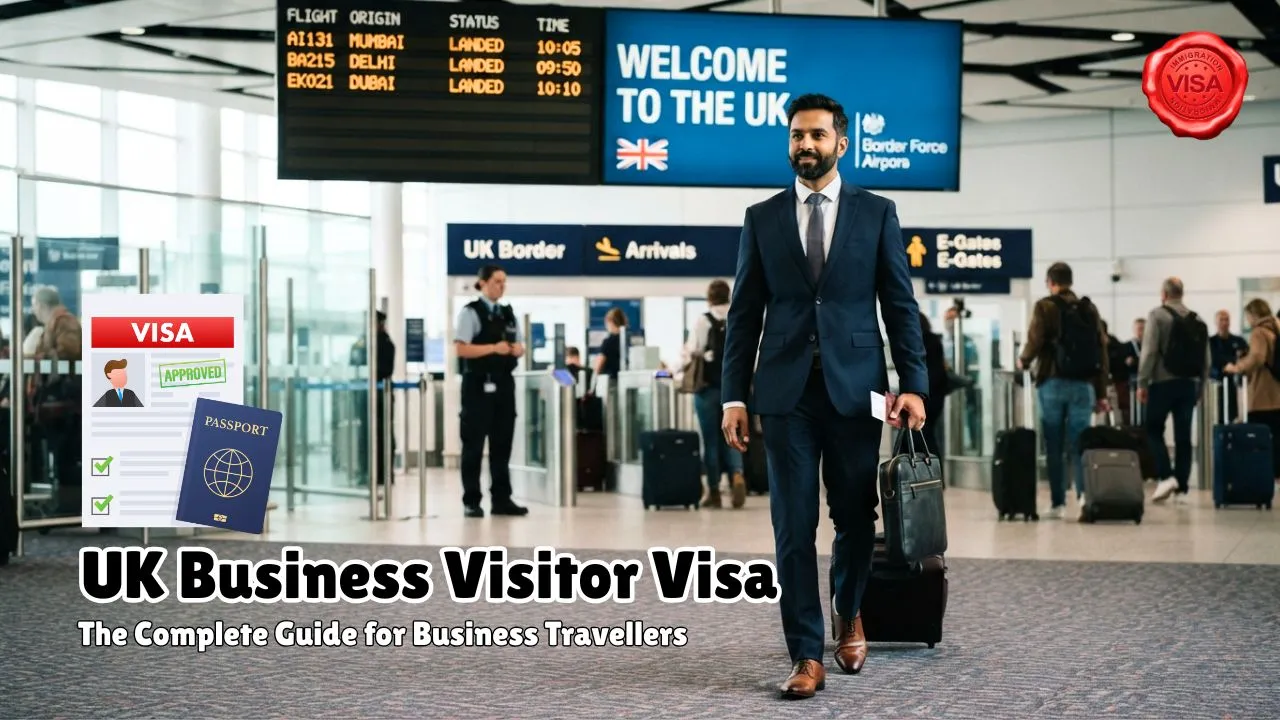

Rajiv had done this trip a dozen times before — Mumbai to Heathrow, three days of supplier meetings, home again before the weekend. So when his company’s UK immigration paperwork came back flagged for further checks, he was genuinely baffled. He’d never worked in the UK. He’d never taken a salary from a British company. What he had done, unknowingly, was let his host’s invitation letter describe him as “joining the UK team for a short project” — four words that turned a routine business trip into a compliance headache.
That’s the thing about the UK Business Visitor Visa. It looks simple from a distance. Fly in, attend some meetings, fly out. But the line between “attending meetings” and “working” is drawn far more precisely than most business travellers, or their well-meaning UK hosts, ever realise. Get the wording wrong, misunderstand what’s actually permitted, and a straightforward trip becomes a genuine immigration problem.
This guide sets out exactly where that line sits, what the Home Office actually expects to see, and how to get a business trip through the system cleanly, the first time.
What Is a UK Business Visitor Visa, Actually?
Here’s the first thing worth clearing up, because it trips up more applicants than almost anything else: there is no separate “Business Visa” as a standalone category. What people call the Business Visitor Visa is, technically, a Standard Visitor Visa, with business listed as the purpose of visit.
Same application. Same fee. Same six-month cap per visit. The difference is entirely in the activities being declared and evidenced, not in the form itself.
This matters practically, because it means a Standard Visitor visa already held for tourism can, in principle, cover a business trip too — provided the actual activities carried out stay within what’s permitted for business visitors under Appendix V and Appendix Visitor: Permitted Activities of the Immigration Rules.
Who Actually Needs a Business Visitor Visa?
Nationals of countries not on the UK’s non-visa national list need to apply for entry clearance before travelling, regardless of how short the trip is or how senior the traveller happens to be.
Non-visa nationals — largely those from the EU, US, Canada, Australia, and similar countries — don’t need a full visa for short business trips, but since the rollout of the UK’s Electronic Travel Authorisation scheme, many of them now need an ETA before boarding. The ETA system has been expanding steadily through 2026, and it’s worth checking current eligibility carefully rather than assuming last year’s rules still apply, since coverage keeps growing.
Either way — full visa or ETA — the underlying eligibility test is the same: genuine visitor intentions, permitted activities only, and a clear plan to leave.
UK Business Visitor Visa Requirements
To qualify, an applicant needs to satisfy a caseworker of the following:
- Genuinely seeking entry for a purpose permitted under the visitor route
- Intending to leave the UK at the end of the visit
- Not intending to live in the UK through frequent or successive visits
- Able to fund the trip without working or accessing public funds
- Able to meet the cost of onward or return travel
- Not falling foul of general suitability grounds — character, conduct, previous immigration history
None of this is unusual for a visit visa. What makes the business category distinct is the extra layer sitting on top: the specific activities being undertaken need to match, precisely, what Appendix Visitor actually permits for business visitors. Vague or mismatched purpose statements are where a lot of otherwise strong applications come unstuck.
What a Business Visitor Can Actually Do in the UK
This is the part worth committing to memory, because it defines the entire visa. Permitted business activities generally include:
- Attending meetings, conferences, seminars, and training sessions
- Negotiating and signing contracts or business deals
- Conducting site visits, inspections, and audits
- Giving a one-off talk or a short series of talks or speeches
- Attending trade fairs, provided there’s no direct selling to members of the public
- Checking or overseeing the delivery of goods and services on behalf of an overseas employer
- Receiving job-related training, in limited circumstances
- Since January 2024, certain remote working for an overseas employer while visiting, under Appendix Visitor’s expanded provisions
That last point catches a surprising number of people out, because it sounds like a loophole and isn’t one. It permits someone to continue their normal overseas job remotely while in the UK for other permitted purposes — it does not permit taking up UK-based work, covering a UK role, or doing anything for a UK entity.
What Business Visitors in UK Cannot Do — No Exceptions
The prohibited side of this list is where refusals, and worse, compliance breaches, tend to happen. Business visitors must not:
- Take paid or unpaid employment with a UK company
- Do a work placement or internship
- Provide short-term cover for a role within a UK organisation
- Sell goods or services directly to members of the public
- Receive payment from a UK source for services performed in the UK, outside the narrow Permitted Paid Engagement route
- Study for a course lasting more than 30 days, or one that isn’t purely incidental to the visit
A useful, if slightly blunt, way to think about it: if the activity generates value for a UK entity in a way that looks like a role being filled, it’s almost certainly outside the permitted list. Genuine business visitors represent their own overseas employer, in the UK, briefly — they don’t step into UK operations.
Border Force takes this seriously. A visitor declaring “business meetings” who turns up with a laptop full of UK client work, a desk already arranged at a UK office, and a schedule that looks more like employment than a visit invites exactly the kind of scrutiny nobody wants at the border.
UK Business Visitor Visa Documents Required
Documentation needs to build one consistent, coherent picture: genuine business purpose, genuine employer overseas, genuine intention to leave. The typical checklist includes:
Identity and travel documents
- Valid passport with at least one blank page
- Passport-style photograph
- Previous passports showing relevant travel history, if applicable
Employment and business evidence
- Employment confirmation letter from the overseas employer, detailing role and purpose of travel
- Company registration documents, if self-employed or a business owner
- A detailed itinerary of planned business activities, with named contacts and dates
Invitation and host evidence
- A letter of invitation from the UK company or contact being visited (details below)
- Confirmation of any conference, meeting, or trade fair registration
Financial evidence
- Personal or company bank statements, typically covering the last 3 to 6 months
- Evidence of who is funding the trip — self-funded, employer-funded, or UK host-funded
Accommodation and return evidence
- Hotel booking confirmation, or host accommodation details
- Return flight booking or a credible onward travel plan
The UK Business Visitor Visa Invitation Letter: What Actually Belongs In It
An invitation letter isn’t technically compulsory for most business visit applications, but in practice, it’s one of the strongest pieces of supporting evidence a UK host can provide — and a poorly written one can do genuine damage.
A solid business invitation letter should include:
- The date, and a clear addressee — typically “UK Visas and Immigration / Entry Clearance Officer”
- The visitor’s full name, passport number, and nationality
- The relationship between the UK company and the visitor’s overseas employer
- The specific purpose of the visit — meetings, contract negotiation, training, site inspection — with exact dates and locations
- Confirmation of who is covering costs, if the UK company is contributing
- A clear statement that the visit does not involve UK employment, and that the visitor will leave the UK by a stated date
- The host’s name, position, and signature, on official company letterhead
A short sample structure:
Dear Entry Clearance Officer,
I am writing to confirm the invitation of [Visitor’s Full Name], passport number [XXXXXXX], a [job title] at [Overseas Company Name], to visit our offices at [UK Company Name] between [start date] and [end date].
[Visitor’s Name] will be attending meetings related to [specific business purpose — e.g., ongoing supply contract negotiations], and will not undertake any employment, paid or unpaid, during this visit. [UK Company Name] will [cover / not cover] accommodation costs for the duration of the stay.
[Visitor’s Name] is expected to return to [home country] on [return date], and this visit does not form part of any UK-based role.
Yours sincerely,
[Host Name, Position, Company, Contact Details]
The single biggest mistake with these letters is genericness. Caseworkers see enough of them to spot a template instantly. Specific dates, specific named contacts, and a clear, honest description of the actual business purpose carry far more weight than polished but vague corporate language.
UK Business Visitor Visa Fees (2026)
As of 8 April 2026, the standard UK Business Visitor Visa fee structure runs as follows:
| Visa Length | Fee (GBP) |
|---|---|
| Standard Visitor Visa (6 months) | £135 |
| Long-term Visitor Visa (2 years) | £506 |
| Long-term Visitor Visa (5 years) | £903 |
| Long-term Visitor Visa (10 years) | £1,128 |
| UK Electronic Travel Authorisation (ETA) | £20 |
Frequent business travellers often find the long-term multiple-entry options genuinely cost-effective, since each individual entry is still capped at six months, but repeated applications and fees are avoided entirely for several years at a time.
On top of the core fee, Priority and Super Priority services are available in many locations for faster decisions, typically adding several hundred pounds depending on the route chosen.
UK Business Visitor Visa Processing Time
Processing time is the question every corporate travel coordinator asks first, and reasonably so, given how often trips get booked around fixed meeting dates.
- Standard processing: approximately 3 weeks from the biometric appointment
- Priority Service: around 5 working days, where available
- Super Priority Service: next working day, in many key visa application centres
The honest, experienced advice here is simple: book the biometric appointment the moment travel dates are confirmed, not the week before departure. Peak business travel seasons — spring conference season, autumn trade fair season — see visa application centre slots fill up well in advance.
UK Business Visitor Visa Checklist
A quick, practical run-through before submitting:
- Confirm the trip’s purpose fits squarely within permitted business activities
- Complete the online application accurately, matching every date to supporting documents
- Gather employer confirmation, itinerary, and UK invitation letter
- Prepare financial evidence showing the trip is fully funded
- Book the biometric appointment early
- Cross-check passport validity and photo requirements
- Keep copies of everything submitted, in case of later queries or future applications
Business Visitor Visa vs Skilled Worker Visa: Getting the Category Right
This distinction matters enormously, and getting it wrong doesn’t just cause delay — it can create a genuine breach of immigration conditions.
| Feature | Business Visitor Visa | Skilled Worker Visa |
|---|---|---|
| Purpose | Short-term business activities | Taking up UK employment |
| Maximum stay per visit | Up to 6 months | Duration of sponsored role |
| UK salary permitted | No | Yes |
| Sponsor required | No | Yes (licensed UK sponsor) |
| Can switch in-country to work | No | N/A |
| 2026 fee | £135 (6-month) | Varies by length and role |
A consultant flying in to advise on a project, negotiate terms, and fly out again fits the business visitor route neatly. Someone filling an actual operational role within a UK team, drawing a UK salary or its equivalent, does not — regardless of how the trip gets described on paper.
Common Pitfalls That Derail UK Business Visitor Visa Applications
- Vague or generic invitation letters that read like a template rather than a specific, dated business relationship
- Describing the trip in terms that sound like employment — “joining the team,””covering the role,””on secondment” — even when the actual activities are permitted
- Inconsistent dates between the itinerary, invitation letter, and flight bookings
- Underestimating financial evidence, particularly for self-employed applicants or business owners
- Assuming remote work provisions are broader than they are, and continuing UK-based client work rather than genuinely overseas employer work
- Leaving the biometric appointment too late, especially around conference and trade fair season
Two Trips, Two Outcomes
Consider two supply chain managers, both travelling to the UK the same month, both meeting UK-based manufacturing partners.
The first arrived with a specific, dated itinerary — three named meetings, a site inspection at a supplier’s warehouse, and a signed invitation letter naming exact dates and describing the ongoing commercial relationship between the two companies. Approved within the standard three-week window, no questions at the border.
The second had a looser plan — a general sense that “some meetings would probably happen” and a UK contact who’d offered a desk to work from during the visit “if useful.” That single offer, mentioned innocently in an email later shared with the caseworker, was enough to raise doubt about whether the visit crossed into providing UK-based work. The application faced additional scrutiny, and the trip nearly didn’t happen in time for the actual meetings it was meant to support.
The activities, underneath it all, were almost identical. The difference was entirely in how clearly, and how specifically, the purpose was documented.
Frequently Asked Questions (FAQs)
Q. What is a UK Business Visitor Visa?
It’s a Standard Visitor Visa used for short-term business activities — meetings, negotiations, training, site visits — rather than a separate visa category of its own.
Q. What are the UK Business Visitor Visa requirements?
Genuine visitor intent, a permitted business purpose, sufficient funds, and a clear plan to leave the UK at the end of the visit, without taking up UK employment.
Q. How much does a UK Business Visitor Visa cost?
£135 for a standard six-month visit, as of 8 April 2026, with long-term options at £506, £903, and £1,128 for 2, 5, and 10 years respectively.
Q. How long does UK Business Visitor Visa processing take?
Around 3 weeks for standard processing, 5 working days with Priority Service, or next working day with Super Priority, where available.
Q. Do I need an invitation letter for a UK Business Visitor Visa?
It isn’t compulsory, but a specific, well-documented invitation letter from the UK host or company significantly strengthens the application.
Q. Can a business visitor work remotely for their overseas employer while in the UK?
Yes, within limits — continuing normal overseas employment remotely is permitted, but taking up any UK-based role or UK-paid work is not.
Final Words
The Business Visitor Visa works exactly as intended for the vast majority of genuine business travellers — quick to obtain, straightforward to use, and entirely fit for purpose. The trouble only starts when the paperwork blurs the line between visiting and working, even accidentally, even with the best intentions on both sides.
Get the purpose stated precisely, get the invitation letter specific rather than generic, and keep every document telling the same clear story, and a business trip to the UK remains exactly what it should be: a formality that clears the way for the actual work being done back home.
Disclaimer:
UK Visa Consultant is affiliated with regulated immigration professionals with years of hands-on experience in successful UK visa applications. We closely monitor UKVI/Home Office updates and use only official guidance and sources. The information provided in this blog is subject to change depending on UK immigration laws and policies. It is recommended to stay updated regarding such changes and confirm the details through an official source before proceeding further. Our priority is unwavering accuracy and user trust. Here’s how you can maximize your success:
- Always rely on updates from the UK Government, the Home Office, and regulated immigration advisors.
- Keep up with the latest changes (e.g., digital eVisas, new sponsor requirements, post-Brexit rules).
- If in doubt, consult directly with an accredited UK immigration solicitor or OISC advisor.
- Ensure documentation, financials, and employment/education offers are fully compliant.
- Avoid scams and unregulated agents—your application’s credibility is paramount.
- Our consultants undergo regular professional development, maintain GDPR-compliant data handling, and provide transparent, ethical advice.


Leave a Reply
You must be logged in to post a comment.