



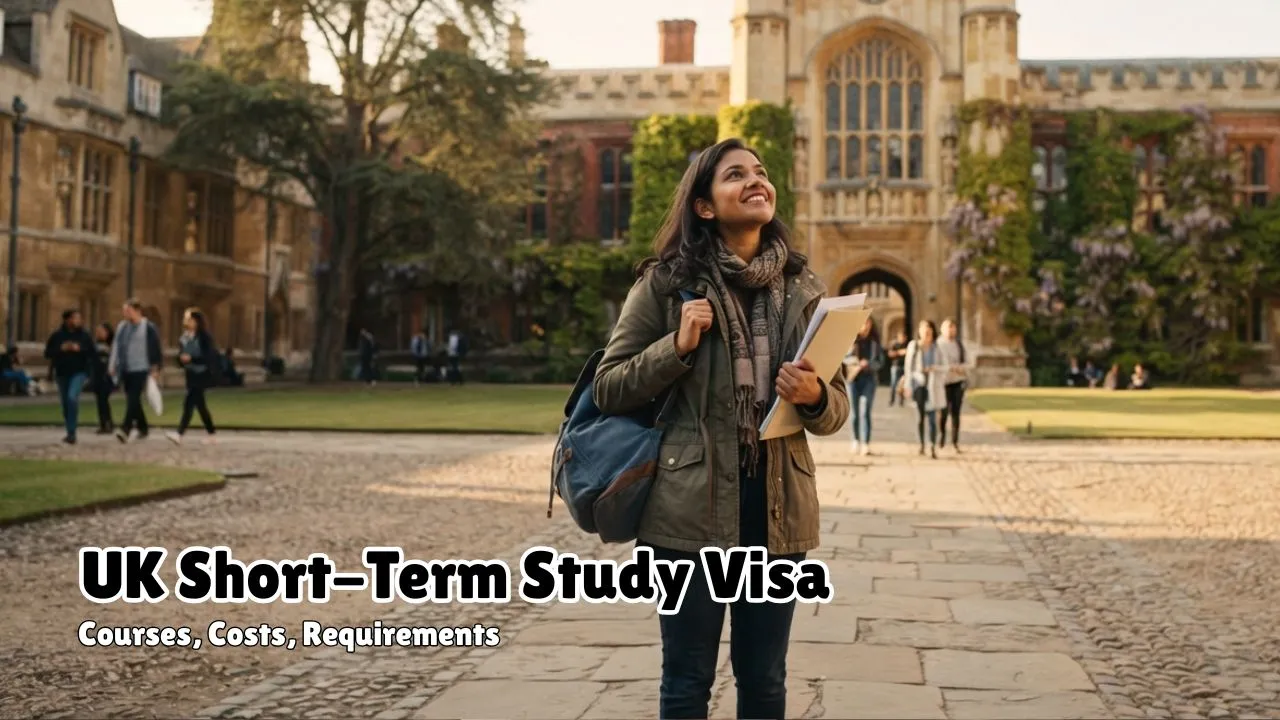

From the classrooms of Oxford Street language schools to the Border Force desk at Heathrow — the real story behind who gets a UK short-term study visa, who gets refused, and exactly what the application needs to say.
There was a young woman from Casablanca — twenty-three, sharp, determined — who had spent eighteen months saving to study English at a school in Brighton. She’d chosen a reputable language college, paid the enrolment fee, booked flights, and told her family she would come home fluent. Her UK short-term study visa application was refused. Not because she was ineligible. Not because the course was wrong. But because her bank statements showed a savings pattern that, to a UKVI caseworker reading it cold, looked thin for eleven months abroad — and because her covering letter said almost nothing about her plans after Brighton. Credibility, the refusal notice said. She reapplied three months later, with a proper financial history and a letter that actually told her story. Approved inside three weeks. Same woman. Same course. Entirely different paperwork.
That story — and dozens like it seen across years of this work — says more about the UK short-term study visa than any official guidance note ever has. The visa itself is relatively straightforward on paper. In practice, it rewards precision and punishes vagueness. Every year, applicants who are entirely eligible get refused because their application doesn’t quite show what the Home Office needs to see. This guide sets out to fix that.
Whether someone is planning six months of intensive English in London or the full eleven-month course allowance, whether they’re applying from Nigeria, Brazil, Saudi Arabia or Japan — the rules work the same way, and the pitfalls are remarkably consistent.
What Is the UK Short-Term Study Visa?
The UK Short-Term Study Visa — formally known under the Immigration Rules as the Short-term Student (English Language) visa, and sitting within Appendix Short-term Student — is a category designed for adults aged 16 and over who want to study English language at an accredited institution in the UK for between 6 and 11 months.
That last part is crucial and gets missed constantly. This visa is not a general student visa for any short course. It is specifically and exclusively for English language study. Academic courses, professional qualifications, vocational programmes — none of those sit here. They need a different route altogether.
It is also worth being clear about what it replaces. The old “Student Visitor” visa category was retired years ago. The short-term study visa is the current mechanism for this kind of stay, and it sits entirely outside the main Student Route (formerly Tier 4). That distinction matters enormously for what it permits — and, critically, for what it does not.
Short-Term Study Visa vs Standard Visitor vs Full Student Visa: Which One?
| Your situation | Correct visa route |
| English language course lasting between 6 and 11 months | Short-Term Study Visa |
| English language or any other course lasting under 6 months | Standard Visitor visa (study is permitted under visitor rules for short courses) |
| Degree, diploma, or any non-English course regardless of length | Student visa (formerly Tier 4) |
| Under 16, studying English for less than 6 months | Child Visitor visa or Standard Visitor |
| Already in the UK on another visa wanting to switch | Leave and apply from abroad — switching into short-term study is not permitted |
What Is the Length of the Short-Term Study Visa?
A language school director in Manchester once described the same conversation happening on a loop every September: a prospective student would book onto an eleven-month programme, then ask whether they could extend after month nine because they still weren’t confident enough to sit their exam. The answer was always the same. No extension. No switch. The eleven months is the ceiling, the floor, and the wall — all at once.
The short-term study visa allows a stay of the duration of the enrolled course plus 30 additional days, up to a maximum of 11 months in total. That 30-day buffer at the end is for settling affairs before departure — not for starting a new course, exploring other options, or working out what comes next.
Courses must be at least 6 months long to qualify for this visa category. Anything under 6 months falls into Standard Visitor territory instead. So the practical length range sits between 6 months and 11 months — no shorter at the bottom, no longer at the top.
- Minimum course length: 6 months (courses under this require a Standard Visitor visa instead).
- Maximum permitted stay: 11 months, including the 30-day post-course window.
- Extension from within the UK: Not permitted. The visa cannot be extended once granted.
- Re-entry: Possible with a new application from abroad, but UKVI looks carefully at patterns of repeated short-term study stays.
- On arrival options: There is no short-term study visa UK on arrival. Applications must be made and approved before travelling. Walk-in, on-the-day applications at a UK port of entry do not exist for this route.
Short-Term Study Visa UK Courses: What Can Actually Be Studied?
This section trips up more applicants than almost any other. The UK short-term study visa is, without exception, for English language courses only. Not English literature. Not business English as a module within a general management diploma. English language, at an accredited institution, as the primary and sole purpose of the course.
The institution delivering the course must be an accredited English language school — inspected and listed accordingly. A Confirmation of Acceptance for Studies (CAS) is not required for this route, which is one of the few meaningful differences between it and the full Student visa. But the institution does need to be legitimate, inspected, and able to demonstrate that their English language provision meets Home Office standards.
Eligible short-term study visa courses in the UK typically include:
- General English courses (beginner through to advanced).
- IELTS and Cambridge English exam preparation programmes.
- Business English, provided it is clearly classified as an English language course rather than a business qualification.
- Academic English pathway programmes, where the primary purpose is language development.
- Intensive English immersion courses of at least 6 months’ duration.
What is not eligible:
- Any course delivered primarily in a language other than English.
- Professional qualifications or vocational training, even short ones.
- University degree programmes or access courses.
- Online-only courses without a physical UK attendance element.
Short-Term Study Visa UK Cost and Fees in 2026
A family from Jeddah once sat down with their education consultant to work out the total cost of sending their eldest daughter to study English in London for eight months. They had researched tuition fees, accommodation, flights. The visa fee itself — they assumed it was nominal, fifty pounds or so. When the consultant quoted the actual figure, including the Immigration Health Surcharge, the total was considerably more than anyone had factored in. Nobody had mentioned the IHS. That’s the part that catches families out more than anything else — not the visa application fee itself, but the surcharge that sits beside it.
The short-term study visa UK cost from 2026 breaks down as follows:
| Fee component | Amount | Notes |
| Visa application fee | £214 | Payable online at the point of application. Non-refundable. |
| Immigration Health Surcharge (IHS) | £776 | Payable upfront, covers NHS access during the stay. Based on the visa length. |
| Priority processing (where available) | +£500 | Decision within approximately 5 working days after biometrics. |
| Super priority (very limited availability) | +£1,000 | Next working day decision. Available at select locations only. |
| Total standard cost (visa + IHS) | £990 | Before any priority service, travel or accommodation. |
The IHS is often the surprise. Unlike the transit visa or the Permitted Paid Engagement category, the short-term study visa does require payment of the Immigration Health Surcharge — which means NHS access is included during the stay, but the cost must be paid upfront and is calculated on the length of the visa, not the length of the course. Both fees are non-refundable if the application is refused.
Those planning short-term study courses in UK cities should also factor in the significantly higher cost of living in London compared to cities like Manchester, Leeds, or Bristol. The visa fee is the same wherever the school is based — but the savings made by studying outside London can be substantial.
UK Short-Term Study Visa Processing Time
Processing time for the UK short-term study visa runs to approximately 15 UK working days — roughly three calendar weeks — from the date of the biometric appointment at a visa application centre. Not from the date the online form was submitted. Not from the date payment was made. From biometrics.
There is a predictable spike in delays every June through September, when applications from students hoping to start courses in the autumn coincide with high demand across the entire visa system. An adviser once spent an entire summer quietly explaining to clients why their “three-week” processing had stretched to five — and why this was entirely foreseeable if they’d applied in April rather than July.
- Standard processing: approximately 3 weeks (15 working days) after biometric appointment.
- Priority service: approximately 5 working days, where available, for an additional £500.
- Super priority: next working day, very limited locations, for an additional £1,000.
- Peak periods: June to September and December can push standard timelines beyond three weeks.
- How far in advance to apply: applications can be submitted up to three months before the intended travel date. Applying at least 6 weeks before travel is strongly advisable; 8 to 10 weeks in peak season.
One detail that still surprises many applicants: the clock does not start on the day the online form is completed. Biometrics must be done first. In some countries, the wait for a biometric appointment slot at a visa application centre can itself run to one or two weeks — meaning the real lead time from starting the application to having a decision in hand can easily be five to seven weeks in practice.
UK Short-Term Study Visa Requirements: What Applicants Must Show
The eligibility criteria themselves are not particularly demanding — most genuine English language students meet them easily. The difficulty lies not in meeting the requirements but in demonstrating them convincingly to a caseworker who will never meet the applicant in person.
Core eligibility criteria
- Age 16 or over.
- Accepted onto an eligible English language course of at least 6 months at an accredited UK institution.
- A genuine intention to study and leave the UK at the end of the visa.
- Sufficient funds to cover course fees, living costs, and return travel.
- No intention to work, take public funds, or switch immigration category while in the UK.
- Application made from outside the UK — not from within, regardless of current visa status.
UK Short-Term Study Visa Documents Required
An experienced caseworker once described the ideal application as one that told a story without needing to be read twice. Everything in order, everything signposted, the purpose obvious from the first document and confirmed by every one that followed. Most refusals, she said, came from applications that raised questions rather than answered them — missing bank statements, vague covering letters, course enrolment letters that didn’t mention fees or duration. The documents below need to work together, not just exist.
The following documents are typically required:
- Valid passport. With at least one blank page and validity extending beyond the intended departure from the UK.
- Course acceptance letter. From the accredited English language school, showing the specific course name, start and end dates, total duration, weekly timetable, and total course fee — with confirmation that it has been paid or details of the payment plan.
- Financial evidence. Bank statements covering at least the last three to six months showing sufficient funds to cover both living costs and any outstanding course fees. Funds should look settled — a large deposit the week before applying is a red flag, not a green light.
- Proof of accommodation. Confirmation of where the applicant will live — whether student accommodation arranged through the school, a private rental booking, or confirmed host family arrangements.
- Evidence of ties to home country. This is the document most often forgotten and most likely to make the difference. Employment letter, property ownership evidence, family responsibilities, return flight booking — anything that demonstrates the applicant has reasons to go home and intends to use them.
- Covering letter. Not mandatory, but in practice almost always essential. This is where the applicant’s story is told: why this school, why this course length, what happens after the visa expires, why the timing makes sense.
- English language evidence (where applicable). Proof of current proficiency where relevant — though this route does not set a minimum entry level, some institutions require it for enrolment.
- Parental consent. Required for applicants aged 16 or 17, alongside confirmation that they are aware of the minor’s travel arrangements.
Can You Work on a Short-Term Study Visa?
No. This is one of the clearest prohibitions in the entire visa category and there are no exceptions to it.
A short-term study visa holder cannot work in the UK — paid or unpaid, formal employment or informal arrangement, online for a foreign employer or in-person for a UK business. The conditions are explicit, and Border Force and UKVI both treat work in breach of visa conditions as a serious immigration violation with consequences that follow the applicant into every future UK visa application.
There was a student from South Korea who, midway through his ten-month English course in Edinburgh, picked up some weekend restaurant work — cash in hand, nothing formal, figured nobody would notice. He was right, in the sense that nobody said anything at the time. He was wrong in the way that mattered: when he applied for a Student visa two years later to attend a postgraduate programme at a Scottish university, his history was examined closely. The previous employer had reported him in a routine HMRC check. His Student visa was refused on grounds of previous breach of visa conditions. The cash-in-hand weekend work cost him the postgraduate place.
There is also no entitlement to claim public funds of any kind. NHS emergency care remains available, but routine appointments are chargeable. The IHS covers access to NHS treatment during the stay, which is why it is levied upfront.
Switching from Short-Term Study Visa to Tier 4 (Student Visa): The Hard Truth
This is the question that comes up constantly, especially among applicants who are hoping the short-term study visa might serve as a stepping stone to longer UK study or residence. The answer is unambiguous and worth stating plainly:
You cannot switch from a Short-Term Study Visa to a Student visa (formerly Tier 4), a work visa, or any other immigration category from within the UK. To apply for a Student visa, you must leave the UK and apply from abroad.
This rule has no exceptions. A student who finishes their English course and decides they want to enrol in a degree programme at a UK university cannot simply submit a new application while still in the UK. They must leave, apply from their home country or country of residence, and wait for the new Student visa to be granted before re-entering.
The Home Office is also attentive to patterns. An applicant who has used multiple short-term study visas in succession, or who applies for a Student visa shortly after returning home from a short-term study stay, may face additional scrutiny about whether the original study was genuine or whether the short-term visa was being used as an informal pathway to longer residence.
For applicants whose goal is a UK degree or postgraduate qualification, the right route is the Student visa from the outset. A short English language preparation course in the UK sounds logical as a preparatory step — and in many ways it is — but it needs to be planned carefully, with the full route mapped out before the first application is submitted.
UK Short-Term Study Visa Success Rate: Why Applications Get Refused
A solicitor who has reviewed refused UK short-term study visa applications for years once said the same thing always came out of those documents: not fraud, not ineligibility, just ambiguity. The applicant left too many questions unanswered. UKVI, facing an application it couldn’t read quickly and confidently, defaulted to refusal. The cases that failed were rarely the most complex ones. They were the ones where somebody had skimped on the covering letter.
UKVI does not publish a UK short-term study visa success rate by nationality, though it is known that refusal rates vary significantly by country of application and by the volume and patterns of applications from any given country. What is consistent across refusals, regardless of nationality, are the grounds on which they happen:
- Credibility concerns. UKVI is not satisfied the applicant is a genuine short-term student who will leave at the end of the visa. This is the broadest and most commonly cited ground.
- Insufficient financial evidence. Bank statements that don’t cover enough history, show irregular activity, or demonstrate funds that look borrowed rather than owned.
- Weak ties to home country. No clear reason, documented in the application, why the applicant will return home when the course ends.
- Course or institution concerns. The accepting school is not sufficiently accredited, or the course does not clearly qualify as English language study.
- Previous immigration history. A previous overstay, refusal, or breach of visa conditions in the UK or another country raises the bar for everything that follows.
- Incomplete or inconsistent documents. Missing dates, mismatched course details, or financial figures that don’t add up.
The refusal itself carries weight beyond the immediate trip. Credibility findings — the Home Office effectively saying it doesn’t believe the application — are recorded and considered in future applications. This is why experienced advisers take the first application seriously even for a course that might seem routine.
How to Apply for a Short-Term Study Visa UK: Step by Step
- Choose and enrol with an accredited institution. Before anything else, the course must be confirmed and documented. The acceptance letter is the foundation of everything.
- Check the visa category. Confirm the course length (6 to 11 months, English language only) fits the short-term study route rather than the Standard Visitor or Student visa.
- Apply online at gov.uk. Select the Short-term Student (English Language) route. Applications can be submitted up to three months before the intended travel date.
- Pay the fees. £214 visa fee plus £776 Immigration Health Surcharge. Both are payable at the point of application and neither is refundable.
- Book a biometric appointment. At a visa application centre in the country of residence. Appointment availability varies by location — book as soon as possible after submitting the online application.
- Submit supporting documents. Acceptance letter, financial evidence, accommodation confirmation, home-country ties evidence, and a covering letter that ties it all together.
- Wait for a decision. Approximately three weeks from the biometric appointment under standard processing, with priority options available at most VACs.
- Register for an eVisa. On approval, create or update a UKVI online account to access the digital immigration record. This became mandatory for all new short-term study visa holders from January 2025.
UK Short-Term Study Visa Rules: The Conditions Every Holder Must Respect
Once the Short-Term Study Visa is granted and the journey begins, the conditions attached to it are strict and non-negotiable:
- Study only. The visa permits attendance at the named institution for the named course. Attending a different school or a different course is a breach.
- No work of any kind. Covered above — paid, unpaid, UK-based or remote, there are no exceptions.
- No public funds. Benefits, council housing, and most social support are out of scope.
- No dependants. Family members cannot join as dependants on this route. They would need their own Standard Visitor visa.
- No extension. The visa cannot be extended from within the UK under any circumstances.
- No switching. Cannot switch into any other immigration category, including the Student visa, from within the UK.
- Leave by the departure date. The 30-day post-course window is for departing, not for making other plans. Overstaying, even by a day, damages every future application.
Frequently Asked Questions (FAQs)
Q. What is the length of the short-term study visa?
The visa covers the duration of the course plus 30 days, up to a maximum of 11 months. The course itself must be at least 6 months long.
Q. What is the short-term study visa UK cost?
The visa application fee is £214, plus the Immigration Health Surcharge of £776, making a total standard cost of £990 before any priority processing fees.
Q. How long does UK short-term study visa processing take?
Approximately three weeks (15 working days) from the biometric appointment. Priority processing reduces this to around 5 working days for an additional £500.
Q. Can I apply for a short-term study visa UK on arrival?
No. Applications must be submitted and approved from outside the UK before travelling. There is no on-arrival option for this visa.
Q. Can you work on a short-term study visa?
No. Work of any kind — paid or unpaid — is strictly prohibited under this visa category.
Q. Can I switch from a short-term study visa to a Student visa (Tier 4)?
No. Switching to a Student visa or any other immigration category from within the UK is not permitted. You must leave and apply from abroad.
Q. What courses qualify for a short-term study visa?
Only English language courses at accredited institutions, lasting between 6 and 11 months. Other courses, regardless of length, do not qualify for this visa category.
Q. What documents are required for a UK short-term study visa?
A valid passport, course acceptance letter, financial evidence, accommodation confirmation, evidence of home-country ties, and a covering letter. See the full list in the documents section above.
Final Thoughts: The Visa That Rewards Preparation
The young woman from Casablanca who got refused and then approved made only one change between her two applications: she explained herself properly. Same eligibility. Same course. Same school. The second application simply made it impossible for a caseworker to doubt her.
That is, in essence, what every successful short-term study visa application does. It does not just tick boxes — it tells a story. Who this person is, why they want to study English in the UK, how they are going to fund it, and why they are absolutely going to get on a plane home when the course ends. The Immigration Rules provide the framework. The documents provide the evidence. The covering letter stitches it together.
For anyone navigating this for the first time — or for the second time after a refusal — the investment of time in getting the application right before submission is by far the most efficient use of effort. A refused application costs the full fee, delays the course start, and leaves a record. An approved one opens eleven months of English language study in one of the world’s most respected academic environments.
Disclaimer:
UK Visa Consultant is affiliated with regulated immigration professionals with years of hands-on experience in successful UK visa applications. We closely monitor UKVI/Home Office updates and use only official guidance and sources. The information provided in this blog is subject to change depending on UK immigration laws and policies. It is recommended to stay updated regarding such changes and confirm the details through an official source before proceeding further. Our priority is unwavering accuracy and user trust. Here’s how you can maximize your success:
- Always rely on updates from the UK Government, the Home Office, and regulated immigration advisors.
- Keep up with the latest changes (e.g., digital eVisas, new sponsor requirements, post-Brexit rules).
- If in doubt, consult directly with an accredited UK immigration solicitor or OISC advisor.
- Ensure documentation, financials, and employment/education offers are fully compliant.
- Avoid scams and unregulated agents—your application’s credibility is paramount.
- Our consultants undergo regular professional development, maintain GDPR-compliant data handling, and provide transparent, ethical advice.


Leave a Reply
You must be logged in to post a comment.