



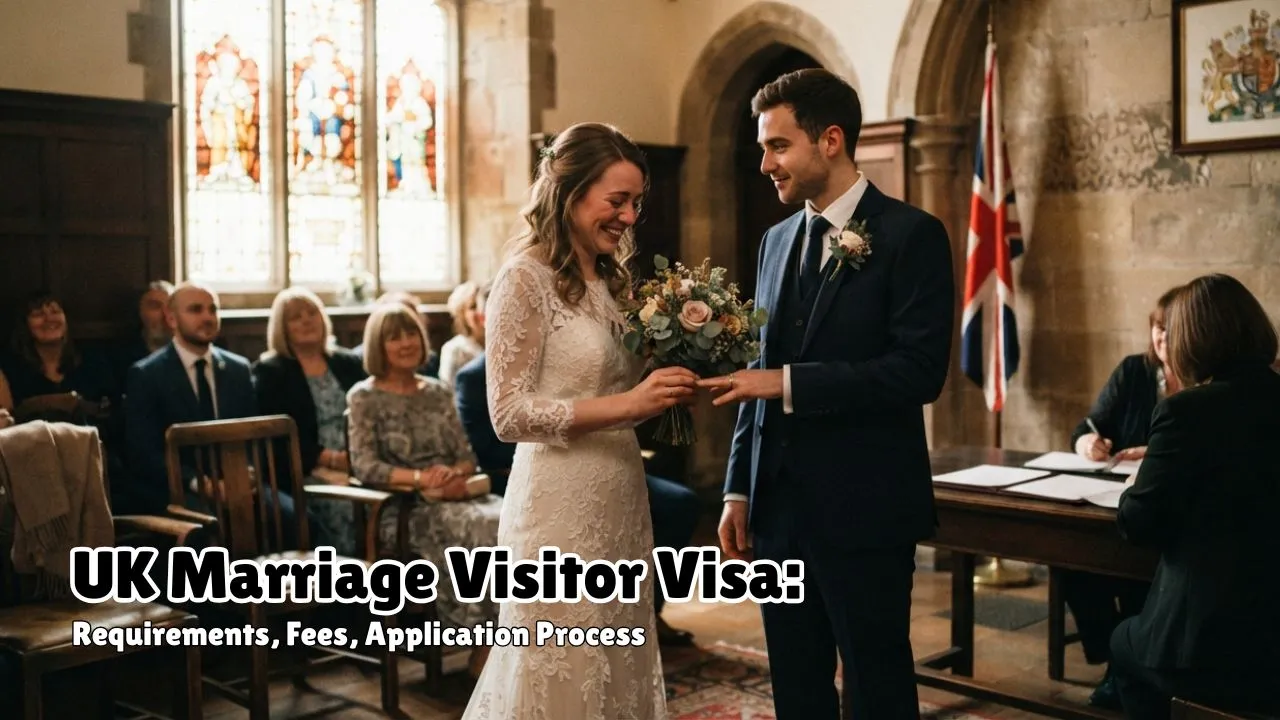

Amara met Michael’s family before she’d even properly met Michael. That’s how these things go sometimes — a match made through aunties and family friends, two people from Lagos and London deciding, quite deliberately, that they wanted to build something together. The wedding was planned for a small church near his mother’s house in Croydon. What nobody in the family quite realised, until three weeks before the flight, was that a Standard Visitor visa wouldn’t do. Amara needed something else entirely — a UK Marriage Visitor Visa — and she needed it fast.
Her story isn’t unusual. It plays out, in one version or another, thousands of times a year. Someone falls in love, or someone’s family arranges a marriage with real care and consent behind it, and suddenly UK immigration law becomes the thing standing between a couple and their wedding day. This guide exists to make that part simpler.
What Is a Marriage Visitor Visa?
A Marriage Visitor Visa is a specific category of UK entry clearance, sitting under Appendix V of the Immigration Rules, designed for one purpose only: entering the UK to marry, register a civil partnership, or give notice of the intention to do either.
It is not a route to settlement. It is not a route to living in the UK long-term. It’s a visit visa, plain and simple, with a wedding attached to it.
That distinction trips people up constantly. A tourist visa lets someone attend a wedding, watch a blessing, celebrate at a reception. It does not let them stand up and legally marry on British soil. For that, the marriage visitor route is mandatory — there’s no way around it, and no amount of paperwork on a Standard Visitor application changes that requirement.
Who Actually Needs a UK Marriage Visitor Visa?
Most non-UK nationals travelling specifically to marry or form a civil partnership in the UK need this visa, regardless of what other visas they’ve held before.
Since January 2021, this has also applied to EEA and Swiss nationals who don’t hold settled or pre-settled status under the EU Settlement Scheme. Before Brexit, this group could simply turn up. Now, they can’t — not for a legal ceremony. Irish citizens remain the one clear exception, under the Common Travel Area arrangements.
Non-visa nationals — those who don’t normally need a visa for short UK visits — still need to formally declare their intention to marry at the border and be admitted specifically as a marriage visitor. Skipping that declaration, even accidentally, can cause serious problems later.
Marriage Visitor Visa UK Requirements
To qualify for a UK Marriage Visitor Visa, an applicant generally needs to satisfy the Home Office of the following:
- Both parties are aged 18 or over
- The relationship is genuine, and there’s a real intention to marry or register a civil partnership
- The wedding or civil partnership will happen within the visa’s validity, typically within 6 months
- There’s no intention to settle in the UK or make it a permanent home
- The applicant intends to leave the UK at the end of the visit
- Sufficient funds exist to cover the stay without accessing public funds or working illegally
- Suitable accommodation arrangements are in place for the duration
None of these exist in isolation. Caseworkers read them together, as one picture. A couple with a booked venue, a joint savings history, and a clear travel plan tells a coherent story. A couple with vague dates and a half-finished form does not — and that gap is where refusals live.
What a UK Marriage Visitor Visa Actually Permits — and What It Doesn’t
This is worth being blunt about, because the restrictions in a UK Marriage Visitor Visa catch people out more than almost anything else in this process.
It permits:
- Entry to the UK specifically to marry, register a civil partnership, or give notice of intention to do so
- Multiple entries during the visa’s validity in most cases (more on this below)
- A stay of up to 6 months
It does not permit:
- Work of any kind, paid or unpaid, including remote work for a foreign employer
- Study beyond incidental short courses permitted under general visitor rules
- Access to public funds
- Free NHS treatment beyond what’s available to any visitor, with emergency care being the one exception
- Switching to another visa category from inside the UK
- Extending the visa beyond its original 6-month validity
That last point matters enormously, and it’s the single biggest structural difference between this visa and its closest cousin, the Fiancé Visa — covered properly further down.
Culturally Arranged Marriages and the Marriage Visitor Visa
Worth addressing directly, because it comes up often and deserves care: an arranged marriage, where families play a central role in bringing two people together, is entirely legitimate under UK immigration law, provided both parties freely and genuinely consent.
Priya’s marriage was arranged this way. Her parents in Chennai and her husband’s parents in Birmingham had known each other for years through their local community. She and her husband met twice, over video calls, before deciding together that marriage was what they wanted. Nothing about that process raised any flags with the Home Office — because consent was clearly hers, freely given, not coerced.
Forced marriage is a different matter entirely, and it’s a serious criminal offence in the UK. Caseworkers are trained to look for signs that consent isn’t genuine — a significant power imbalance, reluctance in interview, inconsistencies about basic facts of the relationship. For couples in a genuinely arranged marriage, being ready to explain how the match came about, who was involved, and why both parties consented freely tends to resolve any doubt quickly and cleanly.
Marriage Visitor Visa UK Cost (2026)
As of 8 April 2026, the UK Marriage Visitor Visa costs £135 per applicant. That figure rose from the previous £115, in line with the wider fee increases applied across most UK visa categories that spring.
A few cost realities worth knowing upfront:
- The fee is paid per applicant, not per couple, if both partners are applying to enter the UK
- It is entirely non-refundable if the application is refused
- Optional Priority Service, where available, adds roughly £500 for a 5-working-day decision
- No Immigration Health Surcharge applies to this visa category, since it’s a short-term visit route
Beyond the Home Office fee itself, most couples end up budgeting for translation costs, English test fees where relevant, biometric appointment travel, and — inevitably — the wedding itself. Immigration solicitors regularly see couples underestimate this second category far more than the visa fee itself.
UK Marriage Visitor Visa: Documents Required
This is where careful preparation genuinely changes outcomes. The supporting documents needed for a UK Marriage Visitor Visa typically include:
Identity and relationship evidence
- Valid passport or travel document
- A recent passport-style photograph
- Evidence of the relationship — photographs together, message history, joint travel records, family involvement where relevant
Marriage or civil partnership evidence
- Confirmation of a booked venue, register office appointment, or church booking
- Evidence of deposits paid towards the wedding or ceremony
- Details of the notice of marriage appointment, if already arranged
Financial evidence
- Bank statements, typically covering the last 3 to 6 months
- Payslips or employment confirmation letters
- Sponsorship letters, where a partner or family member is covering costs
Accommodation and travel evidence
- Hotel bookings, or a letter from a UK-based host confirming accommodation
- Return flight booking or clear travel plans showing an intention to leave the UK
Additional supporting documents
- Certified translations for any document not in English or Welsh
- Evidence of ties to the home country — employment, property, family remaining behind — supporting the intention to return
Every document should point toward the same conclusion: this is a genuine couple, with a genuine wedding planned, and a clear, credible intention to leave the UK afterwards.
How to Apply for a UK Marriage Visitor Visa?
The process itself runs in a fairly predictable sequence:
- Confirm eligibility against the requirements above before starting anything else.
- Complete the online application on the official gov.uk service, being scrupulously accurate about immigration history, travel dates, and current circumstances.
- Pay the visa fee — £135 as of the current 2026 fee schedule.
- Book a biometric appointment at the nearest visa application centre for fingerprints and a photograph.
- Submit supporting documents, either at the centre in person or through the designated upload portal, depending on the country of application.
- Wait for a decision, typically around 3 weeks for standard processing, or roughly 5 working days with Priority Service where available.
Timing this against an actual wedding date takes real planning. Leaving it to the last minute is, without exaggeration, one of the most common ways couples end up postponing ceremonies.
Marriage Visitor Visa UK Multiple Entry: What Couples Should Know
Here’s a detail that surprises a lot of applicants: UK Marriage Visitor Visas are generally issued as multiple-entry visas, unless specifically endorsed otherwise on the vignette.
This matters more than it sounds. Under UK marriage law, couples must “give notice” at a register office and then wait a statutory 28-day notice period before the ceremony can legally take place. That period can stretch to 70 days if the case is referred under the Home Office’s referral and investigation scheme, which applies where one or both parties aren’t British or Irish citizens and don’t hold settled or pre-settled status, and the Home Office chooses to investigate the genuineness of the marriage.
A multiple-entry visa means a couple can give notice, fly home briefly if they choose, and return for the ceremony itself, all within the same visa validity — rather than sitting in the UK burning through six months of leave waiting around. It’s always worth checking the actual vignette carefully, though, since single or dual-entry endorsements do occasionally get applied, and assuming multiple entry without checking has caught more than one couple out.
Marriage Visitor Visa UK vs Fiancé Visa UK: Which One Do You Actually Need?
This is, genuinely, the single most common point of confusion in this entire area of law — and getting it wrong can unravel months of planning.
| Feature | Marriage Visitor Visa | Fiancé Visa |
|---|---|---|
| Purpose | Marry and leave | Marry and stay |
| Can switch to Spouse Visa in-country | No | Yes |
| 2026 fee | £135 | £2,064 |
| Immigration Health Surcharge | Not payable | Not payable at this stage |
| Income requirement (£29,000) | Not assessed | Assessed |
| English language requirement | Not required | Required (A1 level) |
| Validity | Up to 6 months | Up to 6 months |
The deciding question is simple, even if the emotions around it rarely are: does the couple intend to marry and then both return home together, at least for now — or does the marriage mark the start of a shared life actually based in the UK?
Devendra and his fiancée got this wrong the first time. They applied for a UK Marriage Visitor Visa, assuming — reasonably, given how the venue coordinator described it — that they could simply “sort out the rest” once married. They couldn’t. The marriage visitor route offered no bridge to a Spouse Visa from inside the UK. He had to leave, apply for a Spouse Visa from home, and wait months longer than if they’d applied for the Fiancé Visa from the outset.
From Marriage Visitor Visa to Spouse Visa: The Path After the Wedding
For couples who do marry on a Marriage Visitor Visa and later decide they want a shared life in the UK, the route runs through the standard Spouse Visa application — from outside the UK, not from within it.
That means, after the wedding:
- The applicant returns to their home country once the Marriage Visitor Visa expires or the visit concludes
- A fresh Spouse Visa application is submitted under Appendix FM, from outside the UK
- The couple must meet the minimum income requirement, currently £29,000
- The applicant must meet the English language requirement at A1 level
- Processing typically takes around 12 weeks from the biometric appointment
It’s a longer road than the Fiancé Visa route, and it means physical separation for a period most couples find genuinely difficult. But for couples who weren’t certain, at the point of the wedding itself, that UK settlement was the plan — the Marriage Visitor Visa remains the honest, correct choice, even with that separation built in.
Common Pitfalls That Derail Marriage Visitor Visa Applications
- Applying under a Standard Visitor visa by mistake, not realising a legal marriage requires the specific marriage visitor category
- Booking flights before securing register office confirmation, leaving no proof the ceremony is actually arranged
- Underestimating financial evidence requirements, particularly for couples covering significant wedding costs
- Assuming the visa allows a switch to a Spouse Visa afterwards — it doesn’t, under any circumstances
- Missing the 7-day residency requirement in the registration district before giving notice
- Weak relationship evidence for arranged marriages, where couples assume the arrangement itself is self-explanatory and under-document the genuine consent behind it
Two Weddings, Two Outcomes
Amara’s application, in the end, went smoothly. The family gathered every document early — venue confirmation, her fiancé’s payslips, a joint statement explaining how they’d met and built their relationship over eighteen months of visits and calls. Her visa was granted in just over two weeks. She flew to Croydon, gave notice, waited the required 28 days, and married in the small church exactly as planned.
A cousin of hers, applying around the same time for a different wedding, wasn’t so fortunate. He’d assumed a Standard Visitor visa would cover things, since he’d travelled to the UK before without issue. It didn’t. His ceremony had to be postponed by four months while he reapplied correctly, under the right category, with the right evidence — a costly, entirely avoidable delay.
Frequently Asked Questions (FAQs)
Q. What is a Marriage Visitor Visa?
It’s a UK visit visa allowing entry specifically to marry, register a civil partnership, or give notice of the intention to do either, without any route to settlement.
Q. How much does a Marriage Visitor Visa UK cost in 2026?
The current fee is £135 per applicant, effective from 8 April 2026.
Q. Can I switch from a Marriage Visitor Visa to a Spouse Visa?
No. Switching in-country isn’t permitted under this route. The applicant must leave the UK and apply for a Spouse Visa from their home country.
Q. Is a Marriage Visitor Visa multiple entry?
Generally yes, unless the vignette is specifically endorsed for single or dual entry — always worth checking carefully before assuming.
Q. Can an arranged marriage use the Marriage Visitor Visa route?
Yes, entirely. A culturally arranged marriage is legitimate under UK law provided both parties freely and genuinely consent; only forced marriage, where consent is absent or coerced, is unlawful.
Q. What’s the difference between a Marriage Visitor Visa and a Fiancé Visa?
The Marriage Visitor Visa is for couples marrying and then leaving the UK, at a fraction of the cost. The Fiancé Visa, at £2,064, allows switching to a Spouse Visa in-country afterwards, for couples planning to settle.
A Final Thought
Every couple approaching for a UK Marriage Visitor Visa via this process is really asking the same underlying question, even if they phrase it differently: will immigration law let us have the wedding we’ve planned, in the country we’ve chosen, without derailing everything that comes after it?
The Marriage Visitor Visa UK answers that question cleanly, for exactly the couples it’s designed for — those who want to marry in the UK and then, at least for now, return home together. Get the category right, get the evidence right, and give the timeline the respect it deserves, and the paperwork becomes what it should always have been: a formality standing quietly behind the day that actually matters.
Disclaimer:
UK Visa Consultant is affiliated with regulated immigration professionals with years of hands-on experience in successful UK visa applications. We closely monitor UKVI/Home Office updates and use only official guidance and sources. The information provided in this blog is subject to change depending on UK immigration laws and policies. It is recommended to stay updated regarding such changes and confirm the details through an official source before proceeding further. Our priority is unwavering accuracy and user trust. Here’s how you can maximize your success:
- Always rely on updates from the UK Government, the Home Office, and regulated immigration advisors.
- Keep up with the latest changes (e.g., digital eVisas, new sponsor requirements, post-Brexit rules).
- If in doubt, consult directly with an accredited UK immigration solicitor or OISC advisor.
- Ensure documentation, financials, and employment/education offers are fully compliant.
- Avoid scams and unregulated agents—your application’s credibility is paramount.
- Our consultants undergo regular professional development, maintain GDPR-compliant data handling, and provide transparent, ethical advice.

Leave a Reply
You must be logged in to post a comment.