




It’s one of the most common questions I get asked — and probably the most misunderstood. International students spend three, four, sometimes seven or eight years in the UK. They build their lives here. They assume that time counts for something when it comes to settlement. And then they find out it doesn’t. Not in the way they expected, anyway.
The answer is not a flat no. It is more complex than that. And simplifying this complex scenario can make a substantial difference to your immigration timeline.
So let’s go through it properly.
The Short Answer: Does a Student Visa Count Towards ILR? | Student Visa Time and the 5-Year ILR Route
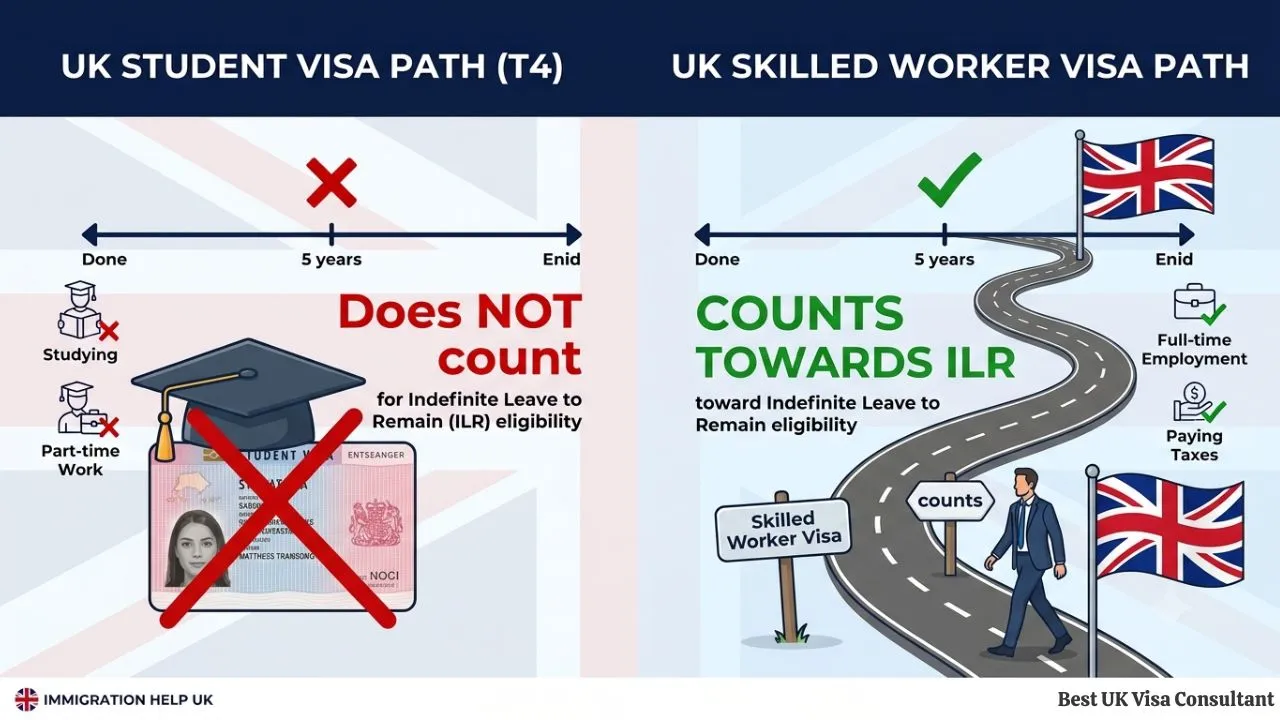
NO. Time spent in the UK on a Student visa — previously known as the Tier 4 (General) Student visa — does not count towards the standard 5-year qualifying period for Indefinite Leave to Remain.
The reason is structural. UK immigration law divides visas into ‘settlement routes’ and ‘temporary routes.’ The Student visa sits firmly in the temporary category. Its purpose is study. The Home Office’s position is that temporary residence for the purpose of education does not, in itself, justify permanent settlement.
So if you have spent five years in the UK entirely on a Student visa, you cannot walk straight into an ILR application. That five years counts for nothing on the standard route. You would need to switch to a qualifying visa — typically a Skilled Worker visa — and begin a fresh five-year clock.
That surprises a lot of people. Understandably.
The Important Exception: The 10-Year Long Residence Route
Here is where it gets more interesting. And more useful.
There is a separate ILR route called the 10-Year Long Residence route. Under this route, time spent on a Student visa does count — provided you have been living in the UK continuously and lawfully for ten years in total, across any combination of qualifying visa types.
The key condition: your residence must have been lawful throughout. No gaps. No overstays. No periods where you were in the UK without valid leave to remain. And a Visitor visa or Short-term Study visa (for English language courses) does not count, even here.
What Counts Towards 10-Year Long Residence ILR?
Under the long residence route, you can combine time spent on multiple visa types. So a typical timeline might look like this:
- 3 years on a Student visa (undergraduate degree)
- 1 year on a Student visa (master’s degree)
- 2 years on a Graduate visa
- 4 years on a Skilled Worker visa
That adds up to ten years. All of it lawful. All of it continuous. And all of it counts. At that point, you could apply for ILR under the Long Residence route — even though none of the first six years would have counted under the standard five-year route.
It is a longer road. But for people who have been in the UK for many years across multiple visa types, it is sometimes the most realistic pathway.
Absence Rules for the 10-Year Route
The continuous residence requirement is strict. You must not have been absent from the UK for more than 180 days in any 12-month period during those ten years. And a single absence of more than six consecutive months will break the continuity of your residence entirely — restarting the ten-year clock from scratch.
That last part is worth repeating. A single gap of more than six months — a gap abroad to care for a relative, a period of working overseas, a prolonged holiday — can potentially reset everything. I have seen it happen. Keep records of every trip abroad.
Which Visas Count Towards ILR? A Quick Reference
| Visa / Route | Counts to 5-yr ILR? | Counts to 10-yr ILR? |
|---|---|---|
| Student visa (formerly Tier 4) | ✗ No | ✓ Yes |
| Graduate visa | ✗ No | ✓ Yes |
| Skilled Worker visa | ✓ Yes | ✓ Yes |
| Health and Care Worker visa | ✓ Yes | ✓ Yes |
| Spouse / Partner visa | ✓ Yes | ✓ Yes |
| Global Talent visa | ✓ Yes (3 yrs) | ✓ Yes |
| UK Ancestry visa | ✓ Yes | ✓ Yes |
| Innovator Founder visa | ✓ Yes | ✓ Yes |
| Tier 5 Youth Mobility visa | ✗ No | ✓ Yes |
| Visitor visa / Short-term study visa | ✗ No | ✗ No |
Note: The Global Talent visa offers a faster route — three years to ILR for those endorsed as ‘exceptional talent’, five years for ‘exceptional promise’. Always verify current rules at GOV.UK.
Does Time on a Graduate Visa Count Towards ILR?
No — not on the standard five-year route. The Graduate visa is also a temporary route. It allows you to stay in the UK for two years after graduation (three years for PhD holders) and work without sponsorship. Flexible, yes. But it does not lead directly to ILR.
Time on a Graduate visa does count towards the ten-year Long Residence route, in the same way that Student visa time counts. So if you did a four-year undergraduate course, then used the Graduate visa for two years, you would have six years of lawful continuous residence building towards that ten-year total.
The Graduate visa cannot be extended. That is not a mistake — it is deliberate. The Home Office wants Graduate visa holders to either secure sponsored employment (Skilled Worker), leave, or use the time creatively to build towards something more permanent.
Worth knowing: if your goal is ILR as quickly as possible, it may be worth forgoing the Graduate visa and switching directly to a Skilled Worker visa as soon as you have a job offer. Every month you spend on the Graduate visa is a month that doesn’t count toward the five-year Skilled Worker clock. The Graduate visa has value — freedom, flexibility, the chance to explore. But it comes at an opportunity cost.
The Fastest Route from Student Visa to ILR
If settlement is your goal — and you want to get there as efficiently as possible — the pathway looks like this:
- Complete your studies on a Student visa
- Apply for a Graduate visa immediately after graduating — optional, but useful if you need time to find sponsored work
- Secure a job offer from a Home Office-licensed sponsor in an eligible skilled role
- Switch to a Skilled Worker visa — your five-year ILR clock starts here
- Maintain continuous lawful residence, keeping absences under 180 days per 12-month period
- Apply for ILR after five years on the Skilled Worker route
- After 12 months of ILR, apply for British citizenship through naturalisation
The minimum theoretical timeline — if you move straight from Student to Skilled Worker without using the Graduate visa — is five years from the point of switching. In practice, most people need a year or two on the Graduate visa to find sponsored work, which means the real-world timeline is more like six to eight years from arriving as a student to holding ILR.
That is a long time. It requires planning. It requires consistency. And it requires understanding which years count and which don’t.
Can You Combine Student Visa Time with Other Qualifying Visas?
For the five-year route: No. You cannot combine Student visa time with Skilled Worker time to reach five years. The five years must be entirely on qualifying routes. Student visa time is excluded from that calculation.
For the ten-year route: Yes. You can combine Student visa time, Graduate visa time, and Skilled Worker visa time (or any combination of qualifying and permitted temporary routes) to reach the ten-year total. This is precisely the value of the Long Residence route for people who have been in the UK a long time but on a mix of visa types.
One important practical point here. If you combine visa types for ILR purposes — say, three years as a Skilled Worker and then two years on a Spouse visa — that combination works fine for the five-year route. But Student visa time cannot be part of that five-year calculation regardless of what other visas you subsequently held.
What About the English Language Requirement for ILR?
If you studied at a UK university and your degree was taught and assessed in English — which it almost certainly was — you generally satisfy the English language requirement for ILR without needing to sit a new test. Your degree effectively serves as evidence of English proficiency at B1 level or above.
The Life in the UK test is still required. That is a separate matter and applies regardless of your education in the UK. If you have not already passed it, factor in the preparation time.
What If There Were Gaps in Your Visa History?
This matters more than most people realise, particularly for the Long Residence route. If there was any period when you were in the UK without valid leave — an expired visa, a failed application with no appeal pending, a period of overstay — that gap can break your continuity of residence.
For the ten-year route, a continuous residence break means the clock resets. You would need to recommence from the point where your residence became lawful again.
Section 3C leave — the legal provision that extends your existing visa while a further leave application is pending — does preserve continuity, provided the application was made before your visa expired. This is a frequently misunderstood area. If you applied for a new visa before your Student visa expired and your application is still being decided, that in-between period is generally covered.
However, if you let your visa expire and then applied, even a day late — that gap is a gap. It will likely affect your application. It is something a solicitor would need to advise on specifically, based on your exact dates.
Frequently Asked Questions (FAQs)
Q. Does time on a Tier 4 student visa count towards ILR?
Yes — but only for the 10-year Long Residence route. Tier 4 is the predecessor to the current Student visa. The rules are the same: Tier 4 time does not count towards the standard 5-year ILR, but it does count towards the 10-year long residence calculation, provided all other conditions are met.
Q. Can I apply for ILR directly from a Student visa?
No. The Student visa is not a settlement route. You cannot apply for ILR directly from a Student visa, regardless of how long you have held it. You must either switch to a qualifying visa and complete the relevant qualifying period, or accumulate ten years of continuous lawful residence to apply under the Long Residence route.
Q. Does a PhD student visa count towards ILR?
The rules are the same regardless of the level of study. A PhD student visa — whether that took three, four, or six years — does not count towards the five-year route. It does count towards the ten-year Long Residence route. One practical note: PhD holders switching to the Graduate visa receive a three-year rather than two-year visa, which gives more time to secure sponsored employment.
Q. If I studied in the UK for 10 years, can I apply for ILR now?
Possibly — but only if that ten years was entirely continuous and lawful, with no gaps in leave, no overstays, and no single absence exceeding six consecutive months. You would also need to have held your current visa for at least 12 months at the point of applying. Short-term study visas (English language courses) and Visitor visas do not count even under the Long Residence route. Get your full travel and immigration history documented before applying.
Q. Does the Graduate visa count towards ILR?
Not towards the standard five-year route — the Graduate visa is a temporary route. It does count towards the ten-year Long Residence route. As noted earlier, the Graduate visa cannot be extended and can only be obtained once.
Conclusion
Does student visa time count towards ILR? The honest answer is: sometimes, and only in specific circumstances.
On the standard five-year route, no — it doesn’t. Switch to a qualifying visa and start your clock from there. On the ten-year Long Residence route, yes — it can count, as long as your residence has been continuous, lawful, and unbroken throughout.
The decision about which route to pursue depends on your specific immigration history, your current visa status, and your long-term plans. For most people who arrived as students and want to settle permanently, the fastest option is switching to a Skilled Worker visa as quickly as possible after graduation. The Graduate visa offers flexibility, but it does not accelerate the path to settlement.
If you are approaching the ten-year mark across multiple visa types, or if you have a complex immigration history with possible gaps, get specific legal advice. The Long Residence route is genuinely powerful — but the Home Office’s scrutiny of continuous residence is thorough, and mistakes in the application can be costly.
The path from student to settled resident in the UK is achievable. Plenty of international graduates have done it. But it requires planning, patience, and a clear understanding of which years count — and which years simply don’t.
Disclaimer:
UK Visa Consultant is affiliated with regulated immigration professionals with years of hands-on experience in successful UK visa applications. We closely monitor UKVI/Home Office updates and use only official guidance and sources. The information provided in this blog is subject to change depending on UK immigration laws and policies. It is recommended to stay updated regarding such changes and confirm the details through an official source before proceeding further. Our priority is unwavering accuracy and user trust. Here’s how you can maximize your success:
- Always rely on updates from the UK Government, the Home Office, and regulated immigration advisors.
- Keep up with the latest changes (e.g., digital eVisas, new sponsor requirements, post-Brexit rules).
- If in doubt, consult directly with an accredited UK immigration solicitor or OISC advisor.
- Ensure documentation, financials, and employment/education offers are fully compliant.
- Avoid scams and unregulated agents—your application’s credibility is paramount.
- Our consultants undergo regular professional development, maintain GDPR-compliant data handling, and provide transparent, ethical advice.






Leave a Reply
You must be logged in to post a comment.