



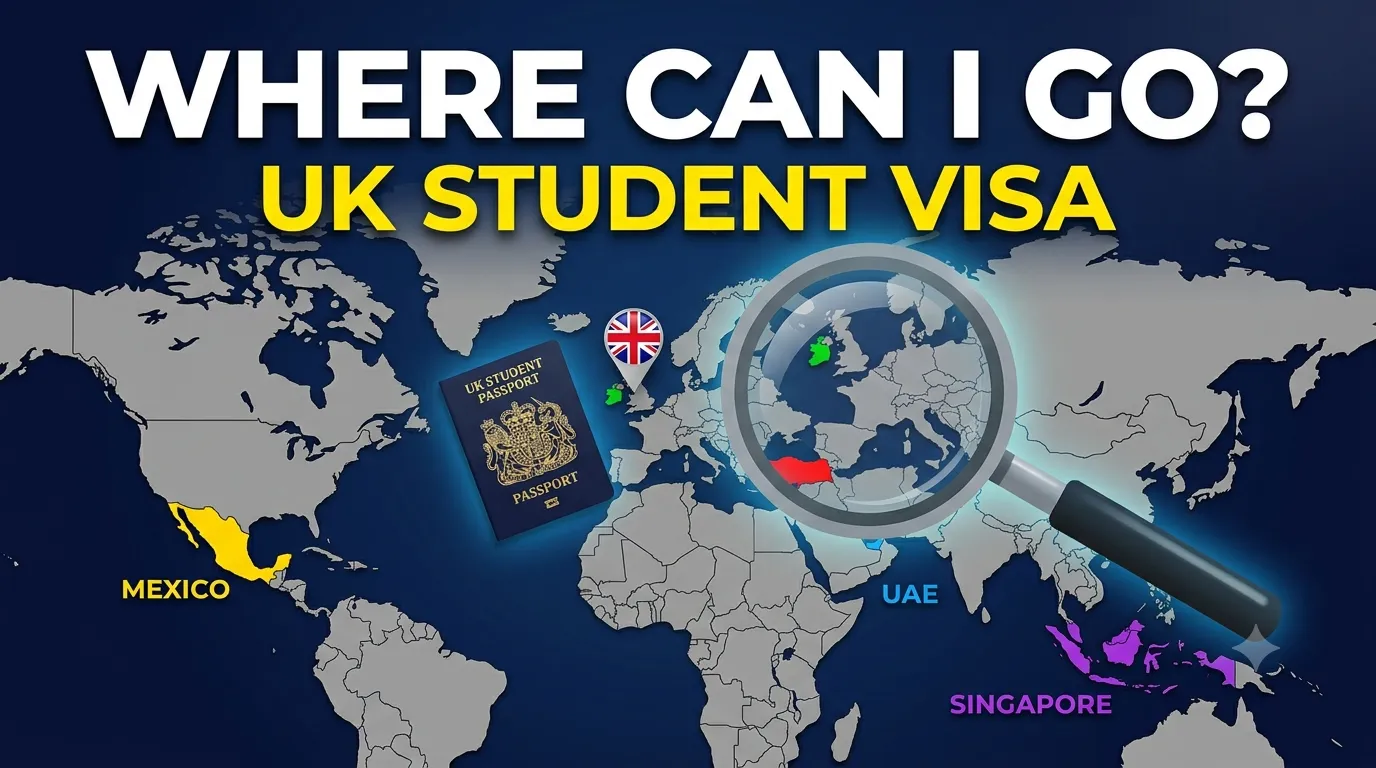

One of the most exciting things about studying in the UK — honestly, one of the things students don’t talk about enough — is the travel. Wondering which countries you can visit with a UK Student Visa? You are right in the middle of a continent. Europe is a short train ride or a budget flight away. Weekends feel like mini adventures waiting to happen.
But before you book anything, there are things you genuinely need to understand. Because your UK Student visa is not a free pass to travel everywhere. And getting the details wrong can cause real problems — not just for a holiday, but potentially for your visa, your studies, and your Graduate Route application down the line.
This guide covers exactly where you can travel with a UK Student visa, what you need to know about working, how long you can stay in the UK, the Schengen question that trips up so many students, and how to travel smartly without risking your immigration status.
Where Can I Travel with a UK Student Visa? Which Countries Can I Visit with a UK Student Visa
Let’s start with the good news. A valid UK Student visa — particularly one that is multiple-entry — can unlock simplified or visa-free access to more than 20 countries across Europe, Asia, the Middle East, Africa, and the Americas. It depends significantly on your nationality and your passport, but the visa itself is a meaningful travel document beyond just the UK.
The key phrase in most of these countries’ policies is ‘valid UK visa used at least once.’ That means your Student visa needs to be current, and you need to have already entered the UK before using it to access these additional destinations. A brand-new visa you haven’t used yet generally won’t qualify.
Countries Where You Can Travel with a UK Student Visa — At a Glance
| Region / Country | Entry Type | Max Stay | Key Condition |
|---|---|---|---|
| Ireland | Visa-free (BIVS) | 90 days | UK visa must be multiple-entry & used. BIVS eligible nationalities only (e.g. India, China) |
| Albania | Visa-free | 90 days | UK visa valid 6+ months, used at least once |
| Serbia | Visa-free | 90 days | Valid & used UK visa required |
| Montenegro | Visa-free | 30 days | Valid UK visa or eVisa (BRP not accepted) |
| North Macedonia | eVisa available | 15 days | UK visa vignette only — BRP/eVisa NOT accepted |
| Georgia | Visa-free | 365 days | Valid UK student visa or BRP accepted |
| Kosovo | Visa-free | 90 days | Valid UK visa holders |
| Turkey | eVisa | 90 days | Apply online before travel; fee payable |
| Malaysia | Visa-free / eNTRI | 30 days | Many nationalities; check by passport |
| Singapore | Visa-free | 30–90 days | Depends on nationality |
| Thailand | Visa-free | 30 days | Majority of nationalities; confirm passport |
| Philippines | Visa-free | 14–30 days | UK visa valid 6+ months; eligible nationalities |
| Japan | eVisa required | Up to 90d | Apply via Japan embassy in UK; UK residence proof needed |
| UAE (Dubai) | Visa on arrival | 30 days | Many nationalities get 30-day VOA; check by passport |
| Oman | eVisa | 30 days | Apply online; accessible with UK visa |
| Qatar | Visa-free / VOA | 30 days | Depending on nationality |
| Bahrain | eVisa | 14 days | Online application; accessible with UK status |
| Dominican Republic | Visa-free + tourist fee | 30 days | Small entry fee on arrival; UK visa holders eligible |
| Panama | Visa-free | 30 days | Used multi-entry UK visa; valid 6+ months |
| Colombia | Visa-free | 90 days | Most nationalities; confirm by passport |
| Ecuador | Visa-free | 90 days | Many nationalities; no UK visa requirement |
| Morocco | eVisa required | 30 days | Apply before travel; UK visa holders eligible |
| Kenya | eVisa | 90 days | Online application; UK visa holders eligible |
| Tanzania | VOA / eVisa | 90 days | Apply in advance recommended |
| Egypt | VOA / eVisa | 30 days | Available at major airports; fee payable |
Important: This table is a guide only. Entry requirements change frequently. Always verify with the official government website or embassy of your destination country before booking. Your nationality may affect eligibility even in countries that generally accept UK visa holders.
Can I Travel to Europe with a UK Student Visa?
This is the one that gets students into trouble most often. So let’s be very clear about it.
The Schengen Area: You Need a Separate Visa
The Schengen Area covers 29 European countries — including France, Germany, Italy, Spain, the Netherlands, Portugal, Greece, and more. Your UK Student visa does NOT give you the right to enter any of these countries.
To visit Schengen countries, you must apply for a Schengen visa separately, either from your home country before coming to the UK or from the relevant country’s embassy in the UK once you’re here. You apply to the embassy of the country you plan to spend the most time in — or your first point of entry if you’re visiting multiple.
What About Ireland?
Ireland is not in the Schengen Area, and this is where the British-Irish Visa Scheme (BIVS) comes in. Under BIVS, nationals of certain countries — currently including India, China, Bahrain, Kuwait, Oman, Qatar, Saudi Arabia, UAE, and a few others — can visit Ireland using their valid UK short-stay visa without applying separately.
But there are conditions. Your UK visa must be multiple-entry. It must have been used to enter the UK before your trip to Ireland. And only nationalities specifically listed under BIVS are eligible — it doesn’t cover everyone.
Students from countries not on the BIVS list — Nigeria, Pakistan, Ghana, and many others — will need to apply for a separate Irish visa. Check the Irish Naturalisation and Immigration Service (INIS) website to confirm your eligibility.
Non-Schengen Europe: Easier Options
Not every European country is in the Schengen Area, and these destinations are often more straightforward for UK Student visa holders:
- Georgia — visa-free for up to 365 days. Genuinely one of the most generous policies anywhere. Great for a proper break
- Albania — visa-free up to 90 days if your UK visa is valid and has been used
- Serbia — visa-free with a valid used UK visa
- Montenegro — up to 30 days with a valid UK visa (note: BRP card alone is often not accepted — the vignette sticker or eVisa matters here)
- Kosovo — visa-free for many nationalities with a valid UK visa
- Turkey — requires an eVisa applied for online before travel; relatively quick and inexpensive
These are genuinely excellent options for European travel during your studies. Georgia in particular is underrated — stunning country, incredibly affordable, and the one-year visa-free period is remarkable.
How Long Can I Stay in the UK with a Student Visa?
Your UK Student visa allows you to stay for the duration of your course plus a short buffer — typically:
- Up to 2 weeks after your course end date, if your course lasts 12 months or less
- Up to 4 months after your course end date, if your course lasts more than 12 months
- If you’re a government-sponsored student, you must leave within 30 days of your course ending
In practice, for most undergraduates on a 3-year degree, your Student visa will cover the length of your studies with that buffer built in. Your CAS (Confirmation of Acceptance for Studies) will show your course end date, and your visa will be issued accordingly.
The important thing is what happens at the end. When your course finishes, your options are:
- Apply for a Graduate visa — if you’re eligible (more on this below)
- Switch to a Skilled Worker or other qualifying visa — if you have a job offer
- Leave the UK — if you’re not staying on
You cannot simply stay on beyond your visa expiry without doing one of these things. Overstaying is a serious matter and has long-term consequences for future UK visa applications.
Can I Work with a Student Visa in the UK?
Yes — but within strict limits. This is one of the most commonly misunderstood aspects of the Student visa, so it’s worth being precise about it.
| Work Type | Allowed on Student Visa? |
|---|---|
| Part-time term-time work | Yes — up to 20 hours per week |
| Full-time during vacations | Yes — official university vacation periods |
| Paid internship (part of course) | Yes — if embedded in your programme |
| Self-employment / freelance | No — not permitted |
| Work as an entertainer | No — not permitted |
| Business activities | No — not permitted |
| Filling a permanent full-time vacancy | No — not permitted |
The 20-hour per week limit during term time is a hard cap — not a rough guideline. Exceeding it is a visa condition breach and can result in your Student visa being curtailed. Employers should be checking your right to work, so this isn’t just theoretical.
The term ‘official vacation periods’ means the vacation periods published by your university — not whenever you personally decide to stop attending. If you’re in a sandwich year or on a placement, different rules may apply depending on whether it’s part of your course.
Can I Work in the UK on a Student Visa? — The Common Questions
Can I be self-employed? No. Self-employment and freelancing are not permitted on a Student visa.
Can I do a paid internship? Only if it’s a formal, assessed part of your degree programme — not any internship you arrange independently during holidays.
Can I work for my own business? No. Setting up or running a business is not permitted under Student visa conditions.
Can I work full-time during the summer? Yes — during official university vacation periods, full-time work is permitted.
Can I work in any sector? Generally yes, with a few exceptions such as entertainment work and professional sports. Check with your university’s international student adviser if you’re unsure about a specific role.
Travel and the Graduate Route: What You Must Know
If you’re planning to apply for the Graduate visa after your degree — and many of you will be — travel during your studies directly affects your eligibility.
To qualify for the Graduate Route, you must have been a Student visa holder for the duration of your studies and must be in the UK when you apply. But the deeper issue is absences.
The Graduate Route itself doesn’t have a strict absence rule — you can travel freely once you have it. But your future path to Indefinite Leave to Remain does. If you later switch to a Skilled Worker visa and count towards the five-year ILR qualifying period, those previous absences on your Student or Graduate visa may not affect the count directly, but any period spent outside the UK cannot build towards ILR.
The more pressing concern during your studies: excessive absences can trigger a sponsor compliance issue. Your university (your Student visa sponsor) is required to monitor attendance and may report unexplained or excessive absences to the Home Office. If your attendance record is flagged, your visa can be curtailed — which would end your right to stay in the UK immediately.
Practical Travel Tips for UK Student Visa Holders
Here’s what I tell every student I work with before their first trip abroad from the UK.
Before You Book
- Check the entry requirements for your specific passport — not just for ‘UK visa holders’ in general. Your nationality matters enormously, and policies differ by citizenship
- Verify that your UK Student visa is multiple-entry — single-entry visas will not re-admit you to the UK after travel abroad
- Confirm your visa will still be valid at the time of travel — it’s surprisingly easy to forget your expiry date when you’re excited about a trip
- Book travel during official university vacation periods wherever possible — this avoids any attendance complications
- For Schengen travel, apply for your visa at least 8-12 weeks before your trip — Schengen application slots at some embassies are heavily oversubscribed
Documents to Carry When Travelling
- Your passport — with the UK visa vignette if you have one
- Your eVisa share code printout or screenshot — useful at some border crossings
- Your university student ID card
- A copy of your university enrolment letter, showing your course and your UK address
- Return flight or travel ticket back to the UK
- Travel insurance — genuinely essential, not optional. Medical emergencies abroad are expensive
- For Ireland under BIVS: a copy of your BIVS confirmation or documentation if required
What to Do at the Border
When re-entering the UK after travel, be prepared to confirm that you are returning to continue your studies. Border officers may ask. Your student ID, university letter, and a brief explanation of your course are usually sufficient. Don’t overthink it — millions of student visa holders travel in and out of the UK every year without issue.
If re-entering a foreign country, carry your university enrolment letter. Some border officials at entry points in Georgia, Albania, and other destinations request it as confirmation of your UK residence status.
Frequently Asked Questions (FAQs)
Q. Which countries can I visit with a UK Student visa without a separate visa?
The list includes Albania, Serbia, Georgia, Kosovo, Montenegro (with conditions), Ireland (under BIVS for eligible nationalities), Turkey (eVisa), UAE (visa on arrival for many nationalities), the Dominican Republic, Panama, Morocco (eVisa), and several others. Your nationality and whether your visa has been previously used both affect eligibility. Always verify before booking.
Q. Do I need a Schengen visa if I have a UK Student visa?
Yes, absolutely. A UK Student visa does not grant access to Schengen Area countries. You must apply for a Schengen visa separately. This includes France, Spain, Italy, Germany, the Netherlands, Portugal, Greece, and 20+ other countries. Apply well in advance — Schengen visa appointment slots can be in very high demand, particularly during busy periods.
Q. Can I travel to the USA with a UK Student visa?
A UK Student visa alone does not grant entry to the USA. You would need either a separate US visa or to travel on a passport from a country that participates in the Visa Waiver Programme (VWP). Most VWP nationals can enter the USA for up to 90 days without a visa — but this is based on your passport nationality, not your UK Student visa.
Q. How long can I stay in the UK with a Student visa?
Your Student visa covers the duration of your course plus a buffer — typically four months after your course end date for courses longer than 12 months. After that, you must either apply for a new visa (such as the Graduate visa), switch to another route, or leave the UK.
Q. Can I work in the UK on a Student visa?
Yes, within limits. You can work up to 20 hours per week during term time and full-time during official university vacation periods. You cannot be self-employed, run a business, or take on certain types of work. Always confirm your working rights with your university’s international student team before starting any job.
Q. Does travel affect my Graduate visa application?
You must be in the UK when you apply for the Graduate visa. Excessive absences during your studies can also raise sponsor compliance concerns with your university. For future ILR purposes, absences from the UK on a Skilled Worker visa matter — the 180-day rule applies. Plan travel thoughtfully.
Q. Can I travel to Europe with a UK Student visa?
It depends which part of Europe. For Schengen countries — France, Spain, Italy, Germany, and most of Western Europe — no, your UK Student visa is not enough. You need a separate Schengen visa. Non-Schengen countries like Georgia, Albania, and Serbia are more accessible.
Q. Can I travel to Ireland with a UK Student visa?
Possibly, yes — but only if your nationality is on the British-Irish Visa Scheme (BIVS) list, which includes India, China, and the UAE among others. Your UK visa must be multiple-entry and already used. If your country isn’t on the BIVS list, you’ll need a separate Irish visa.
Q. Can I go to Scotland with a UK Student visa?
Absolutely — Scotland is part of the United Kingdom, so your UK Student visa covers it completely. No additional permission needed. Edinburgh, Glasgow, the Highlands — all yours to explore freely during your studies.
Q. Can I visit Mexico with a UK Student visa?
Your UK Student visa doesn’t specifically open Mexico’s doors, but many nationalities can enter Mexico visa-free for up to 180 days based on their passport alone — regardless of their UK visa status. Check whether your home country’s passport qualifies for Mexican visa-free entry first.
Q. Can I travel to France with a UK Student visa?
No. France is part of the Schengen Area, and a UK Student visa gives you no right of entry. You must apply for a Schengen visa — from the French embassy in the UK — before travelling. Apply at least 8 weeks ahead; appointment slots go fast.
Q. Can I go to Dublin with a UK Student visa?
Dublin is in Ireland, so the same BIVS rules apply. If your nationality qualifies under the British-Irish Visa Scheme, you can visit Dublin using your valid multiple-entry UK Student visa without applying separately. If your nationality isn’t on that list, you’ll need an Irish visa.
Conclusion
Studying in the UK and exploring the world from here is one of the genuinely great privileges of being an international student. Georgia is breathtaking. Albania is still undiscovered. Southeast Asia in your Easter break is absolutely doable. And even a weekend in a Balkan country you’d never otherwise have considered can turn into a highlight of your entire university experience.
But do the homework first. Check the entry requirements for your specific passport. Apply for your Schengen visa early — very early. Keep your attendance record clean. Tell someone at your university if you’re planning an extended trip. And make sure your UK Student visa is valid, multiple-entry, and has been used before you rely on it to enter other countries.
The travel possibilities are genuinely exciting. Just plan them properly, and they’ll go smoothly.
If you’re ever unsure about whether a trip is compatible with your visa conditions or your studies, your university’s international student advisory team is there to help. That’s what we’re for.
Disclaimer:
UK Visa Consultant is affiliated with regulated immigration professionals with years of hands-on experience in successful UK visa applications. We closely monitor UKVI/Home Office updates and use only official guidance and sources. The information provided in this blog is subject to change depending on UK immigration laws and policies. It is recommended to stay updated regarding such changes and confirm the details through an official source before proceeding further. Our priority is unwavering accuracy and user trust. Here’s how you can maximize your success:
- Always rely on updates from the UK Government, the Home Office, and regulated immigration advisors.
- Keep up with the latest changes (e.g., digital eVisas, new sponsor requirements, post-Brexit rules).
- If in doubt, consult directly with an accredited UK immigration solicitor or OISC advisor.
- Ensure documentation, financials, and employment/education offers are fully compliant.
- Avoid scams and unregulated agents—your application’s credibility is paramount.
- Our consultants undergo regular professional development, maintain GDPR-compliant data handling, and provide transparent, ethical advice.




Leave a Reply
You must be logged in to post a comment.