



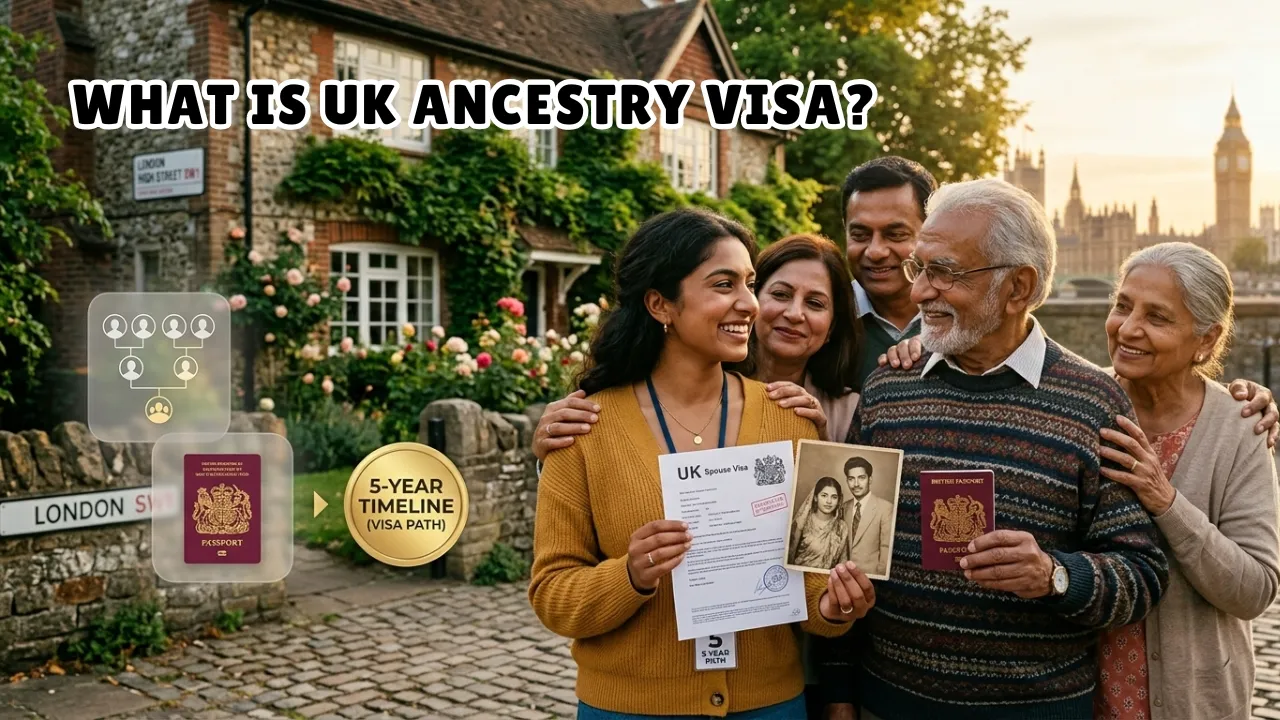

The UK Ancestry Visa is a five-year immigration route for Commonwealth citizens (and certain related categories) aged 17 or over who can prove that at least one grandparent was born in the UK, the Channel Islands, the Isle of Man, or in what is now the Republic of Ireland before 31 March 1922. It allows the holder to live, work and study in the UK without a sponsor and leads to indefinite leave to remain after five years if the requirements are met.
The route is straightforward in theory. In practice, the evidence of the grandparent connection and the documentary trail often cause problems. The visa itself is simple. The family history is not always.
What Is UK Ancestry Visa?
The UK Ancestry Visa is a family-descent route that gives eligible Commonwealth citizens the right to live and work in the UK for five years. It is not points-based and does not require a job offer or employer sponsorship. The core requirement is ancestry, not employment.
The visa is granted for five years. It can be extended, but most people use it as a direct path to settlement. After five years of continuous residence, an applicant can apply for indefinite leave to remain if the other requirements are met.
It is one of the few routes that combines open work rights with a clear settlement path and no salary threshold. For those who qualify, it is often the most practical option.
UK Ancestry Visa Requirements
The requirements for UK Ancestry Visa applications are specific. All must be met.
(i) Nationality and age
- Applicant must be a Commonwealth citizen, British overseas citizen, British overseas territories citizen, British national (overseas) or a citizen of Zimbabwe.
- Applicant must be aged 17 or over at the time of application.
- Applicant must be able to show they intend to work in the UK.
Commonwealth citizenship is the gateway. Without it, the route is not available, even with a UK-born grandparent. Dual nationality is fine as long as one nationality is from a qualifying category.
(ii) Grandparent connection
- At least one grandparent must have been born in the UK, the Channel Islands or the Isle of Man.
- A grandparent born in what is now the Republic of Ireland before 31 March 1922 also qualifies.
- A grandparent born on a UK-registered ship or aircraft, or on a ship or aircraft belonging to the UK government, can also count.
- The grandparent must be a biological or legally adopted grandparent.
The birth location matters. A grandparent born in Southern Ireland after 31 March 1922 does not qualify under the Ireland rule. The UK, Channel Islands and Isle of Man rule has no date cut-off.
(iii) Work and maintenance
- Applicant must intend to work in the UK.
- Applicant must be able to support and accommodate themselves and any dependants without relying on public funds.
- There is no fixed minimum income threshold, but adequate maintenance must be shown.
This is not a Skilled Worker-style financial test. The focus is on credibility and ability to maintain, not on hitting a specific salary figure.
How to Qualify for UK Ancestry Visa?
To qualify, an applicant must tie together nationality, age, ancestry and intention to work. The ancestry piece is usually the hardest part.
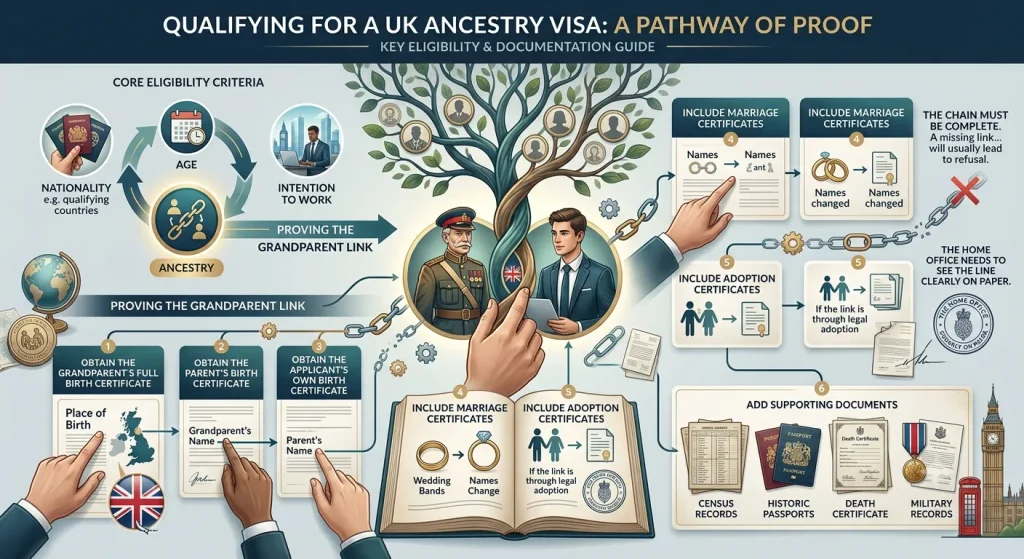
Proving the grandparent link:
- Obtain the grandparent full birth certificate showing place of birth.
- Obtain the parent birth certificate showing the grandparent name.
- Obtain the applicant own birth certificate showing the parent name.
- Provide marriage certificates where names have changed.
- Include adoption certificates if the link is through legal adoption.
- Add any supporting documents: census records, passports, death certificates, military records.
The chain must be complete. A missing link between grandparent, parent and applicant will usually lead to refusal. The Home Office needs to see the line clearly on paper.
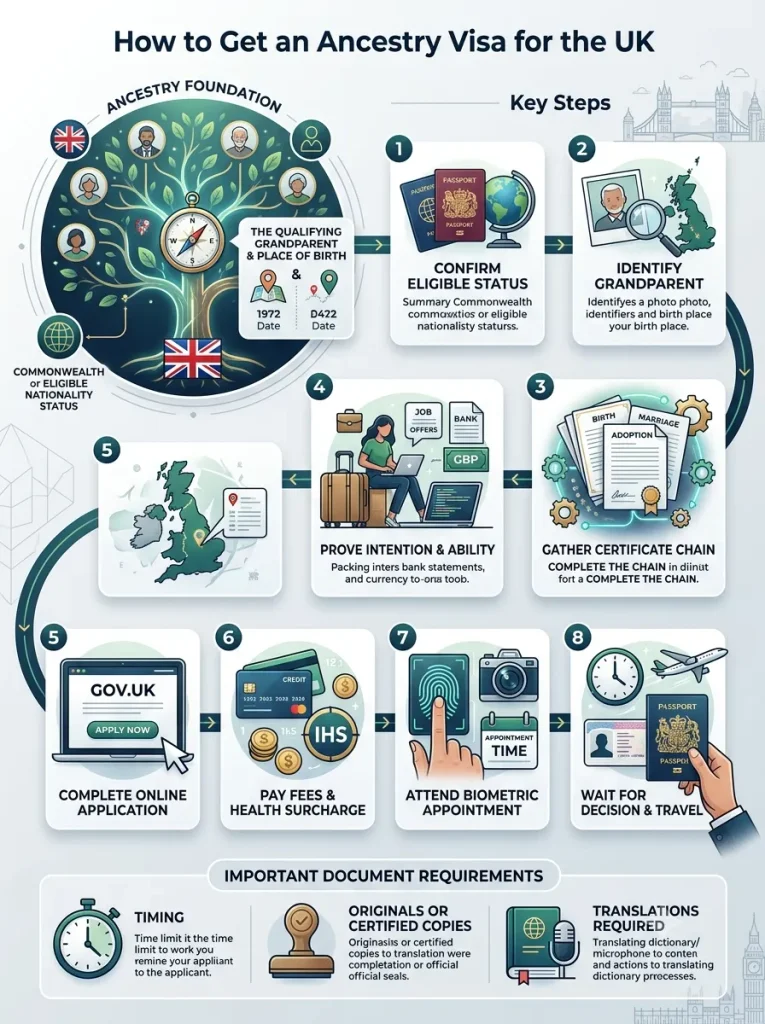
How to Get an Ancestry Visa for the UK
The process is standard entry clearance, but with extra focus on the family documents.
Key steps:
- Confirm Commonwealth or eligible nationality status.
- Identify the qualifying grandparent and their place of birth.
- Gather the full birth, marriage and adoption certificate chain.
- Prepare evidence of intention and ability to work and maintain in the UK.
- Complete the online UK Ancestry Visa application.
- Pay the application fee and Immigration Health Surcharge.
- Attend a biometric appointment and submit supporting documents.
- Wait for the decision and travel to the UK once the visa is granted.
Timing is important. Documents must be originals or certified copies. Translations are required for any document not in English or Welsh.
How Much Does a UK Ancestry Visa Cost?
The UK Ancestry Visa cost has two main parts: the Home Office application fee and the Immigration Health Surcharge (IHS).
Current fees (2026)
- Application fee from outside the UK: £726.
- IHS: £1,035 per adult per year.
- For a five-year visa, total IHS for an adult is £5,175.
- Total typical cost for one adult: around £5,901.
Dependants pay the same application fee and a reduced IHS rate for children (£776 per year). The total cost for a family can be significantly higher. These figures can change with fee updates.
What Tier Is a UK Ancestry Visa?
The UK Ancestry Visa is not part of the old Tier system. It is a standalone route under Appendix UK Ancestry of the Immigration Rules. It is not Tier 1, Tier 2 or any other active tier category.
People still ask what tier it belongs to because of older terminology. The answer is simple: none. It is its own route, based on ancestry rather than points or sponsorship.
What Documents Are Required for UK Ancestry Visa?
The document list is focused on ancestry, nationality and maintenance.
Core documents:
- Valid passport or travel document.
- Evidence of Commonwealth or eligible nationality (passport, nationality certificate).
- Full birth certificates for applicant, parent and grandparent showing the family link.
- Marriage certificates where surnames have changed.
- Adoption certificates if the link is through adoption.
- Evidence of intention and ability to work and maintain in the UK.
- TB test certificate if required for the country of residence.
The grandparent birth certificate is the key document. Without it, the application usually fails. Other records can support, but they rarely replace it.
What Happens When My UK Ancestry Visa Expires?
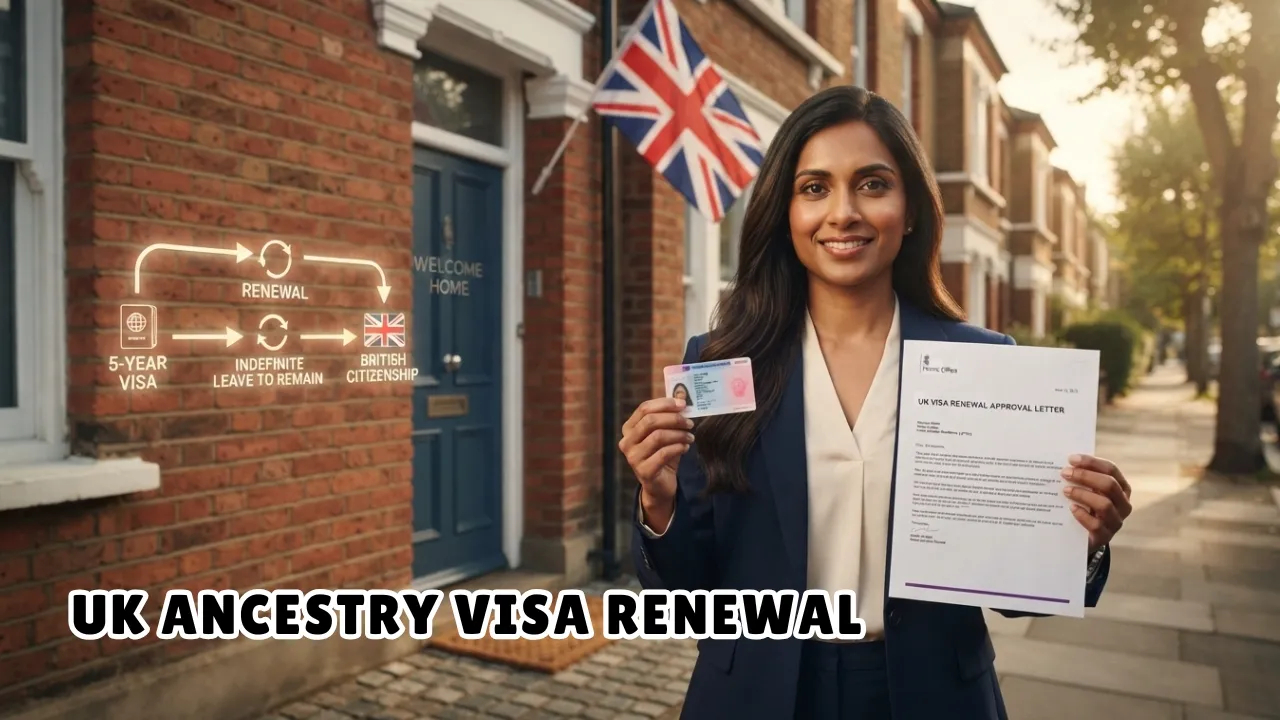
When the UK Ancestry Visa expires, the holder must either apply for indefinite leave to remain (if eligible) or apply to extend their Ancestry permission. Staying beyond the expiry date without valid permission leads to overstaying and can damage future applications.
Options at expiry:
- Apply for ILR after five years of continuous residence, if all settlement requirements are met.
- Apply to extend the Ancestry visa for a further five years if ILR is not yet possible.
- Switch to another eligible route, such as a work or family visa, if the criteria are met.
- Leave the UK before the visa expires if no further stay is planned.
Most applicants aim for ILR at the five-year point. The absence limit is normally no more than 180 days in any 12-month period during the five years. The Life in the UK test and English language at B1 are also required for settlement.
UK Ancestry Visa and Settlement
The UK Ancestry Visa is a direct route to settlement. After five years of continuous residence, an applicant can apply for indefinite leave to remain if they meet the requirements.
ILR requirements:
- Five years continuous residence on the Ancestry route.
- No more than 180 days outside the UK in any 12-month period during those five years.
- Pass the Life in the UK test.
- Meet the English language requirement at B1 level (unless exempt).
- Show ongoing intention and ability to work and maintain without public funds.
After ILR, British citizenship may be possible after 12 months, subject to the usual residence and good character requirements. The Ancestry route is one of the clearest paths to citizenship for eligible Commonwealth citizens.
Comparison: UK Ancestry Visa vs Other Routes
The Ancestry Visa for UK is often compared with work and family routes. It is different in structure.
| Feature | UK Ancestry Visa | Skilled Worker Visa | Family Partner Visa |
|---|---|---|---|
| Basis of eligibility | Grandparent born in UK/Islands/Ireland before 1922 | Sponsored job with licensed employer | Relationship with British/settled partner |
| Nationality requirement | Commonwealth or related categories only | Any nationality | Any nationality |
| Job offer required | No | Yes | No |
| Salary threshold | No | Yes | Yes (financial requirement) |
| Visa length | 5 years | Up to 5 years per grant | 33 months initially from outside UK |
| Path to ILR | Yes, after 5 years | Yes, after 5 years | Yes, after 5 years |
For those who qualify, the Ancestry Visa is usually the simplest and most flexible option. No sponsor, no salary threshold, open work rights. The barrier is ancestry, not employment.
Common Mistakes and Misunderstandings
- Assuming any UK-born grandparent qualifies without checking the Ireland date rule.
- Missing part of the birth certificate chain between grandparent, parent and applicant.
- Using non-certified copies or unofficial records as the main evidence.
- Overlooking the Commonwealth nationality requirement.
- Failing to show intention and ability to work and maintain.
- Assuming the visa automatically leads to ILR without meeting absence and other rules.
- Overstaying after the visa expires instead of applying in time.
Most refusals are document-driven. The rules are clear. The evidence must simply be complete and credible.
Conclusion
The UK Ancestry Visa is a five-year route for Commonwealth citizens with a qualifying grandparent connection to the UK. It allows open work and study rights, requires no sponsor and leads to indefinite leave to remain after five years.
Eligibility depends on nationality, age, a provable grandparent link and the ability to maintain without public funds. The cost is around £5,901 for a single adult, including the application fee and IHS.
For those who qualify, it is often the most straightforward path to living and working in the UK long term. The key is careful preparation of the family documents and timely applications for ILR before the visa expires.
Disclaimer:
UK Visa Consultant is affiliated with regulated immigration professionals with years of hands-on experience in successful UK visa applications. We closely monitor UKVI/Home Office updates and use only official guidance and sources. The information provided in this blog is subject to change depending on UK immigration laws and policies. It is recommended to stay updated regarding such changes and confirm the details through an official source before proceeding further. Our priority is unwavering accuracy and user trust. Here’s how you can maximize your success:
- Always rely on updates from the UK Government, the Home Office, and regulated immigration advisors.
- Keep up with the latest changes (e.g., digital eVisas, new sponsor requirements, post-Brexit rules).
- If in doubt, consult directly with an accredited UK immigration solicitor or OISC advisor.
- Ensure documentation, financials, and employment/education offers are fully compliant.
- Avoid scams and unregulated agents—your application’s credibility is paramount.
- Our consultants undergo regular professional development, maintain GDPR-compliant data handling, and provide transparent, ethical advice.




Leave a Reply
You must be logged in to post a comment.