




If you’ve spent any time googling your way through the UK’s temporary work visa system, you’ll know the feeling. Ten tabs open. Three different fee figures. A GOV.UK page that tells you almost nothing, and a forum post from 2021 that tells you far too much of the wrong thing.
I’ve spent more than a decade advising both employers and individual applicants on UK work visas, and the Temporary Work category is, honestly, one of the messier corners of the Immigration Rules. Not because it’s complicated exactly — once you see the shape of it, it’s fairly logical — but because it used to be called “Tier 5”, half the internet still calls it that, and none of the routes lead anywhere permanent. That last point genuinely surprises most people I speak to.
This guide sets out, what a UK temporary work visa actually is, which route might apply to you, what sponsors and applicants both need in place, and — the bit people usually skip past — what happens, and doesn’t happen, once your time runs out.
What Is a Temporary Work Visa in the UK?
A UK temporary work visa is permission to come to, or remain in, the UK to do a specific job, placement or programme of work for a fixed period, sponsored by an organisation holding a Home Office sponsor licence. It sits under Appendix Temporary Work of the Immigration Rules and it isn’t really one visa at all. It’s a family of routes, each built for a different kind of temporary activity.
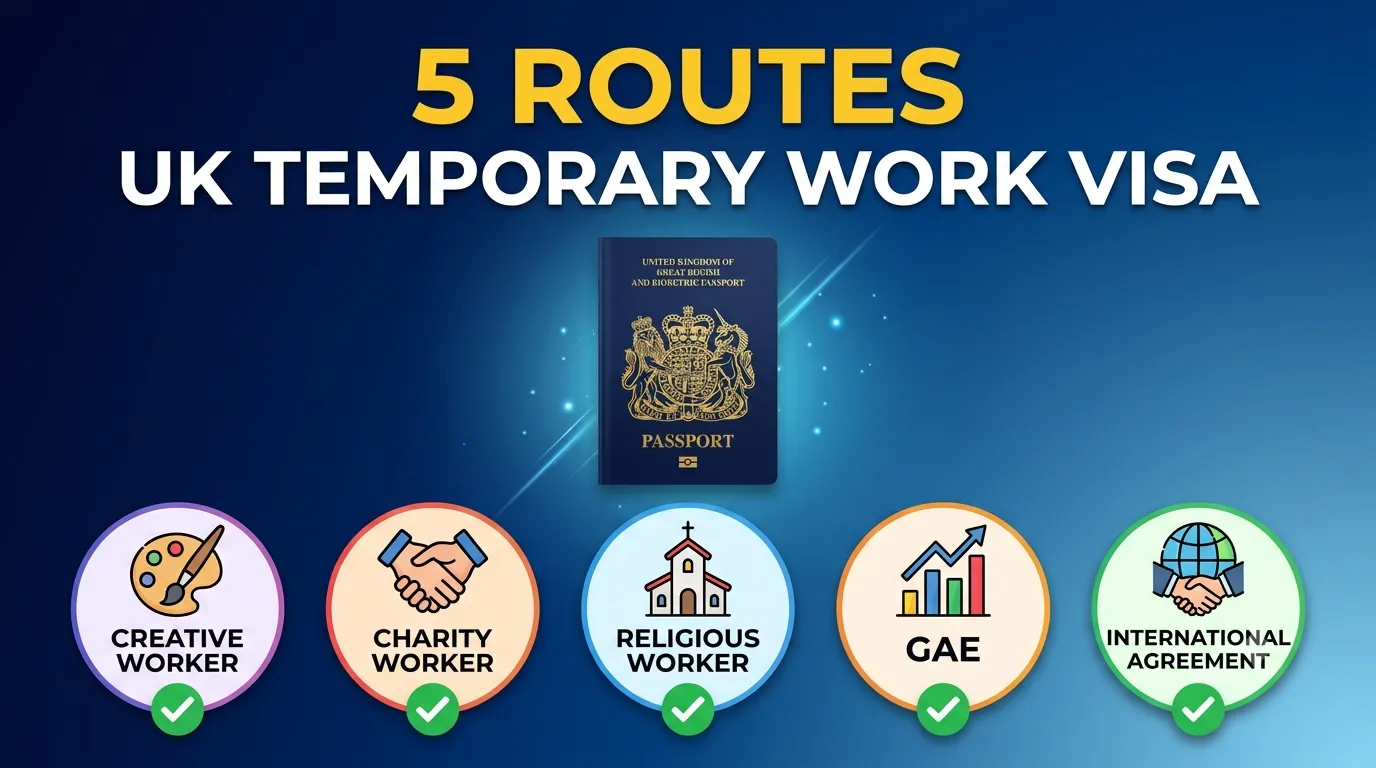
The routes for temporary worker visas, currently open are:
- Creative Worker visa
- Charity Worker visa
- Religious Worker visa
- Government Authorised Exchange (GAE) visa
- International Agreement visa
- Seasonal Worker visa
There’s also the Youth Mobility Scheme, which sits in the same family historically but works differently — no sponsor is needed, and it’s nationality and age based rather than job based. I’ll come back to that separately.
UK Temporary Work Visa List: The Six Routes for Temporary Worker Visas Explained
1. Creative Worker Visa
This is the route for performers, actors, dancers, musicians, film crew and other creative professionals coming to work for a UK sponsor. It replaced the old Tier 5 Creative and Sporting route back in October 2021, though the work itself hasn’t really changed.
- Duration: up to 12 months, extendable to a maximum of 24 months if you’re staying with the same sponsor.
- Salary: must meet the rate set by the relevant industry body — usually Equity, PACT or BECTU, depending on the sector.
- Supplementary work: up to 20 hours a week in the same sector and level, or in a role on the Immigration Salary List, is generally permitted.
- Short engagements: touring performers with a single sponsor (an agent, say) and gaps of no more than 14 calendar days between bookings can often be covered by one Certificate of Sponsorship rather than several.
2. Charity Worker Visa
Strictly for unpaid voluntary fieldwork that directly advances a charity’s charitable purpose. Not paid volunteering — genuinely unpaid, beyond reasonable expenses such as accommodation and travel.
- Duration: up to 12 months, or the length of the Certificate of Sponsorship plus a short grace period, whichever is shorter.
- Sponsor requirement: only charities with A-rated sponsor status can issue a Certificate of Sponsorship on this route.
- Age: applicants must be 18 or over on the date of application.
- Cooling-off period: you can’t apply for entry clearance on this route (or the Religious Worker route) if you held permission on either in the 12 months before applying — unless you weren’t in the UK at all during that window.
A word of caution here, because I see it trip people up constantly: this route cannot be used to fill what would otherwise be a paid position, even temporarily. If the role looks and functions like a job, the Home Office will treat it as one, and refuse on that basis.
3. Religious Worker Visa
For those coming to undertake religious work in a non-pastoral capacity, or as part of a religious order — supporting activities rather than leading a congregation, performing rites or preaching, which instead fall under the separate Minister of Religion route.
- Duration: up to 24 months.
- Pay: some religious workers may be exempt from the National Minimum Wage under Section 44A of the National Minimum Wage Act 1998, depending on the nature of the role.
- Shares the same 12-month cooling-off period as the Charity Worker route.
4. Government Authorised Exchange (GAE) Visa
This one’s for approved exchange schemes — work experience, job shadowing, training, an Overseas Government Language Programme, research, or a fellowship. The whole point of the route is sharing knowledge and best practice, not filling job vacancies.
- Duration: 12 or 24 months depending on the scheme; work experience specifically is capped at 12 months.
- Sponsorship: individual employers cannot sponsor on this route directly, even if they hold a licence in another category. Sponsorship sits with an approved scheme operator.
- This route explicitly cannot be used to bring in unskilled labour or fill ordinary vacancies — it exists for structured, time-limited exchange.
5. International Agreement Visa
For people whose work in the UK is governed by international law or a treaty. Three broad groups fall under this route: employees of overseas governments and international organisations, private servants in diplomatic households, and contractual service suppliers or independent professionals delivering a contracted service.
- Foreign government employees and diplomatic household staff: up to 2 years, with some private servant cases permitted longer, up to a maximum of 5 years.
- Contractual service suppliers under the UK-EU Trade and Cooperation Agreement: up to 6 months in any 12.
- Under the UK-Swiss services mobility agreement: 12 months in any 24.
- Private servants in diplomatic households applying from overseas generally need to demonstrate English language ability at CEFR level B1.
6. Seasonal Worker Visa
The horticulture and poultry route — picking, planting, packing, and the winter poultry surge. Capped at 6 months (or a defined seasonal window for poultry work), and quite deliberately not designed with any long-term future in mind.
UK Temporary Work Visa Requirements
The specifics vary route by route, but there’s a common backbone running through all of them. In my experience, applications fail far more often on these basics than on anything exotic.
- A valid Certificate of Sponsorship (CoS) from a sponsor licensed for the correct route — a Temporary Worker licence is entirely separate from a Skilled Worker licence, so double-check the sponsor holds the right one.
- A genuine role or placement that fits the definitions of that specific route — this is where refusals often happen, particularly on Charity Worker and GAE applications.
- Financial requirement: broadly £1,270 held for 28 consecutive days, though this is frequently waived where an A-rated sponsor certifies maintenance on the CoS, or where the applicant has held valid UK leave for 12 months or more.
- Suitability requirements — criminal record and immigration history checks, as with any UK visa.
- A TB certificate, where the applicant is coming from a country on the Home Office’s listed list.
- No general English language test on most routes — the notable exception being private servants under the International Agreement route applying from outside the UK.
Fees and thresholds on these routes have moved more than once over the past couple of years, and I’d be doing you a disservice pretending otherwise. Always verify the current fee on GOV.UK before you budget for an application — don’t rely on a figure you read somewhere six months ago. Mine included.
UK Temporary Work Visa: Typical Costs at a Glance
| Item | Typical Cost | Notes |
| Visa application fee | Approx. £319–£340 | Varies by route and date; check GOV.UK for the current figure |
| Immigration Health Surcharge | £1,035 per year (adult) | £776 per year for under-18s; paid upfront for the visa’s duration |
| Priority service | From around £500 | Optional; faster decision where available |
| Sponsor licence application | From £536 | Paid by the sponsoring organisation, not the worker |
What Happened to “Tier 5” Temporary Worker Visa?
Short answer: it’s a naming convention now, not a live legal category. Since 11 October 2021, the former Tier 5 (Temporary Worker) routes were rebranded as Temporary Work – Creative Worker, Charity Worker, Religious Worker, Government Authorised Exchange, International Agreement and Seasonal Worker. The visas themselves still exist. The label just changed.
Why does this matter? Because a lot of old guidance, forum threads and even some sponsor paperwork still says “Tier 5”, and applicants understandably get confused about whether it’s still valid. It is — just under new names. If someone tells you Tier 5 has been scrapped, they’re only half right.
How to Apply for a Temporary Work Visa in the UK?
The mechanics are broadly the same across routes, even though the underlying rules differ enormously. Here’s the sequence I take clients through:
- Confirm the correct route. This sounds obvious. It isn’t always — Charity Worker and GAE get confused constantly, and the wrong choice means a wasted application fee.
- Your sponsor secures (or confirms it already holds) the correct sponsor licence for that route, and assigns you a Certificate of Sponsorship.
- Gather your documents — passport, CoS reference number, proof of funds (if not certified by the sponsor), and a TB certificate if required.
- Submit your application online via GOV.UK. You can generally apply up to 3 months before your intended start date.
- Pay the visa fee and, in almost all cases, the Immigration Health Surcharge.
- Attend a biometric appointment — usually at a Visa Application Centre if you’re applying from overseas.
- Wait for a decision, and don’t book non-refundable travel until you have one.
One thing worth saying plainly: a sponsor licence application, if your prospective employer doesn’t already hold one, typically takes around eight weeks for standard processing. That timeline runs before any of the above steps can even start. Build it into your planning early, not as an afterthought.
UK Temporary Work Visa Processing Time: How Long Does It Take?
For applications made from outside the UK, most decisions come through within around three weeks of the biometric appointment. In-country applications tend to run longer — often up to eight weeks, sometimes more depending on volumes. Priority and super-priority services can shorten this considerably where they’re available in your country, at additional cost.
These are typical figures, not guarantees. Processing times move with Home Office caseload, so treat them as a planning estimate rather than a promise.
UK Temporary Work Visa for Indian Nationals: What’s Different?
There’s no separate “Indian” version of the Temporary Work visa for UK — Indian applicants use exactly the same six routes as everyone else, through the same Certificate of Sponsorship process. In practice, the routes I see used most by Indian nationals are the Government Authorised Exchange visa (research fellowships, training placements) and, less commonly, the International Agreement route for contractual service suppliers.
The one India-specific quirk worth knowing is the Youth Mobility Scheme, which — unlike the sponsored Temporary Work routes — operates a ballot for Indian applicants, with 3,000 places allocated annually. You need to win a place in the ballot before you can even submit a visa application. Applicants from India typically attend a VFS Global centre for biometric enrolment as part of any of these applications.
UK Temporary Work Visa: Working Restrictions and Supplementary Employment
Every Temporary Work visa comes with conditions attached, and breaching them is taken seriously — a sponsor can lose its licence, and a worker can be curtailed or refused future applications.
- You can only work in the role described on your Certificate of Sponsorship, for the sponsor named on it (with limited scheme-based exceptions on GAE and Seasonal Worker routes).
- Supplementary employment — a genuine second job — is permitted on several routes for up to 20 hours a week, provided it’s in the same sector and at the same professional level, or on the Immigration Salary List.
- Self-employment and setting up a business are not permitted.
- Permanent employment is not permitted, whatever the route — these are, by definition, temporary.
- No access to public funds, at any point during your stay.
Overstaying warning: staying beyond your visa’s expiry, even briefly, can trigger a re-entry ban of 12 months if you leave voluntarily within the stated grace period, rising to several years — potentially up to 10 — if you’re removed by enforcement action. It also affects future applications for years afterwards, since you’ll be asked to declare any previous overstay. Don’t let a visa run out “just to sort a few things”. Apply to extend or switch before expiry, not after.
UK Temporary Work Visa Dependants: Can Your Family Join You?
Yes, on most — but not all — of these routes. Partners and children under 18 can generally apply as dependants on the Creative Worker, Charity Worker, Religious Worker, Government Authorised Exchange, and (in most cases) International Agreement visas, provided the relationship and financial requirements are met.
- The Seasonal Worker visa does not permit dependants, under any circumstances.
- Private servants in diplomatic households under the International Agreement route generally cannot bring dependants either, given the household-based nature of the arrangement.
- The Youth Mobility Scheme does not allow dependants at all.
- Each dependant pays their own visa fee and IHS, and must separately meet the financial requirement — typically £285 for a partner, £315 for a first child, and £200 for each additional child, held for 28 days, unless the sponsor’s certification covers this.
- Dependants can usually work full time in almost any role — including paid work — without the restrictions that apply to the main applicant, though professional sportsperson or sports coaching roles are typically excluded.
UK Temporary Work Visa Switching Rules: Can You Change Routes?
This is genuinely one of the more inconsistent corners of the Rules, and it has shifted with recent Statements of Changes, so treat anything you read — including this — as a starting point for a proper conversation with a solicitor, not a final answer.
As a general position: switching into most Temporary Work routes from within the UK on a visit visa isn’t possible — you’ll usually need to apply from overseas. Switching out of Temporary Work into a settlement-track route, most commonly Skilled Worker, is often possible from within the UK where the applicant meets that route’s own salary, skill-level and English language requirements, and the sponsor holds an appropriate licence. Some routes, however, impose tighter restrictions on in-country switching than others, and the position can differ depending on which sub-category you’re on.
Do not assume you can switch freely just because a friend, or a firm’s blog post, tells you it worked for them. Rules move. Get it checked against the current version of the Rules before you make a decision that hinges on it.
UK Temporary Work Visa Settlement: The Path That Isn’t There
Here’s the point that catches people out more than any other, and I say this to almost every client who comes to me on one of these routes: none of the Temporary Work visas lead to settlement. Not Creative Worker, not Charity Worker, not Religious Worker, not GAE, not International Agreement, not Seasonal Worker. Time spent on any of them does not count towards the 5-year continuous residence period required for Indefinite Leave to Remain (ILR), no matter how many times you extend or renew.
If settlement is your long-term goal, you need to switch — before your temporary leave runs out — to a route that does lead there. Skilled Worker is the most common bridge, provided you meet its salary threshold, occupation code and English requirements. Family routes may apply in some circumstances too. The ILR clock starts fresh from the date of that new grant, not from whenever you first arrived on a Temporary Work visa.
It’s a hard truth, but better to hear it now than three years into a Charity Worker visa when someone assumes, wrongly, that years add up towards something permanent. They don’t.
Frequently Asked Questions (FAQs)
Q. What is a temporary work visa in the UK?
It’s sponsored permission to work in the UK in a specific role, placement or exchange programme for a fixed period — covering the Creative Worker, Charity Worker, Religious Worker, Government Authorised Exchange, International Agreement and Seasonal Worker routes.
Q. Is the UK temporary work visa still called Tier 5?
Not officially, since October 2021, though the term is still used informally and in some older sponsor documentation.
Q. Can I bring my family on a UK temporary work visa?
On most routes, yes — partners and children can apply as dependants, subject to relationship and financial requirements. Seasonal Worker and the Youth Mobility Scheme are the main exceptions.
Q. Does a temporary work visa lead to permanent residency?
No. None of these routes count towards Indefinite Leave to Remain. You’ll need to switch to a settlement-track route such as Skilled Worker before your temporary leave expires.
Q. How long does a UK temporary work visa application take?
Typically around three weeks from overseas, and up to eight weeks or more for in-country applications, though this varies with Home Office caseload.
Final Words
Temporary Work visas do exactly what the name says — they’re temporary. That’s not a criticism of the system; some of these routes exist precisely because the activity involved (a touring performance, a short exchange fellowship, a season of fruit picking) genuinely is short-term. The mistake I see most often isn’t picking the wrong route. It’s assuming a short-term visa will somehow become a long-term one without a deliberate switch, application and plan behind it.
If you’re weighing up which route fits your circumstances, or you’re an employer trying to work out whether you need a Temporary Worker licence alongside your Skilled Worker one, get advice before you commit to a Certificate of Sponsorship. Refusals on these routes are often avoidable — and usually come down to details that a specialist would have caught early.
This article is provided for general information purposes only and does not constitute legal advice. Immigration Rules change frequently — always confirm current requirements, fees and processing times on GOV.UK or with a qualified immigration solicitor before making an application.
Disclaimer:
UK Visa Consultant is affiliated with regulated immigration professionals with years of hands-on experience in successful UK visa applications. We closely monitor UKVI/Home Office updates and use only official guidance and sources. The information provided in this blog is subject to change depending on UK immigration laws and policies. It is recommended to stay updated regarding such changes and confirm the details through an official source before proceeding further. Our priority is unwavering accuracy and user trust. Here’s how you can maximize your success:
- Always rely on updates from the UK Government, the Home Office, and regulated immigration advisors.
- Keep up with the latest changes (e.g., digital eVisas, new sponsor requirements, post-Brexit rules).
- If in doubt, consult directly with an accredited UK immigration solicitor or OISC advisor.
- Ensure documentation, financials, and employment/education offers are fully compliant.
- Avoid scams and unregulated agents—your application’s credibility is paramount.
- Our consultants undergo regular professional development, maintain GDPR-compliant data handling, and provide transparent, ethical advice.






Leave a Reply
You must be logged in to post a comment.